
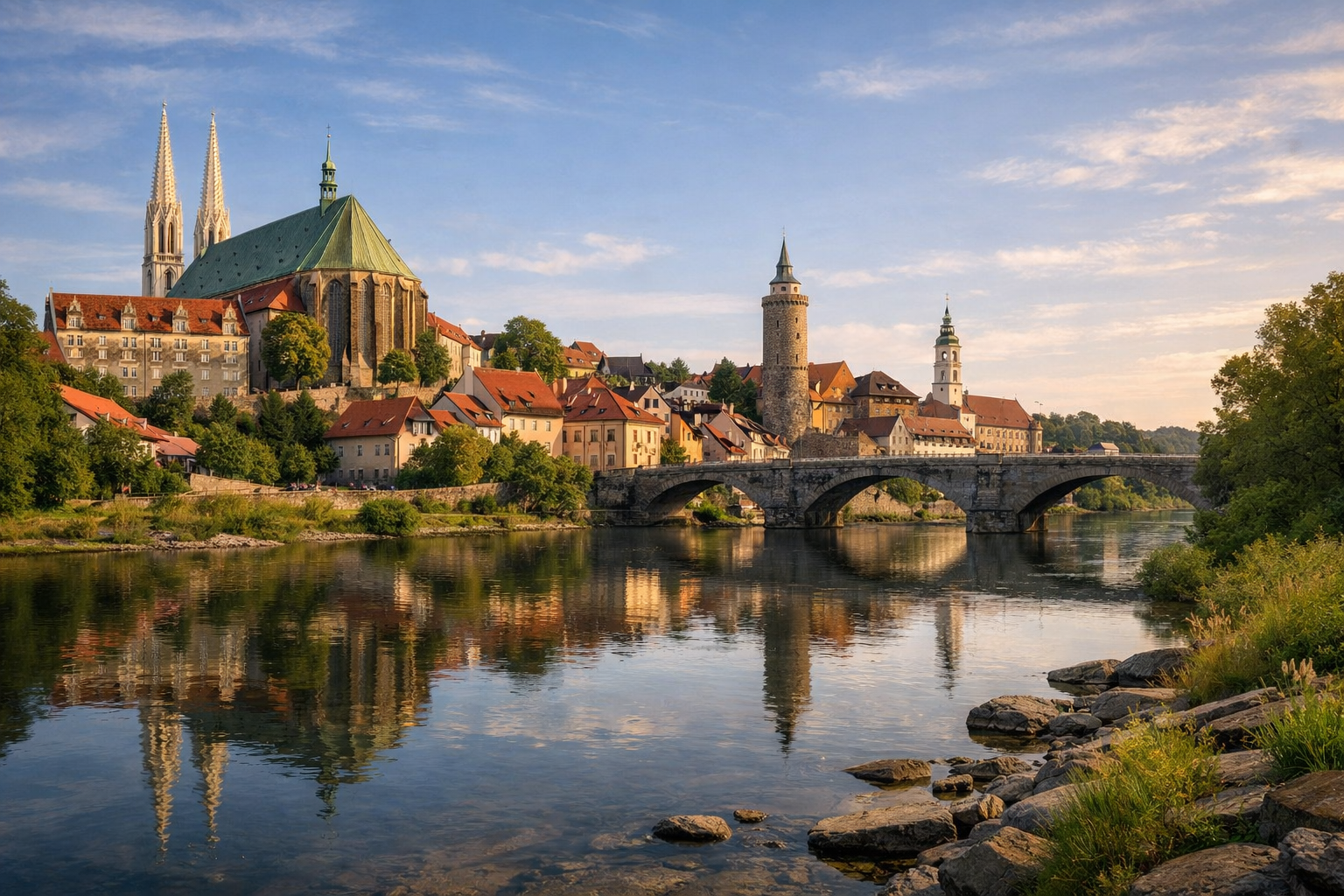
Day 1 — Görlitz: Untermarkt, the town hall, and the grand canvas of the old town
🚆 It is best to plan your arrival in Görlitz for the morning. From the railway station, you can reach the historic center by tram in just a few minutes or walk there in about 15–20 minutes, so the day can realistically begin without rushing or unnecessary transfers. If you are coming from Berlin, the faster rail routes take about 2 hours 56 minutes; from Dresden Airport, the train journey usually takes around 1 hour 30–1 hour 55 minutes depending on the connection. After check-in, give yourself 30–40 minutes to catch your breath and only then head into the old town — Görlitz is at its best in an unhurried rhythm.
🚶 The first day is best devoted to the very heart of Görlitz — the Altstadt, one of the most cohesively preserved historic centers in Germany. The city stands on the Neisse River by the Polish border and creates an almost theatrical impression: late Gothic, Renaissance, Baroque, Art Nouveau, and 19th-century bourgeois urban architecture seem layered here one upon another. The streets do not feel like “museum scenery” in the bad sense — on the contrary, they have the living texture of a real old European city: stone arcades, facades with coats of arms, carved portals, inner courtyards, towers, rooflines, and that rare harmony of scale where almost every turn invites a long look. It is no coincidence that Görlitz is often called “Görliwood”: its architectural setting is so cinematic that the city has many times served as a location for international films.
🚶 Begin your walk at Untermarkt — the Lower Market, one of the most expressive urban spaces in Görlitz. It is here that the richness of local mercantile architecture is most visible: the famous hallenhäuser, warehouse houses, and merchants’ buildings with deep passageways and covered vestibules, born out of long-distance trade routes and gradually turned into the city’s architectural calling card. The square is framed by houses of very different character: in some places the facades are sternly Gothic, elsewhere confident Renaissance plasticity appears, and elsewhere the gentle elegance of late Baroque enters the scene. In the morning it is pleasant to walk slowly here, studying the details of cornices, vaults, and uneven cobblestones; in the middle of the day the square comes alive with cafés and the rare but very expressive voices of bells; by evening, the light falls on the facades so that the old stone seems to grow warm.
🚶 Near Untermarkt is the Görlitz town hall ensemble — the city’s most important focal point, where you especially feel that you are not simply in a beautiful town, but in a formerly wealthy center of crafts and trade. The town hall tower, historic buildings, and surrounding facades create a dense, almost stage-like perspective. It is worth lifting your gaze above the level of shop windows and signs: that is where the true language of the city opens up — the verticals of towers, the weight of old roofs, window rhythms, and the play of volumes that makes Görlitz feel astonishingly coherent. For this part of the route, it is good to allow at least 1.5–2 hours of pure walking without hurry, with short stops for coffee and photos.
🏛️ If you want to add a museum accent already on the first day, it is ideal to stop by Schlesisches Museum zu Görlitz in the Schönhof building at Brüderstraße 8. This is not just a museum “for the checklist,” but one of the key places for understanding the region: it presents the cultural history of Silesia in a European context, and Schönhof itself is considered one of the city’s most important Renaissance civic buildings. Even if you are not planning a long visit, simply entering this ensemble gives a very important sense of the scale and depth of the city’s history.
🚶 After the museum, continue along Brüderstraße, Neißstraße, and the adjoining lanes. It is here that Görlitz reveals itself as a city of details: in the stone portals you can read traces of merchant vanity and urban dignity, in the courtyards quiet transitions between eras are hidden, and almost every building reminds you that the city’s wealth was built over centuries. This part of the day is ideal for free wandering without a rigid plan: you can spend 2–3 hours simply strolling, entering archways and courtyards, looking toward views of the river, and studying facades. Görlitz is that rare city where “doing nothing, just walking” becomes a complete program in itself.
🌆 It makes sense to end the evening at Obermarkt — the Upper Market. Its atmosphere differs from Untermarkt: there is more air, the urban stage opens up more widely, and you feel a different scale and a different urban logic. After the tightly woven, precious medieval fabric of the lower part of the center, Obermarkt feels more open and ceremonial. This is especially beautiful at sunset: the facades catch soft light, the silhouettes of the towers become more expressive, and the whole city seems to shift from architectural study into romantic scenery. It is best to leave 1.5–2 hours for dinner and not rush anywhere else — Görlitz is especially good in the long evening, when the old town gradually grows quiet.