
Buy PDF guide

Buy PDF guide — 6.43 USD

PDF — 6.43 USD

SAXONY - Dresden: Zwinger, Frauenkirche, Elbe

SAXONY - Dresden: Zwinger, Frauenkirche, Elbe

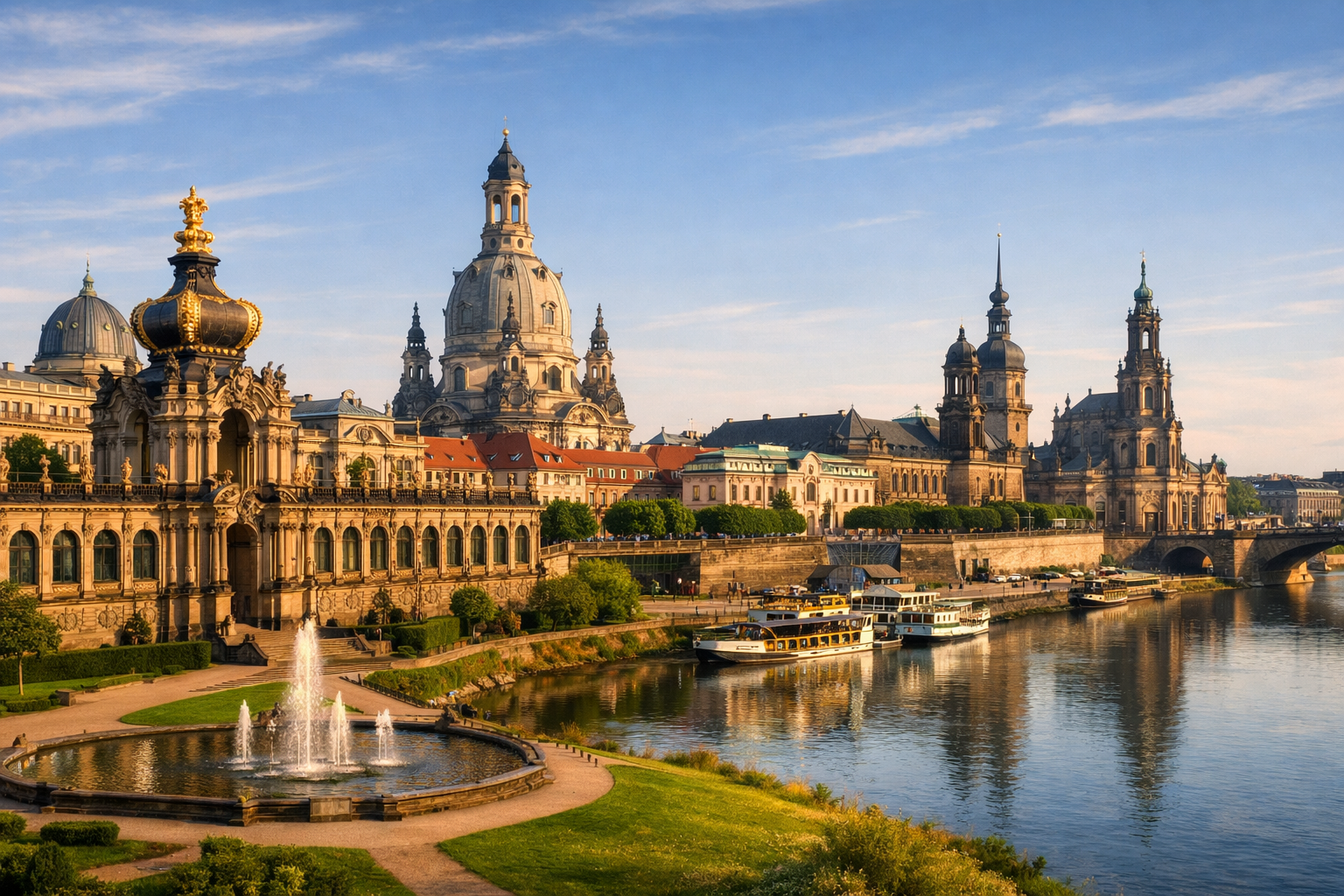
Saxony draws you into Dresden with the baroque splendor of the Zwinger and the soaring dome of the Frauenkirche. Along the Elbe, the city feels graceful and grand, with history and river views at every turn.

🧭 DAY-BY-DAY ITINERARY

Ready-made country and city routes with daily plans, sights, transport and accommodation. Buy PDF guides for independent travel.

🧭 DAY-BY-DAY ITINERARY


Day 1 — Dresden: the Zwinger and the heart of Baroque

  • 🚶 Begin your introduction to Dresden with the Zwinger — one of the most striking Baroque ensembles in Germany and the very architectural stage thanks to which the city is often called the “Florence on the Elbe.” This is not just a palace courtyard with pavilions and galleries, but a ceremonial space where every arch, every balustrade, and every sculpture seems designed for a slow walk and admiration of the details. The inner courtyard, fountains, and symmetry of the facades create the feeling of an open-air grand theater. It is especially nice to come here in the morning: the light falls softly on the stone, there are not yet so many tourists, and the Zwinger itself is perceived not as a museum “must-do,” but as a living setting of Saxon history. If you have the energy for the museum part, it makes sense to visit the Gemäldegalerie Alte Meister — this is where the works are kept that draw lovers of old European art to Dresden, and the visit pairs well with a leisurely walk around the complex.

  • 🚶 From the Zwinger it is easy to walk to Theaterplatz and the Semperoper, and then continue unhurriedly toward the Residenzschloss and the old center. This whole area is remarkably compact: between the main points of the route it is usually only 5–15 minutes on foot, so the day does not require tiring transfers and lets you experience the city at a comfortable pace. Allow 2–3 hours for the Zwinger and its surroundings, then take a break for coffee or an early lunch near Postplatz or around Schlossstraße. After lunch you can add a short visit to one of the nearby museums or simply devote time to looking at the architecture: in Dresden, Baroque works especially well at a slow pace, when the city reveals itself not through separate “checkmarks,” but as the cohesive atmosphere of the ceremonial capital of the former electorate.

  • 💤 Rhythm of the day: a walking route through the old town with short 5–15 minute stretches, a museum block of 2–3 hours, and a mandatory 45–60 minute rest break after lunch. This is a realistic and relaxed start that leaves you energy for an evening walk.


Day 2 — Dresden: Frauenkirche, Neumarkt, and dome panoramas

  • 🚶 Dedicate the second day to the Frauenkirche — the most emotional symbol of modern Dresden. Today this majestic church looks flawlessly whole, but its power lies not only in its beauty, but in its history of destruction and restoration. After the bombings of 1945, the ruins remained a war memorial for decades, and then the church was recreated anew, becoming a sign of reconciliation, memory, and urban rebirth. Approaching it from Neumarkt square, you notice how the dome literally gathers the whole district around itself: house facades, paving stones, café terraces, and flows of people all submit to this architectural center. Inside, the impression changes — instead of outward solemnity, there appears a bright, almost airy space with soft shades, elegant balconies, and very special acoustics. This is a place that is good not just to “see,” but truly to experience: sit silently for a few minutes, look upward, and give yourself time to feel the scale.

  • 🚶 If the weather is good and you want the best views of the old town, go up to the dome. The climb takes time and requires a calm pace, but the reward justifies the effort: from above, Dresden opens up as a complete panorama with the Elbe, Brühl’s Terrace, the tiled roofs of the old center, and green ribbons on the horizon. After visiting the Frauenkirche, it makes sense to leave time for Neumarkt itself and the neighboring streets: this is an area where rebuilt historic development creates a very pleasant urban environment — not a museum under glass, but a space for a walk, lunch, shop windows, coffee, and beautiful evening shots. From the Frauenkirche you can walk to the Albertinum in 10–15 minutes, and then continue to Brühlsche Terrasse. This route is convenient to build without rushing: church and dome in the morning, a 1-hour lunch break, then art and a panoramic walk along the embankment.

  • 🚶 In the evening, this area is especially lovely: when the flow of daytime excursions thins out, Neumarkt becomes softer and more romantic, and the Frauenkirche itself begins to look almost theatrical in the warm illumination. If the first day in Dresden shows the city as the capital of Baroque, then the second reveals it as a city of memory, music, and quiet urban dignity. This is an ideal day without complicated logistics: almost everything is done on foot, and the distances between points usually fit into 8–20 minutes.

Day 3 — Dresden: the Elbe, embankments, and a walk on the water

  • 🚶 Leave the third day for the Elbe — the river without which Dresden cannot be fully understood. It is precisely from the water and from the embankments that you can most clearly see how much this city is built on the play of panoramas: domes, towers, terraces, bridges, and palaces do not compete with one another, but come together into a unified line that looks solemn and highly cinematic. In the morning, you can walk along the embankment around Terrassenufer and Brühlsche Terrasse, then go down closer to the piers. Here Dresden seems lighter and more “airy” than in the depths of the old town: instead of a dense museum program, there are wide views, water, the movement of ships, and the feeling that the architecture has finally gained the distance it needs.

  • ⛴️ One of the best ways to end a short tour is to choose a boat trip on the Elbe. A short route under Dresden’s bridges or a ride toward the “Blue Wonder” lets you see the city from a new angle: from the deck, the silhouettes of the old center, the curves of the banks, and the calm, noble line of urban development are especially beautiful to read. This is not hurried transportation, but truly part of the experience, so it is worth allowing not only the time of the cruise itself, but also an extra 20–30 minutes before boarding and the same after — for waiting, boarding, and an unhurried disembarkation. In good weather, a river route pairs perfectly with lunch by the water or a long walk along the opposite bank for postcard views of the historic center.

  • 🚶 If you still have energy after the river trip, add Großer Garten — Dresden’s largest and best-loved park. This is already a different side of the city: not ceremonial and not museum-like, but green, relaxed, almost resort-like. Such a finale balances the route perfectly: after two days of Baroque, art, and architecture, there is finally space to exhale. In terms of timing, the day turns out very comfortable: walking stretches of 10–20 minutes, a river cruise of about 1.5–2 hours including boarding and waiting, and 1–2 hours of rest in a café or park. The result is an end to the trip without rush and with that very feeling that the city has managed not only to impress, but also to stay with you.

Flight tickets

eSIM for travel

Buy PDF guide

Buy PDF guide — 6.43 USD

PDF — 6.43 USD