
Buy PDF guide

Buy PDF guide — 6.43 USD

PDF — 6.43 USD

SAXONY-ANHALT - Castles and Monasteries of Saxony-Anhalt

SAXONY-ANHALT - Castles and Monasteries of Saxony-Anhalt

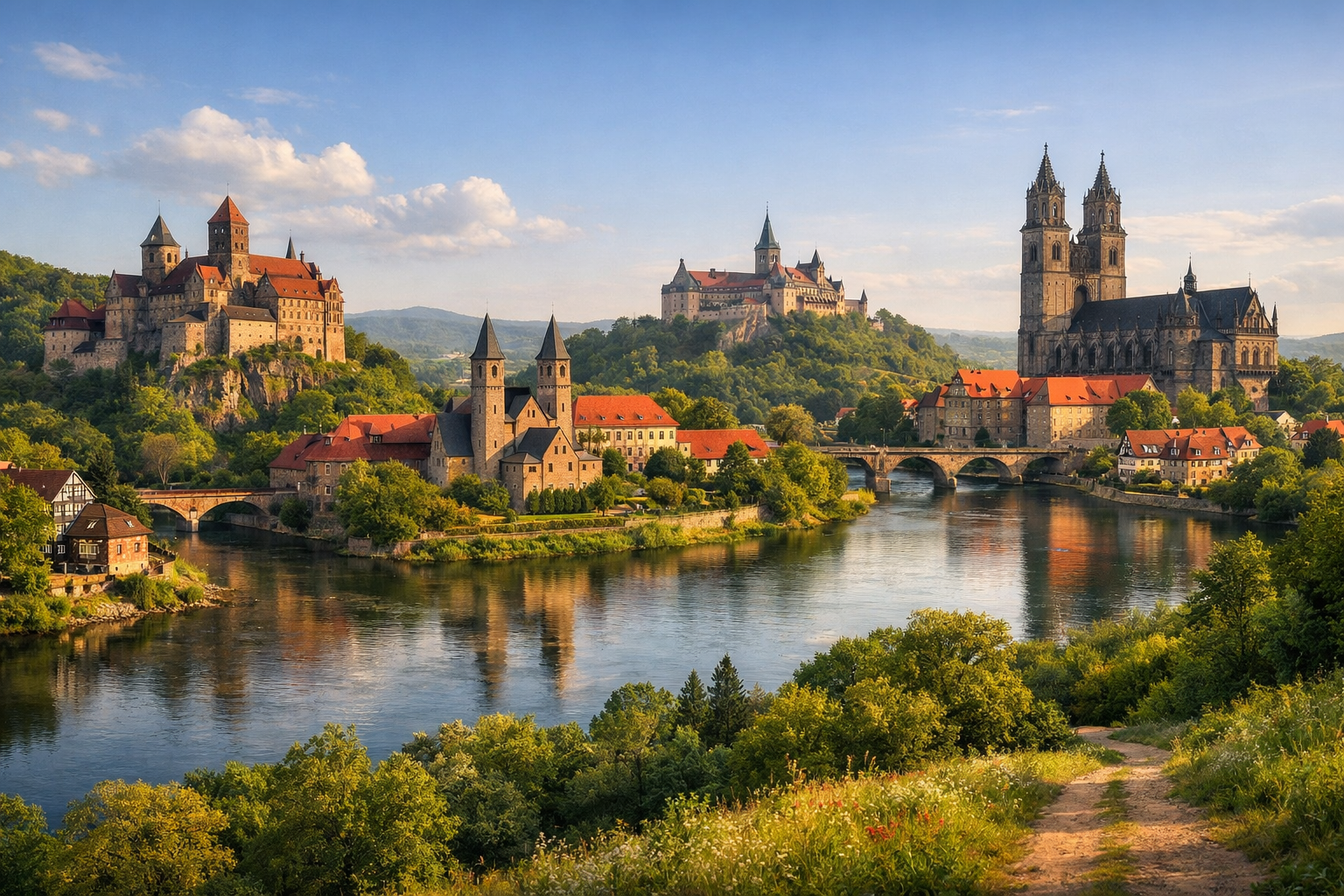
Saxony-Anhalt invites you into a landscape of storybook castles, Romanesque monasteries, and beautifully preserved medieval towns. From the half-timbered charm of Quedlinburg and Wernigerode to the grand cathedrals of Halberstadt and Naumburg, this route feels like a journey through Germany’s living history.

🧭 DAY-BY-DAY ITINERARY

Ready-made country and city routes with daily plans, sights, transport and accommodation. Buy PDF guides for independent travel.

🧭 DAY-BY-DAY ITINERARY


Day 1 — Quedlinburg and Wernigerode: imperial heritage and a fairytale castle

  • 🚆 Arrival at Leipzig/Halle Airport. The most realistic start for a short tour of western Saxony-Anhalt is to pick up a car at the airport or take regional trains toward the Harz. By car, the trip to Quedlinburg usually takes about 1 hr 45 min–2 hr 10 min, while public transport takes roughly 2 hr 40 min–3 hr 20 min with changes via Halle and the Halberstadt area. For a three-day route, a car gives much more freedom and keeps the trip from turning into a chain of transfers.

  • 🚶 Quedlinburg is one of those places where Germany feels not like an abstract “old Europe,” but like a living setting from the chronicles of the Holy Roman Empire. The town is famous for its ensemble of old town, castle hill, and the Collegiate Church of St. Servatius, all of which are listed as a UNESCO World Heritage Site. What is especially impressive here is how the architecture does not break apart into separate monuments, but comes together as a complete historical landscape: narrow streets, steep roofs, cobbled climbs, hundreds of half-timbered houses, and the Stiftsberg dominating it all. The climb to the church and former abbey should be planned without haste: this is not just a “photo spot,” but a place where you can literally feel the Ottonian era, early medieval power, and a sense of urban continuity that is rare in Europe. Even if the museum on the castle hill is operating partly on a modified schedule, the walk around Stiftsberg itself, the views over the tiled roofs and the old town make the first half of the day truly rewarding.

  • ☕ After climbing up to the Stiftskirche, allow at least 1–1.5 hours for a relaxed walk through the old center and a coffee break. Quedlinburg reveals itself best not as a “checklist stop,” but at a slow pace: the market square, half-timbered façades, archways of inner courtyards, and the gentle relief of the streets create the feeling of a town that is almost museum-like, yet still very much lived in. It is a great place for a late breakfast or an early lunch before the second half of the day.

  • 🚗 Transfer: Quedlinburg → Wernigerode — about 25–35 minutes by car. By train, once you include waiting and walking time, it is usually longer, so on a short route it is better to keep the day compact.

  • 🚶 Wernigerode is often called the “colorful town at the Harz,” and that is a very accurate description: it combines resort-like lightness, a mountain backdrop, and the almost theatrical beauty of a historic center. The main highlight of the day is Schloss Wernigerode, a striking castle high above the town. Its silhouette seems made for postcards: towers, crenellated lines, 19th-century romantic eclecticism, and a wide panorama over the red roofs of Wernigerode and the foothills of the Harz. Inside, the contrast is especially interesting between the fortress’s medieval roots and its later transformation into a representative residence, where the ceremonial interiors speak no longer of harsh defense, but of status, taste, and the palace rhythm of life. Even if you do not spend too much time inside the rooms, it is worth going up for the view alone: by late afternoon the light is softer here, and the town looks especially picturesque.

  • 🌿 If you still have energy left, end the day with a short walk toward Christianental, or simply head back down into Wernigerode’s old town. After a full first day, it is best not to overload the evening: dinner in the center and an overnight stay in Quedlinburg or Wernigerode will let you recover calmly before the monastery-focused route of the next day.


Day 2 — Blankenburg and Halberstadt: monastic silence and cathedral treasures

  • 🚗 Transfer: Quedlinburg/Wernigerode → Blankenburg — usually 20–35 minutes depending on your base. After yesterday’s active start, this day is best planned more gently, with fewer walking stretches and longer pauses inside the sites themselves.

  • 🚶 Kloster Michaelstein in Blankenburg is one of the most atmospheric monastic stops in the region. The former Cistercian monastery lies slightly away from the noise of town, and that is exactly what creates the right mood: people come here not only for the architecture, but also for the sense of silence, order, and composure that stood at the heart of monastic life for centuries. The complex is beautiful in its details — stone decoration, interior spaces, garden surroundings, and the neighboring Harz hills. This is a place best experienced slowly: a calm walk around the grounds, a short pause in the greenery, unhurried reading of the signs, and attention to the rhythm of the space itself make the visit much deeper than an ordinary “monastery tour.” If the weather is kind, Michaelstein is especially lovely in the morning, when the light is soft and the landscape around it looks almost like a watercolor.

  • 🍽️ After the monastery, it makes sense to plan a long lunch break — at least 1 hour. The day is built around serious historical sites, and rest here matters just as much as the logistics. On a short tour, it is exactly these pauses that keep the route from turning into a marathon.

  • 🚗 Transfer: Blankenburg → Halberstadt — about 25–35 minutes by car.

  • 🚶 Halberstadt Cathedral of St. Stephen and St. Sixtus, with its famous treasury, is one of the main reasons to come to Saxony-Anhalt specifically for church and monastic heritage. The cathedral itself is an outstanding work of Gothic architecture, but even more striking is the sense of historical density: this is not just a beautiful church, but a space where liturgical objects, reliquaries, textiles, sculpture, and the memory of medieval ceremony accumulated over centuries. The Domschatz of Halberstadt is considered one of Germany’s most significant ecclesiastical treasures, and it is here that you especially clearly understand that the sacred art of the Middle Ages was not a decorative backdrop, but part of a vast world of symbols, power, liturgy, and ideas of eternity. It is best to allow 2–2.5 hours for the cathedral and treasury, without trying to “rush through” everything in forty minutes.

  • 🌆 The evening in Halberstadt is best ended calmly: a short walk around Domplatz, an early dinner, and a return to your base. If you are staying overnight in Quedlinburg, the drive back takes about 20–30 minutes; if in Wernigerode, about 35–45 minutes. This rhythm preserves energy for the third day, when the route heads farther south toward Naumburg and its outstanding cathedral.

Day 3 — Naumburg: a UNESCO cathedral and the monastic landscape of Saale-Unstrut

  • 🚗 Transfer: Quedlinburg/Wernigerode → Naumburg — the longest stretch of the route. From Quedlinburg it is usually about 1 hr 50 min–2 hr 20 min by car, from Wernigerode around 2 hr 10 min–2 hr 40 min. So it is worth leaving earlier, around 8:00, to arrive at the cathedral by late morning and enjoy the main site without rushing.

  • 🚶 Naumburg Cathedral is the culmination of the entire three-day tour and one of the high points of medieval art in Germany. It is included on the UNESCO World Heritage list and is famous not only for its architecture, but also for the rare artistic power of its interior space. It is especially important here not to stop at the façade: the real magic begins inside, where late Romanesque and early Gothic forms combine with exceptional sculpture. The most famous donor figures, including Margravine Uta, make an almost hypnotic impression — this is no longer faceless “stone decoration,” but psychologically precise, astonishingly vivid images in which you can feel character, dignity, and inner composure. Naumburg Cathedral is perceived not as a large museum container, but as an entire world of a transitional era, when sacred art was becoming ever more human, yet without losing its spiritual force.

  • ⛪ After visiting the cathedral, it is worth leaving time for Domplatz itself and the adjoining historic streets. This is a good place to slow down, have lunch, and let the route find its natural closing rhythm. If you go without haste, it is wise to allow at least 3 hours for Naumburg Cathedral and the town center.

  • 🚗 A short drive out to Kloster Pforta near Bad Kösen is a fitting conclusion to the theme of “castles and monasteries of Saxony-Anhalt.” The former Cistercian monastery of Pforta is connected less with urban grandeur than with landscape, the discipline of monastic life, and the cultural depth of the Saale valley. This place does not announce itself with outward drama like a romantic castle, but that restraint is exactly where its strength lies: the stone buildings, church, traces of the economic layout, and the calm surrounding nature let you feel the Middle Ages as a system of life, not just as a pretty picture. If time is short, you can come here even for 45–60 minutes, simply to end the route on a more contemplative note.

  • 🚆/✈️ Return: Naumburg → Leipzig/Halle Airport — about 1 hr 10 min–1 hr 30 min by car. If you are flying out in the evening, this is the most convenient finish. If returning by public transport, you need to allow extra time for changes via Halle, usually no less than 1 hr 40 min–2 hr 20 min from central Naumburg to the terminal.

Flight tickets

eSIM for travel

Buy PDF guide

Buy PDF guide — 6.43 USD

PDF — 6.43 USD