
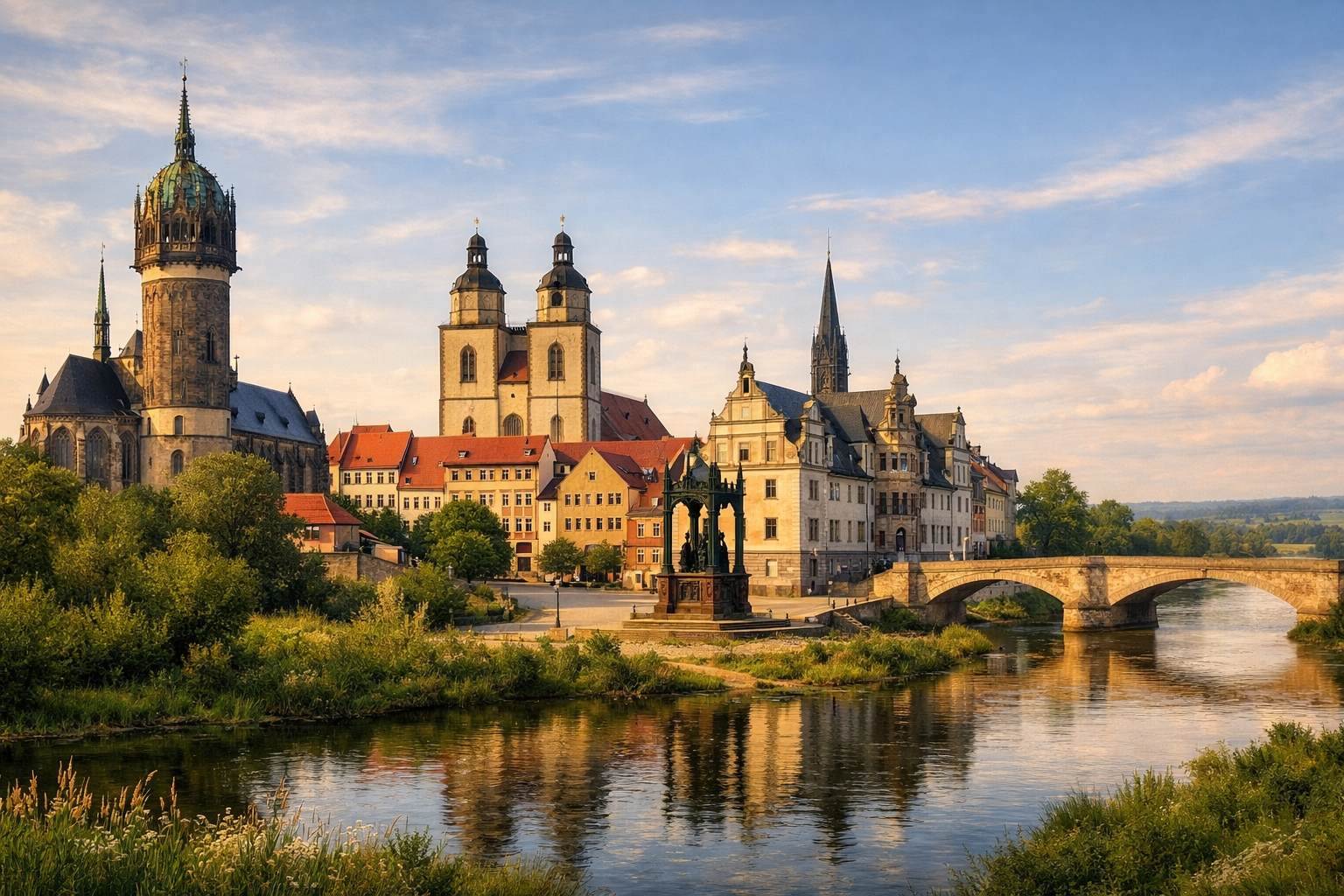
Day 1 — Lutherstadt Wittenberg: Luther, Melanchthon, and the heart of the Reformation
🚆 Transfer: Berlin Brandenburg Airport (BER) → Lutherstadt Wittenberg Hbf. In practice, the most convenient option is usually to travel with a change in Berlin to regional or long-distance DB trains; depending on the specific connection and transfer, the journey typically takes about 1 h 40 m – 2 h 20 m. From Wittenberg central station to the historic center it is about a 15–20 minute walk, so even on the first day you can cover the main sights without rushing and without needing a taxi.
🚶 Begin your introduction to Lutherstadt Wittenberg through its remarkably compact old town, where history is not scattered across districts but literally comes together in one coherent route that can be understood on foot. Here, among calm streets, late Gothic facades, university courtyards, and church towers, the ideas of the 16th century stop being an abstract chapter from a textbook and become almost tangible. Wittenberg does not feel like a huge museum city — and that is its strength: it is intimate, clear, and human in scale, which makes it especially powerful for the imagination. It is easy to picture Luther, Melanchthon, Cranach, and their students walking these same streets, and to imagine how theological debates changed not only the church but the very European way of thinking, arguing, reading, and believing.
🚶 The main stop of the day is Luther House / Lutherhaus, the former Augustinian monastery that became Martin Luther’s home. One current practical detail matters here: the historic Lutherhaus building itself is closed for renovation, and in these years the main museum materials and visits are connected with the neighboring Augusteum. Even with that adjustment, the site remains absolutely essential: Luther lived here for more than 35 years, taught, wrote, welcomed guests, and carried out the intellectual work that changed Europe’s religious map. It is best to plan this visit not as a quick checkmark but as a slow immersion: first walk around the exterior perimeter, feel the scale of the former monastic complex, then enter the exhibition area, and only after that give yourself time for a short pause in a café or on a nearby bench. This rhythm helps avoid overload from facts and lets the history settle not as a list of dates but as a personal experience of being in the place where the Reformation was born.
🚶 Then it makes sense to continue to Melanchthon House — the home of Philipp Melanchthon, the intellectual architect of the Reformation, often seen as the “quiet force” of Wittenberg. In contrast to the more dramatic and world-famous image of Luther, Melanchthon reveals another side of the era: scholarship, structure, humanism, university discipline, and the ability to give controversial ideas a coherent form. The house itself is an outstanding Renaissance town mansion, and its atmosphere is especially appealing because it does not overwhelm with grandeur but instead invites thoughtful reflection. This is a good place to slow down, read the explanations carefully, look closely at the details of daily life and architecture, and after the visit take a walk along Collegienstraße, which in itself looks like a scene from a beautifully staged historical film.
🚶 After the museum visits, devote time to Stadtkirche St. Marien — St. Mary’s Town Church, rightly called the “mother church of the Reformation.” This place is especially powerful not because of outward splendor but because of the depth of its meaning. Luther preached here, the first Protestant services were held here, and this was also the site of his marriage to Katharina von Bora. Inside, it is worth lingering by the Reformation altar from the workshop of Lucas Cranach: it is not just an artistic object but a visual program of new church thought translated into the language of images. If you enter the church during a calm part of the day, when there are fewer visitors, you may feel a kind of silence that is rare in popular historic places — not museum silence, but a living, prayerful one.
🚶 Toward evening, head to Schlosskirche — All Saints’ Castle Church, the most symbolic place on the entire route. It is associated with the memory of the 95 Theses of 1517, and even if the real story of their publication is more complex than the tourist myth, the power of the site is not diminished in the least. It is especially beautiful here in the second half of the day, when the light falls more softly on the tower and facades and the city gradually grows quieter. The impression comes not only from the architecture but also from the awareness that before you stands not just a “famous church,” but one of Europe’s great symbols of intellectual defiance, theological courage, and the beginning of a vast cultural shift.
🚶 The final accent of the day is the market square and Cranach-Höfe / Cranach courtyards. Wittenberg’s old market is perfect for a gentle end to the route: here you can catch your breath, have dinner, and simply watch how the historic center lives in its ordinary rhythm without museum-like theatricality. The courtyards connected with Lucas Cranach are a reminder that the Reformation was not only a theological event but also a cultural revolution of images, printing, workshops, and urban communication. Spending the night in the center is especially fitting here: in the evening Wittenberg becomes quiet, almost contemplative, and that is the ideal mood for such a route.