
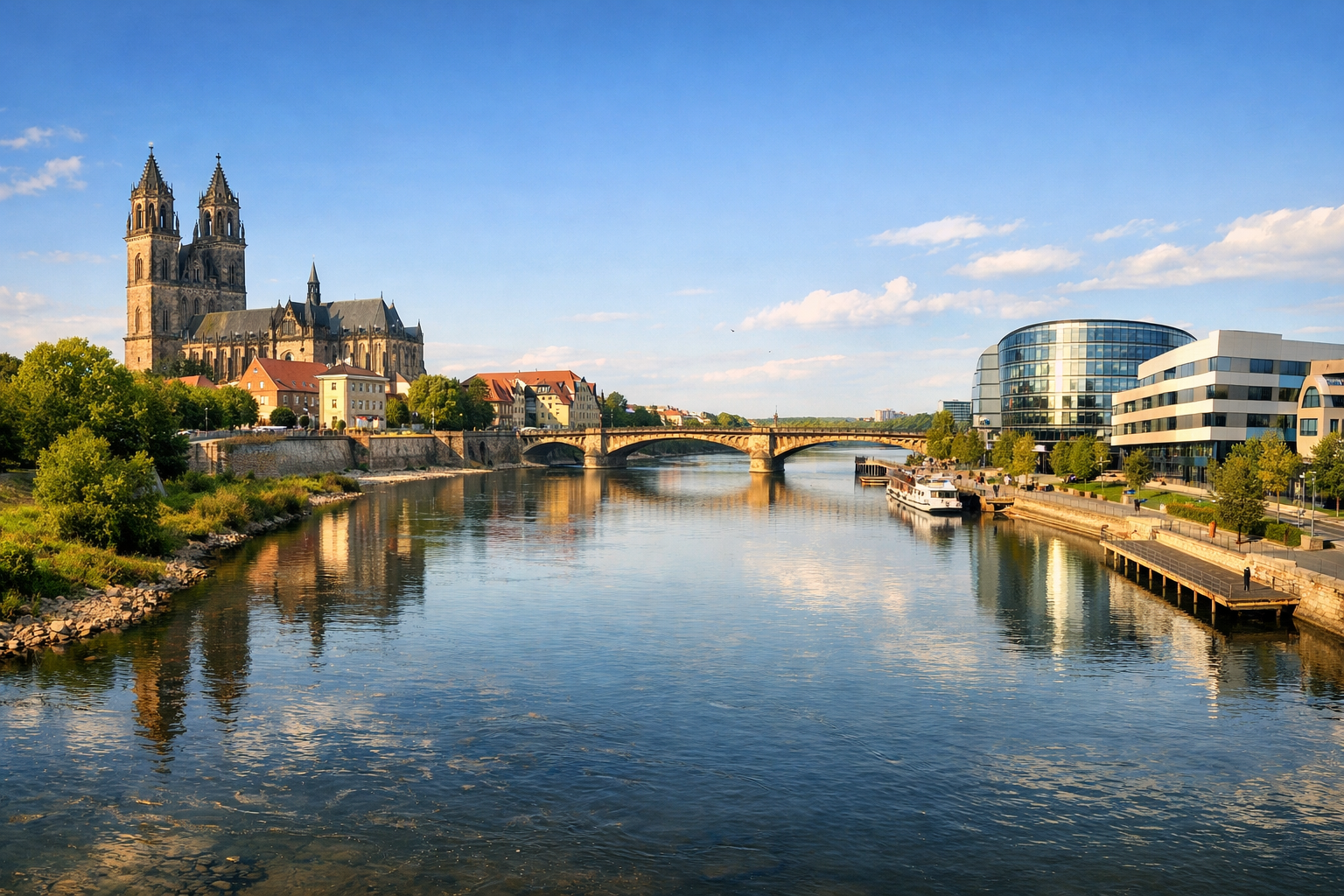
Day 1 — Old Magdeburg: cathedral, monastery, and Grüne Zitadelle
🚆 It is most convenient to plan your arrival in Magdeburg via Hauptbahnhof: from the central station to the city's historic core it is only a few minutes by tram or about 15–20 minutes on foot. If you are flying into Berlin Brandenburg, allow roughly 1 hr 55 min – 2 hr 15 min to reach Magdeburg with a rail transfer, and after arrival leave another 15–20 minutes for a short transfer to your hotel and check-in.
🚶 Start your route with Magdeburg Cathedral — Dom zu Magdeburg, one of the strongest architectural highlights in all of eastern Germany. This is not just the city's main church, but a stone chronicle of imperial Magdeburg, the city of Otto I, trade, destruction, and rebirth. The Gothic towers rise high above the city and are especially impressive up close: the façade feels austere and almost northern in character, while inside the space opens up through verticality, light, and a rare sense of historical depth. The cathedral is tied to Emperor Otto I, and you can feel the weight of medieval political history here, yet the place does not look "frozen like a museum": it remains a living urban landmark around which the rhythm of the center is still built today. Set aside at least 45–60 minutes for a visit, or even a little over an hour so you can explore the interior, walk around the square, and pause for photos at an unhurried pace.
🚶 Then continue to Kunstmuseum Kloster Unser Lieben Frauen, located right in the historic heart of the city. It is a rare combination of a Romanesque monastic complex and a contemporary art museum: stern stone architecture, inner courtyards, arcades, and the quiet of the old monastery are unexpectedly combined here with current art and sculpture. The place captures Magdeburg's character especially well: the city does not try to choose between the Middle Ages and modernity, but combines them into one complete image. Even if you are not planning a long museum visit, it is worth coming in for the space itself — ancient walls, light in the galleries, and a sense of coolness create a beautiful pause in the middle of the day. Allow 60–90 minutes for a relaxed visit.
🚶 After the museum segment, take a lunch break and rest by Domplatz: it is convenient to allow about 1–1.5 hours for this area without rushing. This matters on a two-day route because Magdeburg is better appreciated not in a "racing from point to point" format, but through an alternation of strong architecture and short rest stops.
🚶 In the second half of the day, head to the city's most recognizable modern icon — the Green Citadel of Magdeburg, the last major realized project by Friedensreich Hundertwasser. After the strict Gothic and Romanesque Magdeburg, this place works almost like a visual explosion: pink façades, golden spheres, uneven lines, green terraces, and a complete rejection of the right angle turn the building into an architectural manifesto against uniformity. But the value of the site is not only in its striking outer shell. The Citadel is woven into the city's everyday life: there are inner courtyards, shops, dining spots, hotel spaces, and viewing points here. If you can join a tour with a climb up the tower, the view over the city explains Magdeburg's logic especially well: cathedral spires, postwar urban fabric, green zones, and the broad axes of the modern center coexist side by side. It is reasonable to leave 1–1.5 hours for the visit.
🚶 In the evening, finish the day with a slow walk along the central streets and a stroll out toward the embankments in the direction of the Elbe. Magdeburg does not create the loud tourist impression of Berlin or Dresden, and that is exactly part of its charm: by evening the city becomes very graphic, calm, and spacious. It is better not to overload the plan with late transfers — after a full first day, it is comfortable to return to the hotel a bit earlier and save your energy for the green and panoramic part of the second day route.