
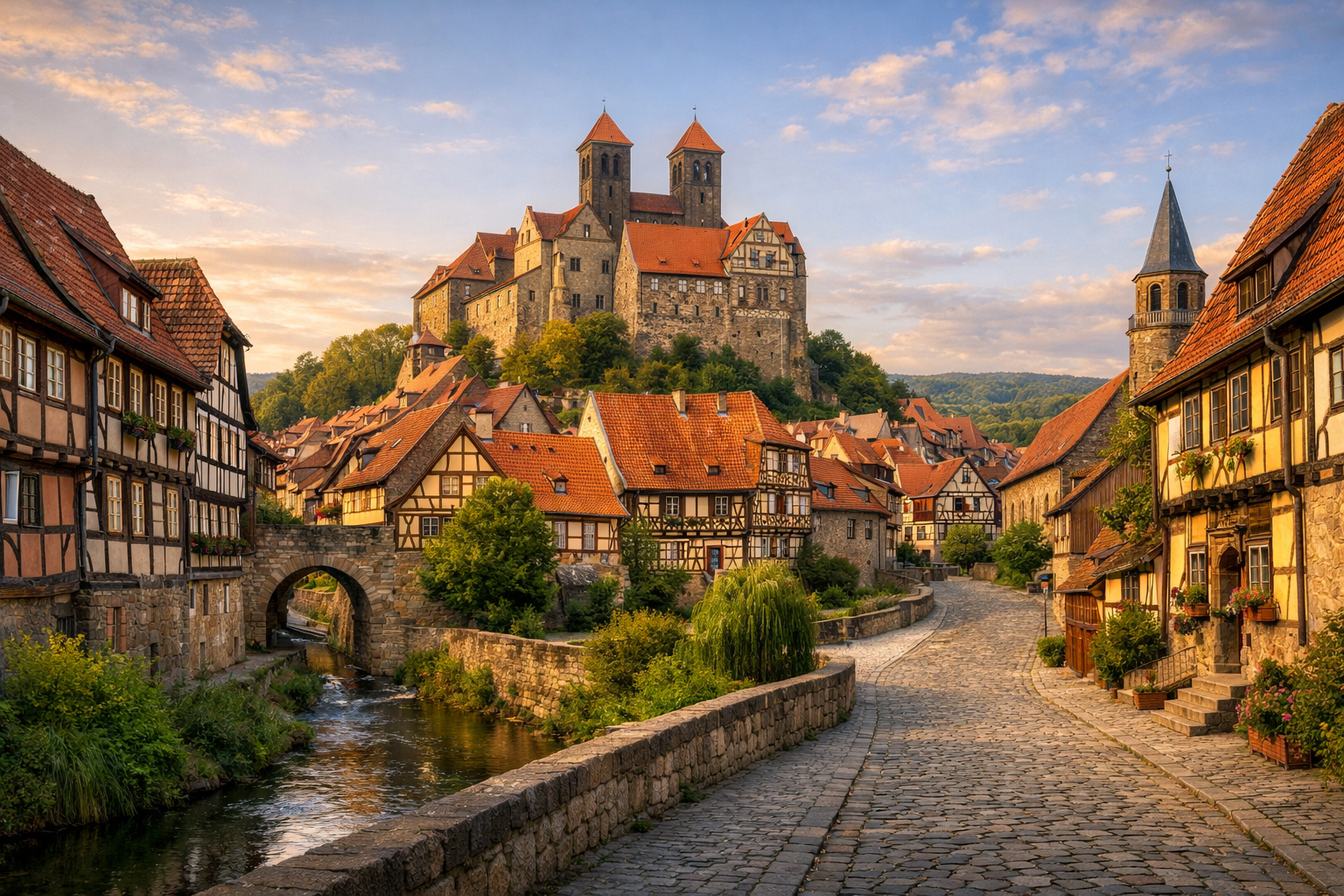
Day 1 — Quedlinburg: medieval center, market square, and a half-timbered fairytale
🚆 It is most convenient to plan your arrival in Quedlinburg in the morning. From the railway station to the historic center it is about a 10–15 minute walk, and to the area around Schlossberg and the southern edge of the old town about 15–20 minutes at an easy pace with luggage. This makes the town ideal for a short, unhurried itinerary: you can check in, leave your bags, and almost immediately start exploring one of the most complete medieval urban ensembles in Germany.
🚶 Quedlinburg is a rare town that feels not like a set of separate sights, but like a single historical stage. More than two thousand half-timbered houses have survived here, and the layout of the old town together with the silhouette of Schlossberg creates the feeling that you have stepped into a three-dimensional set for a North German legend. Narrow cobbled lanes, leaning facades, carved beams, tiny courtyards, and houses with different window rhythms do not look museum-sterile: the town is alive, lived-in, and at the same time remarkably coherent. It is precisely for this exceptional connection between history and architecture that the old town, castle hill, and collegiate church were included on the UNESCO World Heritage list.
🚶 Start your walk at Marktplatz and the surrounding streets. Quedlinburg’s market square is not just an open space in the center, but a natural entry point into the town’s atmosphere. The scale feels just right here: not so large as to be tiring, and not so small as to lose the sense of travel. Around the square stand the town hall, old town houses, cafés, and hotels, and beyond that the old town begins to spread out in a network of lanes where almost every turn gives you a new frame: a carved wooden gable, a house slightly overhanging the street, or an unexpected perspective on towers and rooftops.
🚶 After your first introduction to the center, spend time in the half-timbered quarters and be sure to visit Fachwerkmuseum im Ständerbau at Wordgasse 3. This museum is located in one of the oldest surviving houses in the town, a rare tall post-construction building from the 14th century. Inside, what is especially interesting is not only the story of the development of half-timbered architecture from the Middle Ages to the 19th century, but the house itself as an exhibit: the beams, the structural logic, the traces of time, and the understanding of why Quedlinburg is perceived as a textbook of urban building history written not on paper, but in wood and stone. Usually 40–60 minutes is enough for the museum, which is very convenient for the first day.
☕ After the museum, take a break for lunch and some rest in the center. For a short two-day itinerary this matters: it is better not to try to cover the whole town in one go. Quedlinburg really shines at a slow pace — when there is time to turn into a quiet lane, study facade details, peek into an inner courtyard, and simply sit on the square or at a small café. It is reasonable to allow 1–1.5 hours to recharge.
🚶 In the second half of the day, head up toward Schlossberg. The climb does not take long, but it gives an important change of perspective: from below, Quedlinburg reads like a labyrinth of cozy streets, while from above it appears as a historical organism with a clear structure of roofs, towers, and lanes. Along the way it is especially beautiful to look back at the old town, where the density of half-timbered buildings becomes even more noticeable from above. The evening light is particularly expressive here: reddish roofs, dark wooden frames, and pale plaster begin to look almost painterly.
🌙 In the evening, leave yourself an unhurried walk without a strict plan: Bockstraße, Wordgasse, the areas around Markt, and the lanes at the foot of the hill are especially beautiful after the daytime flow fades. Quedlinburg is not about a bright big-city evening, but about silence, the soft glow of lanterns, the creak of footsteps on cobblestones, and the rare feeling that the city’s historical fabric has preserved not only its form, but also its mood. It is best to spend the night in the historic center itself or near Brühl-Park so you do not waste extra time on the road the next day.