
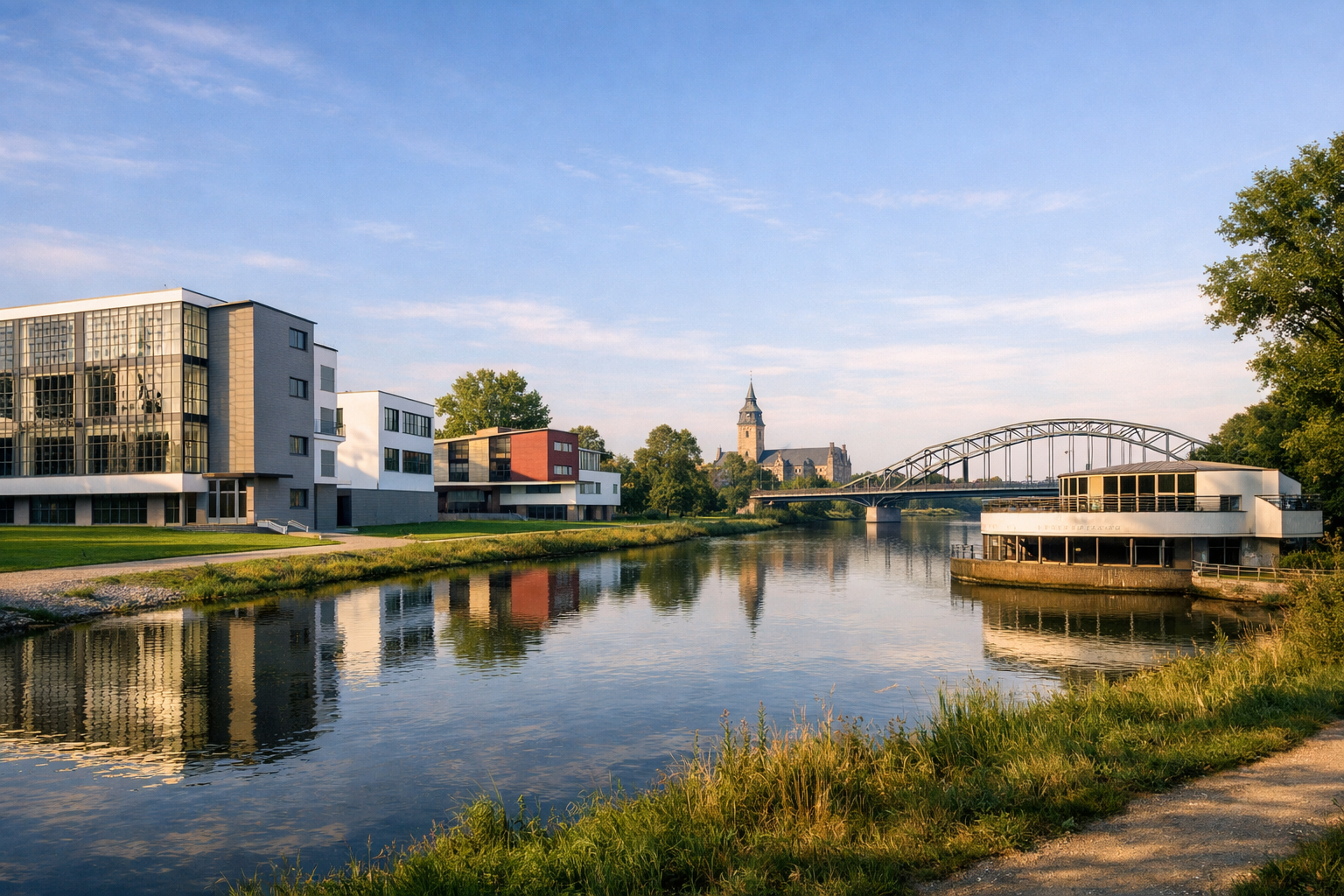
Day 1 — Dessau: Bauhaus, museum, and Masters’ Houses
🚆 It is convenient to plan your arrival in Dessau-Roßlau for the morning: there are regular rail connections here from Berlin, and the city itself is very compact for a short cultural route. From the main station to Bauhaus Museum Dessau it is about 750 meters on foot, which means roughly 10–12 minutes at an easy pace. This kind of start is especially pleasant after the journey: there is no need to jump straight into a taxi, and you can ease into the rhythm of the city, where modernist architecture stands alongside parks, broad avenues, and the unexpectedly relaxed atmosphere of a small Saxony-Anhalt center.
🚶 Start the day with Bauhaus Museum Dessau — a modern museum that does not simply display objects, but helps explain why the Bauhaus became one of the most influential artistic and architectural movements of the 20th century. The museum building itself functions as a manifesto: a glass shell, strict geometry, a sense of light, air, and rational freedom. Inside, it is especially interesting not only to look at furniture, graphics, models, and design objects, but also to grasp the logic of the school itself: the desire to unite art, craft, industry, and everyday life. This place creates a very complete impression — not a museum for display cases alone, but an intellectual space where it becomes clear how Bauhaus ideas changed the appearance of the modern world — from housing blocks and typefaces to furniture, schools, factories, and even the very idea of comfortable, honest, functional space.
🚶 After the museum, take time for a walk to the Bauhaus Building itself on Gropiusallee. Travel between points in the city is short: by bus or a tram-and-bus connection it is usually about 10–15 minutes, and by taxi roughly 5–10 minutes depending on traffic. The Bauhaus building in Dessau is not just the famous façade with its vertical glass wall familiar from architecture textbooks. It is one of the main symbols of modernism as a whole. Built to a design by Walter Gropius, the complex still looks astonishingly modern today: light, clear, almost graphic. Here you can feel especially strongly that the Bauhaus was not style for style’s sake, but a system of thinking. Every part of the building is subordinated to function, yet the whole composition has rare artistic power. Walking through the wings, staircases, workshops, and shared spaces gives the feeling of touching a place where a new visual civilization of Europe was born.
☕ After the visit, it is worth planning a break of at least 45–60 minutes: a short route is best done not in “racing through the sights” mode, but with thoughtful pauses. A café at the Bauhaus sites or in the city center lets you rest, gather your impressions, and avoid overloading the day. This is especially important on this trip because the Bauhaus is not only a spectacle, but also a theme that is enjoyable to “digest”: noticing details, textures, the rhythm of windows, the play of white surfaces and glass, comparing museum theory with what you see in real urban spaces.
🚶 In the second half of the day, head to the Meisterhäuser — the Masters’ Houses, set among pines not far from the main school building. The trip from the Bauhaus Building is very short: by local transport around 5–10 minutes, and walking is also possible for lovers of architectural strolls, though considering time it is more convenient to take a bus. These houses create a completely different mood from the museum and the school building. Here the Bauhaus becomes more intimate and human: it is a space of life, not only of work and manifesto. Kandinsky, Klee, Moholy-Nagy, Feininger, and Gropius himself lived and worked in these houses. The architecture here is strikingly restrained, yet that restraint is exactly where its strength lies: the rhythm of volumes, the careful design of windows, the light, the connection with nature, the sense of privacy without bourgeois heaviness. This is a modernism that is not cold, but surprisingly subtle, almost meditative.
🌆 If you still have energy, end the day with a leisurely walk to Kornhaus on the Elbe, or simply an evening promenade through the quieter districts of Dessau. Kornhaus is one of the most photogenic Bauhaus spots in the city: a former granary-symbol transformed into an expressive landmark with a river horizon and a bright, almost resort-like atmosphere. It is especially beautiful in the evening: water, soft light, wind from the Elbe, and the feeling that Dessau is not only a textbook of modernism, but also a city where architecture knows how to live beside nature. It makes sense to stay overnight in Dessau so you can begin the second day without rushing.