
Day 1 — Saarbrücken: old center, market, baroque, and the taste of the borderland
🚶 Start exploring Saarbrücken in the St. Johanner Markt area — it is not just a square, but the living stage of the city, where its character is felt best: German orderliness here is unexpectedly softened by French lightness, and the historic center does not feel like a museum set, but lives to the rhythm of coffee, glasses of wine, late dinners, and unhurried conversations. Narrow streets lined with 18th–19th century facades, small shops, bistros, wine bars, and pastry stores stretch around the square; it is here that you most clearly understand why Saar is often called the most “French” region of Germany. The morning is best devoted to a gentle walk without rushing: stroll through the Markt, turn into neighboring lanes, look at the details of the old town, and allow yourself a long breakfast or coffee with pastries. The atmosphere here is neither metropolitan nor provincial in a dull sense, but deeply human: the city is compact, welcoming, and encourages you not to just tick boxes, but to truly be inside the place.
🚶 Then it makes sense to walk to Saarbrücker Schloss and the surroundings of Schlossplatz. The castle stands on a rise above the Saar and provides that beautiful transition from urban bustle to a more solemn, historic mood. The modern appearance of the complex is linked to the Baroque era and the architect Friedrich Joachim Stengel, who largely shaped the city’s look. Today the castle combines administrative and cultural functions, but what matters more is this: it is an excellent point to see how Saarbrücken is arranged spatially — the river, bridges, slopes, church towers, and the soft line of the center come together in a very harmonious panorama. It is also convenient to plan a 30–40 minute rest here: sit on the square, take photos, and then head down to the museums around Schlossplatz. If you like history without overload, the place works perfectly: the scale does not weigh on you, and the architecture reads easily and elegantly.
🏛️ Nearby, it is convenient to visit Historisches Museum Saar, Schlossplatz 15, 66119 Saarbrücken. This museum is great because it does not present an abstract history of the region, but helps you understand why Saar is so unlike many other German states. Its border position, constant exchange with France, industrial past, and politically complex regional biography are felt here especially vividly. If time is limited, allow about 1–1.5 hours for the main exhibitions and the underground historical levels; that is enough to keep the route from turning into a marathon and still leave energy for more city walking afterward.
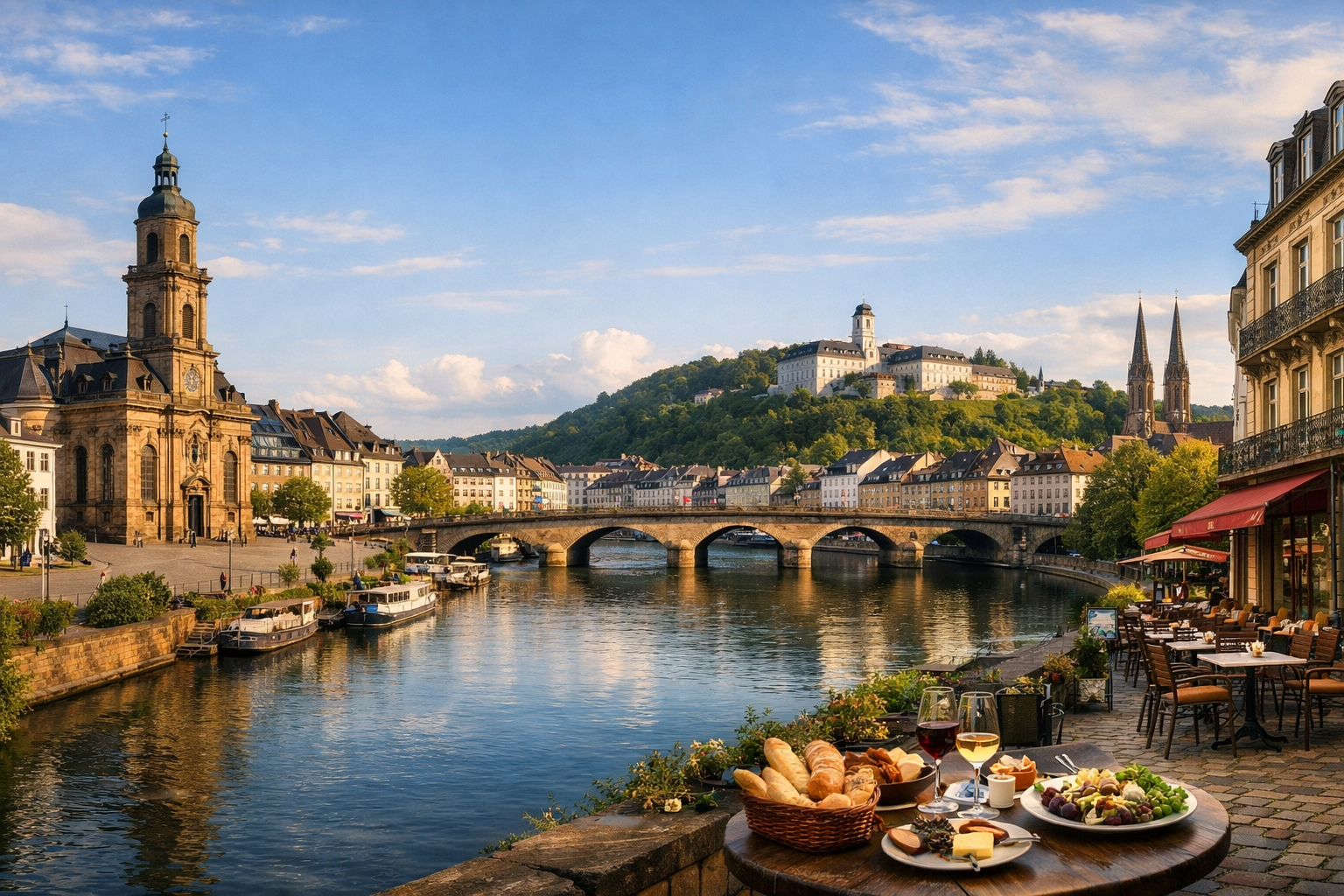
🚶 After the museum, walk across Alte Brücke and along the Saar River. The river itself in Saarbrücken is not just a geographic line, but part of the city’s temperament: it adds air, reflections, light, and a feeling of relaxation even in the center. The embankments and green areas around it are especially pleasant in the second half of the day, when after the museum segment you want to change rhythm. A walk along the bank toward Staden or back toward the center takes 20–40 minutes at a relaxed pace and works perfectly as a natural pause between architecture and gastronomy. There is no need to “manage” anything here — it is enough to walk, look at the bridges and facades, listen to the city, and notice how German urban fabric and an almost French ability to live beautifully without strain come together in it.
🚶 Toward evening, head to Ludwigskirche, Am Ludwigsplatz 18, 66117 Saarbrücken. This is one of the most important Baroque Protestant churches in Germany and perhaps the city’s most striking architectural point. The main impression comes not only from the church itself, but from the entire Ludwigsplatz ensemble: the church and the surrounding square were conceived as a single Baroque composition, so the place is best experienced not in passing, but with a pause. In the soft evening light, the pale facade and strict symmetry are especially beautiful. Even if you are not a fan of church architecture, Ludwigskirche easily draws you in through the unity of the space: it is a rare urban scene where proportions, silence, and light create a very pure sense of European classicism.
🍽️ Devote the evening to Saar cuisine, because this is exactly where the French influence shows. In central Saarbrücken, it is convenient to plan dinner for 1.5–2 hours without any further transfers: choose a bistro, wine restaurant, or contemporary dining spot in the St. Johanner Markt, Mainzer Straße, or Nauwieser Viertel areas. Look on the menu for a combination of German heartiness and French technique: seasonal dishes, tarte flambée, pâtés, good sauces, game, cheeses, creamy desserts, local wines, and crémant. If you want a more “urban” finale, take a walk through Nauwieser Viertel after dinner — it is a creative and more relaxed district with bars, small venues, and a gentle evening life. On the first day, it is better not to overload the program: the city reveals itself precisely when there is time left in it for a long dinner, a glass of wine, and an unhurried walk back to the hotel.