
Buy PDF guide

Buy PDF guide — 4.28 USD

PDF — 4.28 USD

SAAR - Industrial Tour: Völklingen Ironworks

SAAR - Industrial Tour: Völklingen Ironworks

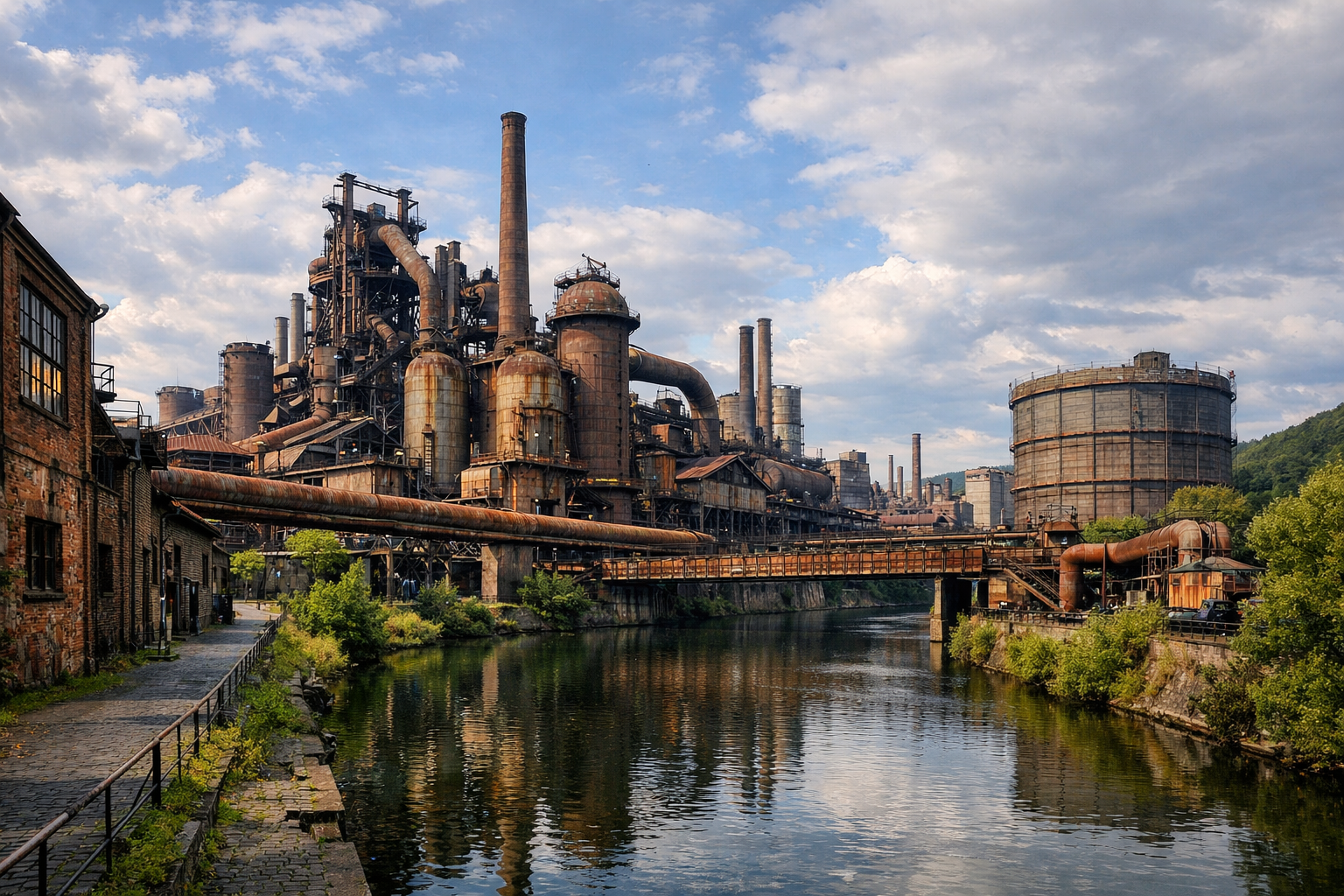
Discover Saar through the monumental Völklingen Ironworks, a UNESCO World Heritage site where blast furnaces, steel, and history create a striking industrial landscape. Just a short trip from Saarbrücken and back, this tour offers a compact but unforgettable look at the region’s powerful past.

🧭 DAY-BY-DAY ROUTE

Ready-made country and city routes with daily plans, sights, transport and accommodation. Buy PDF guides for independent travel.

🧭 DAY-BY-DAY ROUTE


Day 1 — Saarbrücken: getting to know the capital of Saarland and a gentle introduction to the industrial theme

  • ✈️ If you arrive at Saarbrücken Airport (SCN), allow about 25 minutes to get to central Saarbrücken on the regional R10 bus to Hauptbahnhof. By taxi the trip is usually shorter and more convenient with luggage, and if you arrive late, it is the calmest option without extra transfers.

  • 🏨 It is better to plan your stay in Saarbrücken rather than in Völklingen itself: this gives you a wider choice of hotels, restaurants, and evening walks. After the journey, do not overload the day — this route is designed so that on the very first day you already feel the character of the region, while saving energy for the main industrial site on the following day.

  • 🚶 Start your walk in the historic center of Saarbrücken and Schlossplatz. Here the borderland character of Saarland is especially easy to read: German solidity, French lightness, and a surprisingly intimate atmosphere for the capital of a small federal state. The baroque ensemble around Saarbrücken Castle is perceived not as a “monumental imperial stage,” but as an elegant urban setting on a human scale. It is an excellent prelude to the industrial tour: first you see the face of the region as a cultural capital, and only then its powerful industrial past.

  • 🏛️ Be sure to visit Historisches Museum Saar at Schlossplatz 15. This is not just a museum about local history, but a very successful place to understand why Saarland became so distinctive at all. Here the themes of the border, coal, steel, changing political eras, and European identity come together into a clear picture. The underground archaeological and fortification spaces beneath the square are especially impressive: as you descend, you literally feel the city opening its historical layers one after another.

  • 🎨 After lunch, head to Saarlandmuseum – Moderne Galerie, Bismarckstraße 11–15. This museum resonates surprisingly well with the industrial route, because after rough materials, metal, textures, and the history of production, it is especially interesting to look at European art of the 19th–21st centuries. The collection creates a beautiful contrast: in the morning — the history of power, borders, and the region, and by day — light, color, modernism, form, and visual freedom. The spacious sculpture garden and the museum’s contemporary architecture create a sense of cultural breathing space before the “big machine” of the next day.

  • 🌿 In the evening, head to the Deutsch-Französischer Garten. This park, created as a symbol of reconciliation between Germany and France, is an especially fitting end to the first day in Saarland, where the theme of borders and neighboring cultures is felt almost physically. There is no big-city rush here: the lake, avenues, wide lawns, pavilions, and soft evening light give you a chance to exhale after the journey and museum day. It is the right pause before the industrial climax of the route — you are not just “rushing through sights,” but entering the rhythm of the region gradually and thoughtfully.

  • 🍽️ It makes sense to keep dinner in central Saarbrücken, especially around St. Johanner Markt or closer to Nauwieser Viertel. Here it is easy to end the day without long transfers: a walk, a calm dinner, and an early night really matter, because the territory of the Völklingen Ironworks is huge, and the next day you will have to walk a lot through open industrial spaces, staircases, and panoramic levels.


Day 2 — Industrial tour: Völklingen Ironworks

  • 🚆 Transfer: Saarbrücken Hbf → Völklingen. By regional train, the journey usually takes about 15–20 minutes, then another roughly 10–15 minutes on foot from the station to the entrance of the Völklinger Hütte site. If you are traveling by car or car sharing, the route from central Saarbrücken usually takes about 20–25 minutes without serious traffic.

  • 🏭 Völklingen Ironworks is one of the most powerful industrial sites in Europe and a rare place where industrial architecture is perceived almost like a фантастический city. Enormous blast furnaces, overpasses, pipelines, bunkers, iron stairways, platforms, and giant buildings form a multilayered landscape that simultaneously intimidates, amazes, and fascinates. Here you feel especially sharply the scale of an era when metallurgy was not just an industry, but a system that defined the rhythm of life of an entire region, the destinies of thousands of families, and the very geography of the city.

  • 🌍 What makes the place unique is that it is not a “museum about a factory,” but an authentic, almost entirely preserved pig iron production complex included on the UNESCO World Heritage list. Unlike many industrial museums, where only a few buildings remain or the exhibition has been reconstructed, here the industrial fabric of the space itself remains the main exhibit. You are not walking through an abstract exhibition route, but through the real organism of a former production site, where every gallery, every span, and every metal structure is connected to a real technological process.

  • 🚶 Allow at least 4–5 hours for the visit, and if you love industrial photography, architecture, technology, and slow observation of details — almost a whole day. It is best to build the route with pauses: first the overview section and historical context, then the ascent to the panoramic levels and the blast furnace ensemble, then a coffee break, and only after that a deeper immersion into individual zones, temporary exhibitions, and special spaces. This place tires you out not with boredom, but with the scale of impressions, so rest during the day is truly necessary here.

  • 📸 The strongest impression is usually made by the upper viewing points and the passages between industrial volumes. From above it becomes especially clear how much this place resembles a self-contained metallic metropolis: structures layer over one another, rust-red surfaces change shade depending on the light, and the frame constantly reveals a dramatic contrast between technological geometry and living greenery that is gradually reclaiming the former production site. That is why Völklingen is loved not only by industrial historians, but also by photographers, urbanists, artists, and film directors.

  • 🛠️ An important part of the experience is understanding the human scale of this gigantic machine. When you look at the blast furnaces from afar, they seem almost like abstract objects. But as soon as you come closer, see the stairways, workers’ passages, technological levels, and imagine the heat, noise, dust, and round-the-clock rhythm of production, the space begins to be perceived in a completely different way. The plant stops being just a beautiful industrial ruin and turns into a place of memory about labor, discipline, danger, and an incredible concentration of engineering thought.

  • ☕ After the main part of the visit, be sure to take a break. Even if it feels like “just a little more and we’ll have seen everything,” it is better to give yourself 30–40 minutes to rest, drink water, and sit down calmly. This rhythm makes perception deeper: after a pause, you notice more details, read the space better, and feel less tired by the end of the route. For a two-day tour this is especially important, because the goal is not to squeeze out the maximum number of steps, but to take away from Saarland a vivid, complete, and unsmudged impression.

  • 🚶 If you still have time and energy, after returning to Saarbrücken you can end the trip with a short evening walk along the Saar embankment or through the old center. After Völklingen, the city begins to feel different: calm streets, baroque facades, and river views no longer seem simply charming — they become a continuation of the story of a region that managed to transform a heavy industrial past into cultural memory, architectural heritage, and a modern route for a thoughtful traveler.

Flight tickets

eSIM for travel

Buy PDF guide

Buy PDF guide — 4.28 USD

PDF — 4.28 USD