
Buy PDF guide

Buy PDF guide — 10.71 USD

PDF — 10.71 USD

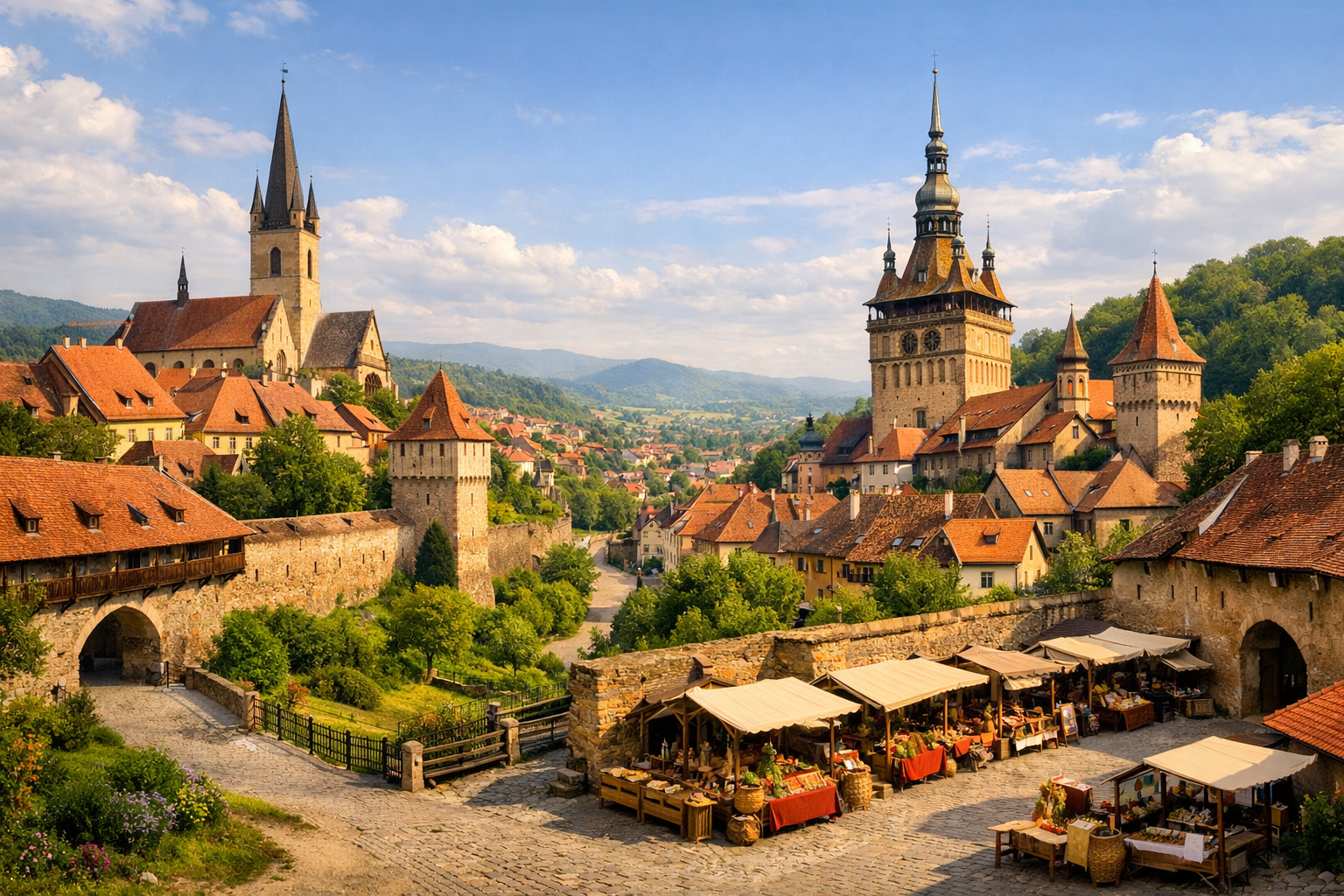
Romania, Sibiu and Sighișoara. A budget route through two beautiful medieval cities of Transylvania with towers, fortress walls, and traditional markets. Season: April - October.

Romania, Sibiu and Sighișoara. A budget route through two beautiful medieval cities of Transylvania with towers, fortress walls, and traditional markets. Season: April - October.

Discover the medieval charm of Transylvania on a budget with a route from Sibiu to Sighișoara and back. Wander among watchtowers, fortress walls, and lively traditional markets as spring and summer bring warm light to two of Romania’s most beautiful historic cities.

🧭 DAY-BY-DAY ROUTE

Ready-made country and city routes with daily plans, sights, transport and accommodation. Buy PDF guides for independent travel.

🧭 DAY-BY-DAY ROUTE


Day 1 — Sibiu: Piața Mare, Piața Mică, and the towers of the old town

  • 🚆 Arrival in Sibiu is easiest via Bucharest: from Henri Coandă Airport you can take a train to București Nord in about 20–25 minutes, then transfer to a CFR Călători train to Sibiu. The whole trip with the connection usually takes a significant part of the day, so it’s best to keep the first day for a calm check-in, rest, and a gentle introduction to the city without overloading yourself.

  • 🚶 Sibiu is one of the most beautiful historic towns in Transylvania, the former Saxon Hermannstadt, where the medieval spirit can be felt literally in the pattern of the cobblestones, in the silhouettes of the roofs with their distinctive “eyes,” in the archways, and in the chain of squares flowing into one another. Start your route at Piața Mare — the Large Square, the ceremonial heart of the city, surrounded by wealthy merchants’ houses, palaces, and facades that look especially striking in the soft evening light. From here it feels natural to continue to Piața Mică, more intimate and lively, where beneath the arcades and along the old houses you can sense the atmosphere of the old trading center. The city’s symbol remains Turnul Sfatului — the Council Tower, one of Sibiu’s most recognizable landmarks: from its viewing platform there is a wonderful view of the tiled roofs, church spires, and lines of the old fortifications. Then it’s worth walking along the Passage of the Stairs — a picturesque stairway passage linking the upper and lower town; it is one of those corners where Sibiu feels almost like a theatrical set, yet still remains a living real city rather than a museum stage.

  • 🛍️ Toward evening, leave time for a relaxed market visit and gastronomic shops in the center: in the season from April to October, the local life is especially pleasant to feel in the squares and pedestrian zones — seasonal fruit, cheeses, pastries, handmade souvenirs, and the calm rhythm of a Transylvanian town. It’s best to end this day early: after the journey, your body needs rest, and Sibiu’s old center is ideal for short walks without transport.


Day 2 — Sibiu: Brukenthal, the cathedral, and fortress walls

  • 🚶 Dedicate the second day to a deeper immersion in the city’s history. Start with the Brukenthal National Museum, one of Romania’s most important museum complexes, associated with Baron Samuel von Brukenthal. Even if you do not plan to spend half the day inside, the museum’s very presence on the main square helps explain Sibiu’s status as an old cultural center of Transylvania. Then it makes sense to walk to the Evangelical Cathedral in the upper town: its Gothic silhouette, austere forms, and tall tower create that very “Central European” atmosphere that makes Sibiu so unlike the stereotypical image of the Balkans.

  • 🏰 After that, switch to the defensive heritage. Sibiu is especially appealing because the medieval urban structure is still very easy to read here: sections of fortress walls, craft guild towers, and walks along the old fortifications let you feel how the city defended itself for centuries while also growing rich through trade. The Cetății Street area is one of the most photogenic places: here the towers and remains of the walls come together into something like a textbook of urban fortification, but without any sense of artificiality. The route is short, walkable, and very pleasant, especially in the warm season.

  • 🏛️ If you still have energy, add the History Museum in Casa Altemberger or the Museum of Pharmacy History — these are good extra stops to see Sibiu not only as a pretty postcard, but as a real old city with crafts, trade, medicine, and guild culture. Once again, it is best to spend the evening quietly in the historic center: distances are short, but the concentration of impressions is high.

Day 3 — Sibiu: ASTRA Museum and Dumbrava Forest

  • 🚌 On the third day, it is worth taking a short trip to the ASTRA Museum, located in Dumbrava Sibiului forest. This is one of the best open-air ethnographic museums in Romania and an excellent contrasting counterpart to the urban medieval atmosphere of the first days. It is easy to get here by Tursib bus or taxi; taking the trip, the walk, and breaks into account, allow at least half a day.

  • 🚶 ASTRA is not a “museum in a building,” but a large open-air world of traditional Romania: wooden houses from different regions, farm buildings, watermills, workshops, churches, and village courtyards are arranged among the trees and by the water so that the walk almost turns into a journey through a disappearing country. It is especially pleasant here from April to October, when the greenery, warm air, and long daylight hours make the visit not tiring but meditative. If in the center of Sibiu you saw the city walls, towers, and facades of merchant Transylvania, here another layer opens up — peasant, artisanal, and natural Romania.

  • 💤 After returning to the city, do not overload the evening. It is better to leave time for rest at the hotel, a late coffee on the square, or a short walk through the illuminated center. The next day includes an intercity transfer, so this day should be rich but not exhausting.

Day 4 — Sibiu → Sighișoara: transfer and citadel

  • 🚆 Transfer: Sibiu → Sighișoara by CFR Călători train. Depending on the specific service, the journey usually takes about 2–2.5 hours, so the route realistically fits into the first half of the day without rushing. After arrival — check-in, a short rest, and heading out into the old town.

  • 🚶 Sighișoara has a completely different mood, although it is also deeply medieval. If Sibiu gives the impression of a large and confident historic center, Sighișoara feels more compact, fairy-tale-like, and almost toy-like: a hill, colorful houses, narrow streets, guild towers, gates, fragments of walls, and the sense that the town still lives inside its old shell. The main dominant is Turnul cu Ceas, the Clock Tower, which guarded the entrance to the citadel for centuries and today remains its main symbol. Climbing the tower and walking the surrounding streets give the best first look at the town.

  • 🏰 Then head to the citadel square and simply wander without a strict plan: in Sighișoara, what matters is not only an individual sight, but the very fabric of the place — the gentle bends of the streets, pastel facades, inner courtyards, little gates, towers, and unexpected angles on the walls. Along the way you can see Vlad Dracula’s House, the old guild towers, and sections of the fortifications. In the evening, when the daytime groups leave, the citadel becomes especially atmospheric: quieter, more spacious, and its old character is felt much more strongly.

Day 5 — Sighișoara: Scholars’ Stairs, the Church on the Hill, and departure

  • 🚶 Dedicate the morning in Sighișoara to the upper part of the citadel. The most expressive route is via Scara Acoperită, the covered Scholars’ Stairs leading to the Church on the Hill. This ascent is one of the city’s most poetic scenes: a wooden covered passage, a gentle vertical route, and a gradual emergence into a calmer, almost contemplative part of the hill. From above, beautiful views open over the tiled roofs, towers, and the valley around the town.

  • ⛪ The Church on the Hill and its surroundings are a fine way to end the trip, because here Sighișoara reveals itself not as a set of postcards, but as a layered Saxon town with religious, defensive, and everyday history. After sightseeing, it is worth returning to the citadel for a late breakfast or early lunch and leaving a little time to buy local souvenirs, sweets, or handmade goods.

  • 🚆 In the second half of the day — departure. The most practical option is to return by train via Sibiu or continue by rail toward your next major hub, checking the current CFR timetable in advance. This 5-day route remains budget-friendly and realistic: a minimum of unnecessary transfers, two very expressive medieval towns, enough time for rest, and no race across the whole country.

Flight tickets

eSIM for travel

Buy PDF guide

Buy PDF guide — 10.71 USD

PDF — 10.71 USD