
Buy PDF guide

Buy PDF guide — 12.85 USD

PDF — 12.85 USD

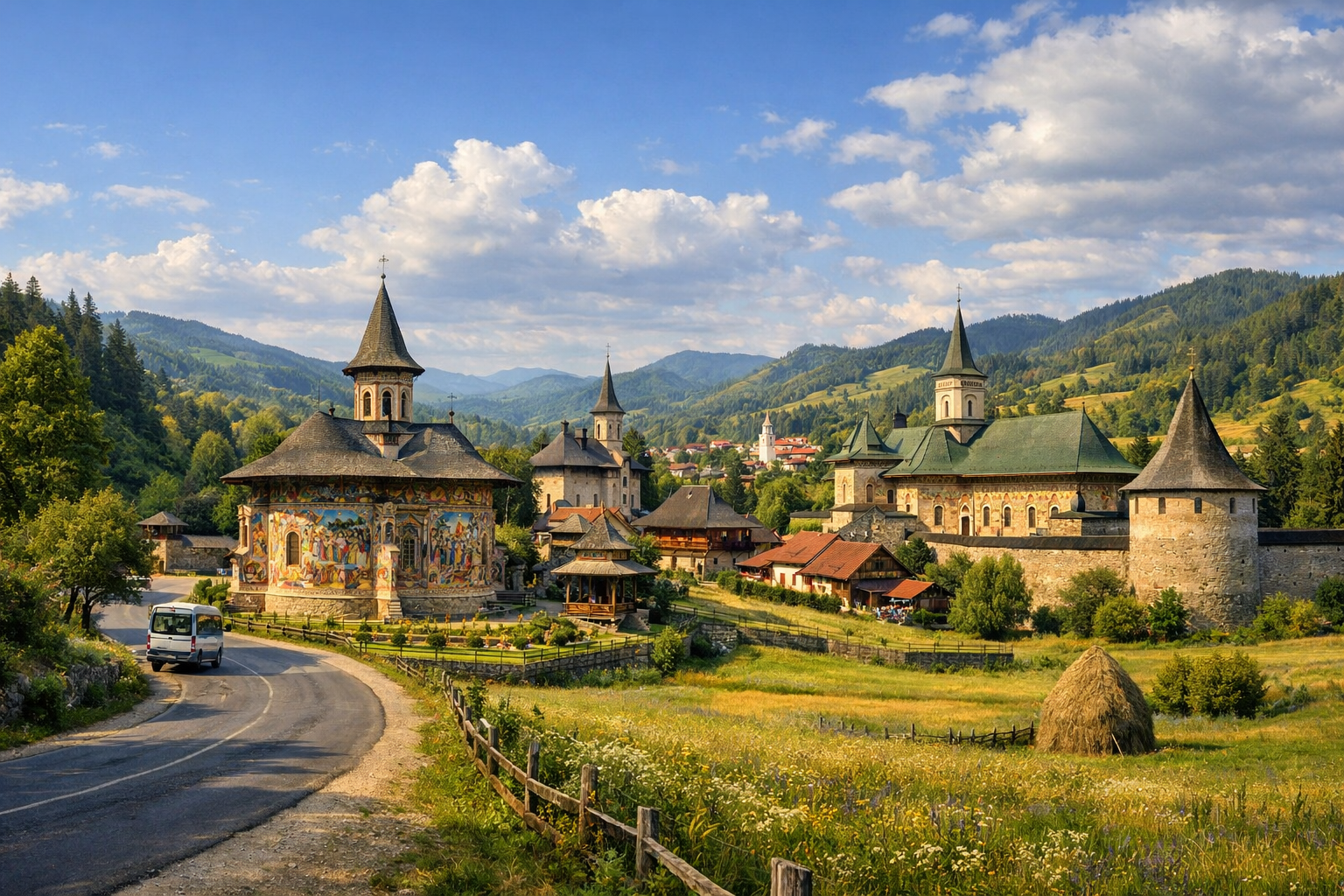
Romania, the monasteries of Bukovina. A budget car or bus route through the painted monasteries, small towns, and rural areas of northern Romania. Season: May - September.

Romania, the monasteries of Bukovina. A budget car or bus route through the painted monasteries, small towns, and rural areas of northern Romania. Season: May - September.

From May to September, Bukovina is ideal for a low-cost road trip or bus journey through northern Romania, where painted monasteries rise above green hills and quiet village roads. Travel from Suceava through Gura Humorului, Moldovița, Sucevița, and Putna to Vatra Dornei for a slow, scenic route of frescoed churches, small-town guesthouses, and deep rural calm.

🧭 DAY-BY-DAY ROUTE

Ready-made country and city routes with daily plans, sights, transport and accommodation. Buy PDF guides for independent travel.

🧭 DAY-BY-DAY ROUTE


Day 1 — Suceava → Gura Humorului: a gentle introduction to Bukovina

  • 🚐 An optimistic start to the route is to arrive in Suceava and then make the short transfer to Gura Humorului, which works well as a budget base for the first three nights. From Ștefan cel Mare Airport in Salcea to Gura Humorului, it is usually wise to allow around 1–1.5 hours for a transfer or bus including waiting time, while from central Suceava the drive along the highway takes about 50–60 minutes. This is an important money-saving choice: there is no need to change accommodation every day, and the key monasteries of southern Bukovina are at a reasonable distance for day trips. Along the way, the scenery changes quickly: urban neighborhoods give way to gentle hills, fields, forest belts, and villages with painted gates, flower gardens, and houses where the traditional way of life feels not like decoration, but like part of everyday life.

  • 🚶 In the second half of the day, it is worth taking an easy walk around Gura Humorului itself. This is a small resort town in historic Bukovina, located in a valley between wooded slopes, and its charm lies precisely in this combination of provincial calm and proximity to famous monasteries. The town center is not overloaded with attractions in the capital-city sense, but it is pleasant to catch the local rhythm here: the market, pastry shops, terraces, low-rise streets, and the feeling that the journey has finally slowed down. If there is still time, visit the Museum of Bucovina Folk Customs — it is an excellent introduction before the monasteries and rural routes. It helps you see the region not only through frescoes and architecture, but also through the cycle of holidays, wedding traditions, crafts, costume, and the symbolism of the home and the village year.

  • 🌿 In the evening, you can walk to the Ariniș area or simply choose a quiet dinner in the center. From May to September the daylight hours are long, so even after the road there will still be time for an unhurried stroll. The first day here is important not for the number of sights, but for setting the right pace: rest after the transfer, do not overload yourself with excursions, and tune in to northern Romania as a space for slow travel. If you are traveling independently, it is useful from day one to follow basic rules: keep an eye on personal belongings on transport and at stations, use official taxis or pre-booked transfers, and keep cash and documents in different pockets or bags. Romania as a whole is suitable for independent tourism with normal caution, and Bukovina is exactly one of those regions where a calm and respectful travel style works best.


Day 2 — Voroneț and Humor: blue frescoes, fortress walls, and the silence of the valleys

  • 🚗/🚌 Today is devoted to the two most accessible and at the same time most expressive monasteries near Gura Humorului. Voroneț Monastery is only a few kilometers from town, so by car the drive takes about 10 minutes, and by taxi or local transfer it is the easiest outing of the entire route. Voroneț is often called one of Romania’s main visual emblems — and not only because of the famous “Voroneț blue,” a rare and extraordinarily deep shade in the exterior paintings. Founded under Ștefan cel Mare at the end of the 15th century, the monastery makes a strong impression precisely through its unity: modest proportions, a quiet courtyard, the green backdrop of the hills, and suddenly — a wall transformed into a theological and artistic universe. It is especially important here not to rush and to walk around the church, because the frescoes work not as separate pictures, but as a continuous narrative meant to be read in movement by both eye and visitor.

  • 🎨 After Voroneț, head to Humor Monastery, usually about 15–20 minutes away through a rolling rural landscape. Humor feels different: if Voroneț impresses with color and fame, Humor captivates with intimacy, reddish tones, its old watchtower, and the sense of a fortified monastic world that for centuries lived on the border of prayer, art, and troubled history. Built in the 16th century, it preserves one of the most expressive exterior painting programs in Bukovina. Especially interesting is the contrast between the decorative sophistication of the frescoes and the almost severe simplicity of the ensemble as a whole. Here it is easy to feel that the painted monasteries are not just a set of “UNESCO postcards,” but the result of a very specific cultural era when the outer wall became a language of faith, memory, and power.

  • 🍽️ After visiting the monasteries, it makes sense to return to Gura Humorului for lunch and a rest, leaving the second half of the day free. You can go back into the center, buy local products, try Bukovinian cuisine, or simply do nothing “mandatory.” This rhythm is especially good for budget independent travel: short transfers, minimal stress, enough time for pauses, and no constant race between points. If you want to add a light walk in nature, choose only clear short trails and park areas; for more serious outings in the Carpathians, go only on marked routes and remember the rules of behavior when encountering wild animals, especially in forest and mountain areas.

Day 3 — Moldovița and rural Bukovina: long fences, meadows, and a monastery among the hills

  • 🚗/🚌 Today the route goes deeper into rural Bukovina. From Gura Humorului to Moldovița, it usually takes about 1 hour 10 minutes by car; with bus connections and waiting for transfers, the day becomes longer, so for this part an early departure and a flexible time buffer are especially useful. The road itself is already part of the experience: valleys with hay meadows, wooden houses, roadside crosses, pastures, small stations, and villages where landscape and daily life are still closely connected. This is one of those days when Bukovina reveals itself not only through a famous monument, but through the space between the points. It is worth making short photo stops and simply looking around: it is on trips like this that you understand why people love this region not only for its monasteries, but also for the feeling of a complete cultural landscape.

  • ⛪ Moldovița Monastery, founded in the 16th century, is famous for its harmonious setting and beautifully preserved system of exterior frescoes. Unlike the more “promoted” Voroneț, there is often less bustle here, and for that reason the impression can be even deeper. Golden-ochre and warm earthy tones look especially beautiful in soft summer light, and the ensemble itself seems almost built into the countryside. Moldovița does not shout — it unfolds gradually: first you see the walls and towers, then you enter the courtyard, then you begin to make out the complex scenes on the facades, and only after that does the church start to work as a unified artistic space. It is better not to try to “rush through” the site in 15 minutes: it is truly worth spending time here so your eye can adjust to the details, to layer after layer of painting, and to the special Bukovinian logic of exterior decoration.

  • 🥚 On the way back, if the pace allows, you can stop in Vama and visit Letiția Orșivschi’s Egg Museum — a small but very characteristic stop for the region. In Bukovina, the painted egg is not just a souvenir, but an important carrier of ornament, symbolism, and craftsmanship connected with the calendar, religious tradition, and women’s artisanal knowledge. In the evening, returning to Gura Humorului, having dinner, and going to bed early will be the best choice: the day is long, but very rewarding, because it brings together the road, art, and the true rural fabric of northern Romania.

Day 4 — Sucevița, Arbore, and transfer to Vatra Dornei

  • 🚗 Leave Gura Humorului in the morning with your bags. By car, Sucevița is usually about 1 hour away, while with the bus option you need to be ready for more complicated logistics and possible connections via Rădăuți or Suceava, so for a budget but comfortable route this is exactly where a car is especially convenient. Sucevița Monastery is one of the most monumental and impressive ensembles in Bukovina. It is often remembered for its powerful walls, almost fortress-like appearance, and the famous composition “The Ladder of Virtues.” Here the visual language is already different: not intimacy, but the sense of a strong, concentrated monastic state in miniature. Inside the courtyard, the strict geometry of the fortifications, the green relief of the surroundings, and the very delicate work of the paintings are combined in a remarkable way. This place shows well how diverse the painted monasteries can be even within a single region.

  • 🏛️ Next, you can stop at the church in Arbore — it is less “theatrical” than Sucevița or Voroneț, but that is exactly its charm. Arbore often makes the impression of a monument for the more thoughtful traveler: without unnecessary bustle, with elegant proportions, clear architecture, and an important place in the series of painted churches of Moldavia. On the way, you can also make short stops in rural settlements to feel how the monastic monuments are woven into the everyday life of the region rather than existing separately from it. This pairing — Sucevița plus Arbore — gives a very full picture of Bukovina: one ensemble is powerful and defensive, the other more restrained and almost intimate.

  • 🚆/🚗 After lunch begins the transfer to Vatra Dornei, which takes about 1 hour 40 minutes to 2 hours by car depending on stops. If you are traveling by public transport, it is realistic to allocate a significant part of the day: first return to a convenient transport point, then take a bus or train toward the mountain resort. Vatra Dornei is already a different Bukovina: more resort-like, more mountainous, with the scent of pine and mineral waters, wide avenues, and the old spa atmosphere of a former Austro-Hungarian resort. Spending the night here makes sense before the final part of the route: you change from a monastery base to a mountain one, finish the trip without rushing, and give yourself room to rest after several full days.

Day 5 — Putna or a day of choice: Bukovina’s great shrine and a slow evening in the mountains

  • 🚗 This day works best in a car-based format. If you have a car, you can make a long but very rewarding trip to Putna Monastery; from Vatra Dornei the road usually takes about 2–2.5 hours one way, so it is worth starting early and treating the journey as a full road excursion. The alternative for a bus traveler is to spend a calmer day around Vatra Dornei and not force overly complicated logistics into the plan. But if you do manage to reach Putna, it will be one of the strongest points of the entire route. Founded by Ștefan cel Mare in the 15th century, Putna is not just a monastery but a place of enormous historical and symbolic power, a kind of spiritual axis of the Romanian Middle Ages. The atmosphere here differs from the monasteries of southern Bukovina: less emphasis on outward decoration and more on historical weight, memory, dynastic scale, and a pilgrim spirit.

  • 🕊️ In Putna, it is worth not rushing: walk around the grounds, visit the museum section, feel the rhythm of the liturgical space, and look at the monastery not as just another item on the list, but as the place that completes the whole Bukovinian line. Even if you have already seen Voroneț, Humor, Moldovița, and Sucevița, Putna does not repeat them — it sets a different tone, more concentrated and more historical. If time allows, you can add a short nature stop in the surroundings, but without trying to combine too much. In northern Romania, distances on the map are deceptive: the roads are scenic but not fast, and fatigue behind the wheel after several days is real, so it is better to leave room for rest and the return drive.

  • 🌲 Returning to Vatra Dornei in the evening feels especially pleasant: after a monastery day, the town’s resort rhythm feels almost like a reward. You can simply walk through the central part, look at the old buildings, park, and spa architecture, have dinner without rushing, and give yourself a long calm evening. If instead of Putna you chose the relaxed option without a long trip, devote the day to Vatra Dornei itself, the park, springs, museums, and short walks by the forest — this is also a very worthy finale. The main rule in the mountain zone is the same: do not go onto wild trails without preparation, choose only marked routes, and remember that the Carpathian forest is a living environment where respect for nature matters more than any race for a beautiful photo.

Day 6 — Vatra Dornei → Suceava: the final note and departure

  • 🚆/🚗 It is best to keep the last day light and technically reliable. From Vatra Dornei to Suceava, by car it is usually about 2–2.5 hours, while by train you should allow around 3 hours or more depending on the specific service and departure station. That is exactly why you should not overload this day with complicated stops: in independent travel, a calm time buffer is almost always more valuable than one more checkmark on the list. In the morning, you can allow yourself a short walk around Vatra Dornei — breathe in the mountain air, stop for a coffee, take one more look at the park or the old spa buildings, and say a gentle goodbye to the region.

  • 🏛️ If you are leaving Suceava not too early and traveling by car, you can make one final cultural stop in the city — for example at the fortress or a museum site, if you still have the energy. But the logic of the route is already complete: in six days you have seen the core of monastic Bukovina, felt the transition from valleys and rural roads to a mountain resort, and not turned the trip into an exhausting marathon. This is exactly the format that works well from May to September: long daylight hours, green hills, rich fresco colors, good conditions for car and bus transfers, and plenty of time for leisurely walks.

  • ✅ Before departure, check the practical details one more time: cash, documents, ticket, departure time, and the time buffer to the airport or station. On transport and at stations, keep your backpack and valuables with you, call taxis through official services or ask your hotel to help book one, and if you are returning to an international flight, arrive early. Bukovina is rarely remembered as a place of “wow attractions,” but it very often becomes one of the warmest and most complete memories of Romania: here it is not only the masterpieces of fresco painting that work, but also the whole combination of road, village, forest, bell towers, quiet courtyards, and the ability not to rush.

Flight tickets

eSIM for travel

Buy PDF guide

Buy PDF guide — 12.85 USD

PDF — 12.85 USD