
Buy PDF guide

Buy PDF guide — 8.57 USD

PDF — 8.57 USD

Romania, Bucharest. A budget-friendly city route through the historic center, parks, markets, museums, and unusual architecture of the Romanian capital. Season: April — October.

Romania, Bucharest. A budget-friendly city route through the historic center, parks, markets, museums, and unusual architecture of the Romanian capital. Season: April — October.

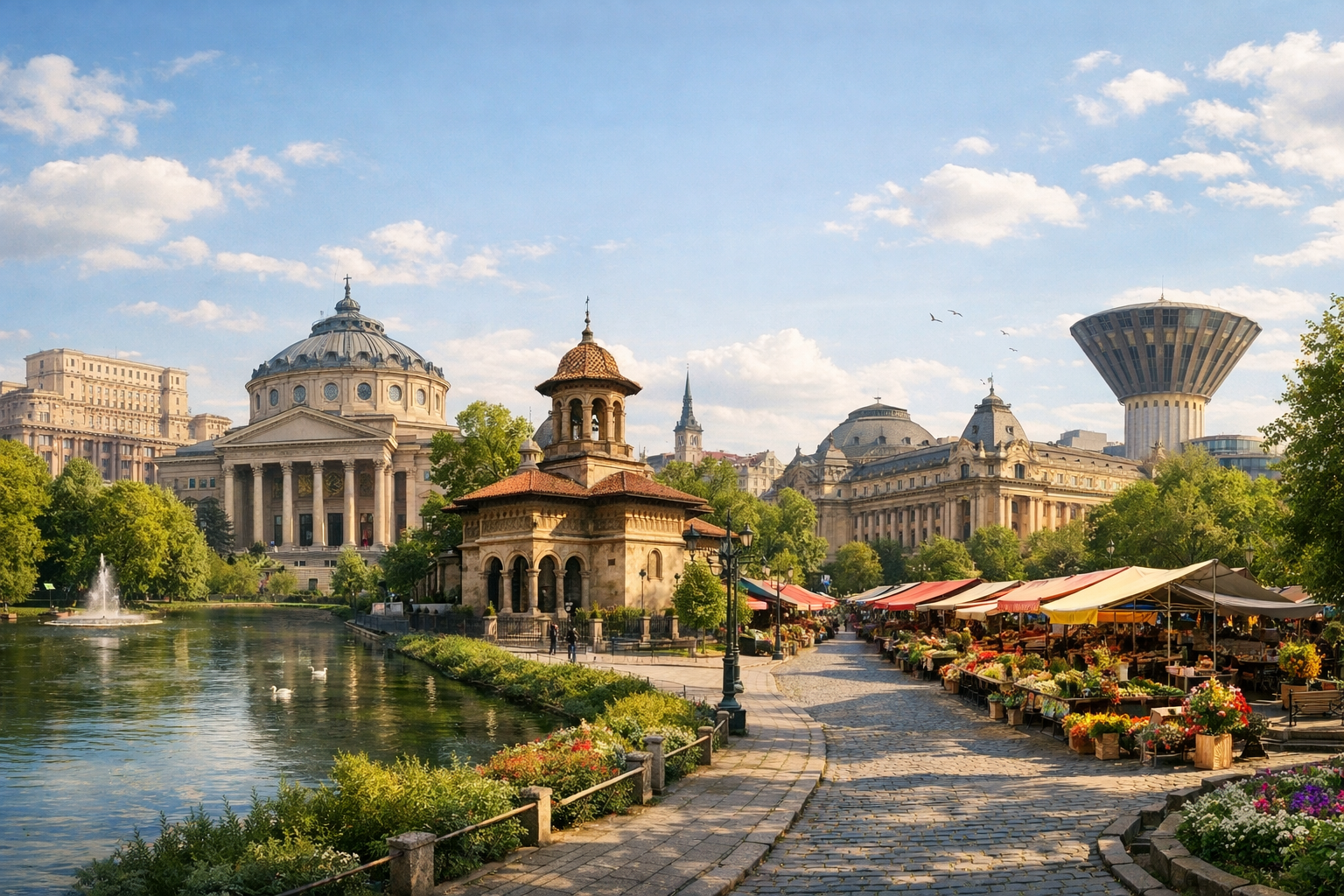
Discover Bucharest on a budget, where the lively Old Town opens into grand boulevards, leafy parks, and atmospheric markets. From Calea Victoriei to eclectic museums and the city’s striking mix of Belle Époque facades and bold communist-era landmarks, Romania’s capital is full of character from April to October.

🧭 ITINERARY BY DAY

Ready-made country and city routes with daily plans, sights, transport and accommodation. Buy PDF guides for independent travel.

🧭 ITINERARY BY DAY


Day 1 — Old Bucharest: Lipscani, Stavropoleos, passages

  • 🚶 Start your introduction to Bucharest in the historic center — the Lipscani district, often called the heart of the old merchant capital. Here, among narrow streets, stone facades, wrought-iron balconies, and a string of cafés, you can still read the layout of the old city that grew around merchants’ houses, inns, and workshops. In the first half of the day, it’s best to walk slowly and without rushing: the route is short in distance but packed with impressions. Be sure to stop by the Stavropoleos monastery church — one of the city’s most elegant religious monuments, a small architectural masterpiece with carved stone, arches, and a quiet inner courtyard that sharply contrasts with the noise of the nearby streets. Nearby, the National Museum of Romanian History and the old passages pair well with the walk, where the city reveals itself not as a “ceremonial” capital, but as a layered Balkan-French metropolis.

  • 🚶 One special pleasure of the day is walking through Pasajul Macca-Vilacrosse, one of Bucharest’s most atmospheric passages. Its yellowish glass roof, soft golden light, and almost theatrical perspective make the space feel at times like a small Parisian passage, at times like a film set from old Europe. Then it’s worth heading to Cărturești Carusel on Lipscani Street — the famous bookstore in a restored 19th-century building. Even if you don’t buy any books, it works perfectly as a rest stop: white galleries, a light well, staircases, and neat balconies turn an ordinary visit into a full architectural episode. Save for the evening a slow walk through the illuminated streets of the center and an inexpensive dinner away from the most touristy terraces: it is after sunset that Bucharest shows especially well its slightly decadent yet very lively atmosphere.

  • ☕ Pace of the day: 6–8 km on foot with frequent stops; a hotel in the Old Town area or on Calea Victoriei will let you reach all points without extra transport expenses. Set aside 2–3 hours total for the museum and church, and at least 1–1.5 hours for lunch and rest.


Day 2 — Calea Victoriei, Romanian Athenaeum, Revolution Square, Cișmigiu

  • 🚶 Dedicate the second day to Bucharest at its most grand and capital-like. Start with Calea Victoriei — not just a long city boulevard, but a true axis of urban memory, where belle époque, neoclassicism, interwar modernism, palaces, former banks, hotels, and cultural institutions come together in a single walk. It is especially pleasant here in the morning or closer to evening, when the facades are not so overheated by the sun. The main architectural star of the route is the Romanian Athenaeum, one of the capital’s symbols: its round volume, columned portico, and dome make it an almost perfect example of representative urban architecture from the late 19th century. Even if you are not attending a concert, it is worth approaching the building for the sake of the square itself, its proportions, and the overall ensemble.

  • 🏛️ Next, it makes sense to continue to Revolution Square and the National Museum of Art of Romania, housed in the former Royal Palace. This is one of the best points on the route to feel Bucharest’s contrasts: monarchical representation, traces of the turbulent 20th century, and a serious art collection are literally within a single block. If you go inside, set aside at least 2 hours for the museum, because this is not a “tick-the-box” stop, but a place where Romanian visual culture unfolds — from medieval icon painting to modern art. After the museum, it is a good idea to take a long break in the Cișmigiu gardens — the city’s oldest public park. It is a gentle, green respite after urban architecture: alleys, water, shaded areas, old trees, and the feeling that the capital has suddenly become much calmer.

  • 🌆 The evening can end back on Calea Victoriei: the beauty of this boulevard is that it does not require a rigid script. You can simply walk, look at the buildings, notice decorative details, bay windows, balconies, entrances, and traces of different eras. For a budget trip, this is an ideal day: the main impressions come from the walking route, the park, and one or two museum stops, while transfers within the center are either unnecessary or take only a few minutes by metro or bus.

Day 3 — North of the city: Arcul de Triumf, Herăstrău Park, Village Museum, market, and unusual neighborhoods

  • 🚇 In the morning, head to the northern part of Bucharest: it is easiest to get here by metro with a short bus transfer or by surface transport, depending on where you are based. This day shows the capital in a completely different way — more spacious, greener, and more representative. Start with Arcul de Triumf, the Romanian version of the triumphal arch, then continue to the huge King Mihai I Park, which many people still habitually call Herăstrău. This is one of the city’s best places for calm urban relaxation in the April–October season: water, long paths, terraces, shade, and the feeling that the metropolis has stepped slightly back. On a hot day, it is especially sensible to take a long lunch or coffee break here.

  • 🏡 The main cultural stop of the day is the Dimitrie Gusti National Village Museum. For a short trip, this is one of Bucharest’s most successful museums: instead of a tiring corridor-style visit, here you get a walk through open space where traditional houses, churches, farm buildings, and details of rural architecture from different regions of Romania are gathered. The place is very photogenic, but its value is not only in the pictures: the museum helps you understand just how diverse the country is in materials, roof shapes, ornament, and everyday culture. It makes sense to allocate 2–3 hours for the visit without rushing.

  • 🛍️ In the second half of the day, you can add an inexpensive everyday touch — a local market or shopping area outside the tourist postcard. If you want to keep a balance between route and rest, return to the center via Piața Victoriei and the Dorobanți or Cotroceni district, where it is pleasant simply to look at interwar villas, quiet streets, and unobvious metropolitan elegance. This is a great day for lovers of unusual architecture: Bucharest is often called a city of contrasts, and it is here that you can see especially clearly how monumental state buildings, green public spaces, modernist quarters, and quiet streets with early-20th-century houses coexist side by side.

Day 4 — Palace of Parliament, Cotroceni / Peasant Museum, final urban note

  • 🏛️ Start the last day with one of the city’s most controversial and impressive sights — the Palace of Parliament. It is impossible to judge this gigantic building by photographs alone: its scale, the heaviness of its volumes, and its almost unbelievable monumentality make a strong impression even on those who are usually indifferent to giant state megastructures. It is important to remember one practical detail: an original physical identity document is required for entry, and tickets for standard visits are purchased on site; individual visitors usually need advance booking by phone. For the visit itself, together with security control and waiting time, set aside at least 1.5–2 hours.

  • 🚶 After this architectural giant, it is very pleasant to change scale and go to a more human, calmer district — Cotroceni, if you want a walk among green streets and beautiful houses, or to the National Museum of the Romanian Peasant, if you want one more strong cultural accent. Cotroceni is good precisely as an urban texture: here you do not need to race “at a gallop” between points, because the very atmosphere of the district does the work — gardens, mansions, silence, walls covered with vines, an интеллигентный rhythm.

  • 🌇 It is best to make the finale of the route light and beautiful: return to the center, have an early dinner, walk once more along Calea Victoriei or the edge of the Old Town, and give yourself time for a farewell Bucharest without mandatory stops. It is often at this moment that the city is liked most of all: when the main sights have already been seen, and all that remains is the simple pleasure of facades, streets, light, balconies, squares, and the unexpectedly cozy multilayered capital atmosphere.

Flight tickets

eSIM for travel

Buy PDF guide

Buy PDF guide — 8.57 USD

PDF — 8.57 USD