
Buy PDF guide

Buy PDF guide — 10.71 USD

PDF — 10.71 USD

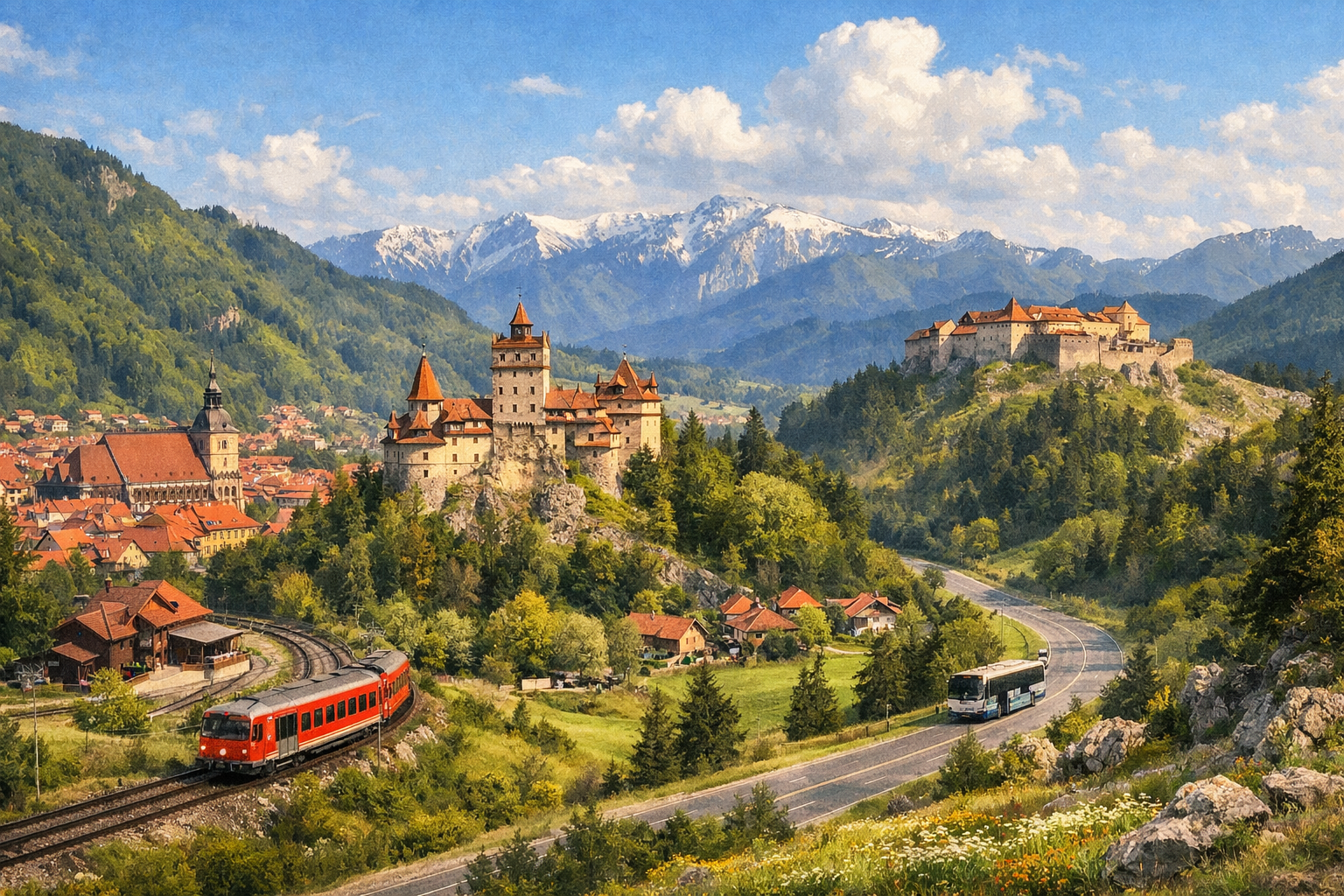
Romania, Brașov and the castles of Transylvania. An inexpensive trip around Brașov, Bran Castle, Râșnov Fortress, and the mountainous surroundings with travel by trains and buses. Season: May–October.

Romania, Brașov and the castles of Transylvania. An inexpensive trip around Brașov, Bran Castle, Râșnov Fortress, and the mountainous surroundings with travel by trains and buses. Season: May–October.

Discover Transylvania on a budget with Brașov as your base, where medieval streets, mountain views, and easy train and bus links make exploring simple. From the legend-soaked towers of Bran Castle to the hilltop walls of Râșnov Fortress and the forested slopes of Poiana Brașov, this is a scenic escape best enjoyed from May to October.

🧭 DAY-BY-DAY ROUTE

Ready-made country and city routes with daily plans, sights, transport and accommodation. Buy PDF guides for independent travel.

🧭 DAY-BY-DAY ROUTE


Day 1 — Brașov: Old Town, the Black Church, and atmospheric streets

  • 🚶 Brașov is one of the most beautiful and convenient cities in Romania for independent travel: compact, surrounded by mountains, with a striking medieval center, cobbled streets, towers, gates, and cozy squares where the Saxon heritage of Transylvania can be felt in almost every facade. Begin your introduction at Piața Sfatului — the old Council Square, which for centuries was the commercial and social heart of the city. It’s pleasant not to rush here: admire the colorful arcaded houses, lift your gaze to Mount Tâmpa, catch the rhythm of the unhurried center, and gradually sink into the atmosphere of old Kronstadt, as Brașov was called in the Saxon era.

  • ⛪ The main highlight of the day is the Black Church, the most recognizable symbol of Brașov and one of Romania’s most important Gothic monuments. Its austere silhouette, mass of stone, and elongated forms make a strong impression even from the outside, while inside you especially feel the blend of spiritual history, urban memory, and northern restraint. The church is associated not only with architecture, but also with organ tradition, antique carpets, and that rare feeling when a space does not try to please you, but simply exists through the centuries — and fascinates all the more because of it.

  • 🚶 After the church, walk through Curtea Johannes Honterus, then stop by Strada Sforii — the famous Rope Street, one of the narrowest streets in Eastern Europe — and continue your stroll toward Catherine’s Gate and the Șchei district. It is here that the transition from the mercantile Saxon town to the older and quieter quarters at the foot of the mountains is especially visible. In the evening, it’s convenient to return to the center, have an inexpensive dinner in one of the local taverns or bistros, and go to bed early: from the second day onward, trips to the region’s main castles and fortresses begin.

  • 🕒 Logistics for the day: if you arrive by train, it is usually convenient to get from Gara Brașov to the historic center by city bus or taxi in 15–25 minutes depending on traffic. If you fly into Brașov-Ghimbav airport, you can reach the city by A1 express bus; for the first day, it is wise to plan only the center without overloading yourself with museums, so you can adapt calmly and not spend energy on long transfers.


Day 2 — Bran: Bran Castle and the valley by the Carpathian pass

  • 🚌 In the morning, head from Brașov to Bran. The cheapest and most practical option is a bus/minibus from Autogara 2; the route usually takes about 45–60 minutes, but in high season and on weekends it is worth allowing extra time because of traffic on the road through Râșnov and the tourist flow to the castle. It is better to plan an early departure so you arrive at the entrance close to opening time and go through the exhibition before the crowds of groups.

  • 🏰 Bran Castle is one of those rare cases when a place is both heavily promoted and genuinely impressive. It stands on a rock as if growing out of the pass between Transylvania and Wallachia, and thanks to its silhouette, internal stairways, narrow passages, courtyards, and mountain views, it almost perfectly matches the romantic image of a “Transylvanian castle.” The history here is richer than any tourist myth: it has been a border fortress, a royal residence, and a museum space where medieval stone sits beside the more personal, almost domestic world of Queen Marie.

  • 🚶 Inside, it is worth moving slowly: the castle is not large in area, but it is very expressive vertically and in composition. Spiral staircases, rooms with wooden ceilings, the inner courtyard, and loophole windows create the impression of a labyrinth that keeps changing scale — at times intimate, at times almost theatrical. Even if you are indifferent to the Dracula legend, the place works on its own: through the relief, the light, the texture of the walls, and the way the fortress is built into the landscape.

  • 🌄 After the visit, you can take a leisurely walk around the village of Bran, have lunch at an inexpensive family restaurant, and, if you still have the energy, stroll a little through the surrounding views at the foot of the Carpathians. Then return to Brașov by bus. Also allow about an hour for the trip back, and a bit more if you get caught in the evening traffic. This format lets you avoid changing hotels and keep costs down by using Brașov as a convenient base.

Day 3 — Râșnov: peasant fortress and panoramas of Transylvania

  • 🚆 On the third day, head to Râșnov — a small town between Brașov and Bran that is ideal for an independent day trip. You can get there by train from Brașov or by bus; in both cases the travel time is usually about 20–35 minutes depending on the service and type of transport. This is one of the most convenient outings in the region: a short transfer, a compact historic area, and a very striking fortress on a hill.

  • 🏯 Râșnov Fortress is one of the most atmospheric defensive citadels in Transylvania. Unlike the more “palatial” Bran, here you feel much more strongly that this was a community shelter: not a luxurious residence, but a fortified refuge for the residents of the surrounding villages. The climb to the fortress already works as a prologue in itself: as you gain height, the town’s roofs, waves of forest, and mountain line open up, while the citadel itself seems austere, low-slung, and very truthful in its defensive logic.

  • 🚶 At the top, it is especially pleasant to linger longer for the views. Râșnov is appealing not so much for museum richness as for its combination of landscape and historical form: bastions, walls, internal spaces, and the view over Bârsa literally explain why such fortresses were vital. Here it is good to imagine not legends, but the everyday history of a border region — anxious, laborious, mountainous.

  • 🦕 If you are traveling with children or simply want an easier second half of the day, Dino Parc Râșnov on Cetății Street is nearby — a large open-air theme park. But even without it, the day will be full: after the fortress, you can have a calm lunch below and return to Brașov by early evening. It is a good day for a more relaxed pace after Bran Castle and before mountain walks.

Day 4 — Poiana Brașov and the mountain surroundings: forest, viewpoints, and Carpathian air

  • 🚌 Dedicate the fourth day to the mountains, but without exhausting alpine climbing. From Brașov, it is easy to go to Poiana Brașov by city bus: the journey usually takes about 30–40 minutes depending on the season, route, and passenger load. This is not only a winter resort, but a year-round mountain base for walks, short treks, and unhurried relaxation among spruce-covered slopes.

  • 🌲 Compared with the medieval center of Brașov, Poiana Brașov feels like a change of scenery: instead of tiled roofs — forest air, the slopes of Postăvaru, chalet hotels, trails, and a rare sense, for a popular destination, of closeness to real mountain nature. In the warm season, it is convenient to take short walks along marked routes, photograph panoramas, and simply pause for long moments with a view of the conifer-covered slopes.

  • 🥾 For a budget trip, the best format is a light trek without rushing, with water, snacks, and strict respect for the trail markings. In the Carpathians, you should not take “shortcuts” through the forest: the weather and terrain can change quickly, and the local fauna requires respect and distance. If you do not want to walk far, you can choose a stroll through the resort area and viewpoint sections, and spend the remaining time in a café with a mountain view.

  • 🚡 If the resort’s cable infrastructure is operating on the day of your visit, you may consider an ascent as an additional option, but in a low-budget itinerary it is not essential. The main value of this day is not the attraction, but the contrast between the city and the Carpathians. In the evening, return to Brașov and leave yourself a calm final evening in the old center: one more walk across the illuminated square often becomes one of the warmest memories of the whole route.

Day 5 — Brașov: the Șchei district, the First Romanian School, and final views over the city

  • 🚶 It is best to spend the last day without long transfers, so you are not dependent on schedules and can pack calmly before departure. Head to the Șchei district — the old part of Brașov beyond the former Saxon walls. Here the city becomes quieter, deeper, and less “postcard-like”: church courtyards, old houses, street climbs and descents, a sense of local everyday life, and historical layering reveal a different side of Brașov.

  • 🏛️ The main point of the day is the “First Romanian School” Museum, a place where the cultural history of the region is felt especially vividly. This is not a huge monster museum, but a space with character, where the themes of education, printing, church tradition, and Romanian written culture are presented in an almost intimate way. After the more spectacular fortresses and castles, such an ending works wonderfully: the journey seems to shift from outward effect to inner substance.

  • ⛪ Nearby is Saint Nicholas Church, and the walk itself through Piața Unirii and the adjacent streets gives you the chance to feel once again how Brașov is connected not only with German medieval heritage, but also with the Romanian history of southern Transylvania. If you still have time and energy, you can climb to one of the viewpoints or walk along the old city walls and towers to end the route beautifully.

  • 🕒 Final logistics: on departure day, it is convenient to leave at least 2–3 hours for the journey to the station or airport, especially if you are taking a bus toward Brașov-Ghimbav airport or planning a transfer to a train. This fifth day is not overloaded, but it leaves a sense of completeness: you have time to see Brașov not only as a base for excursions, but also as an independent cultural center of Transylvania.

Flight tickets

eSIM for travel

Buy PDF guide

Buy PDF guide — 10.71 USD

PDF — 10.71 USD