
Buy PDF guide

Buy PDF guide — 4.28 USD

PDF — 4.28 USD

Rotorua - Zorbing, mountain biking and geothermal routes

Rotorua - Zorbing, mountain biking and geothermal routes

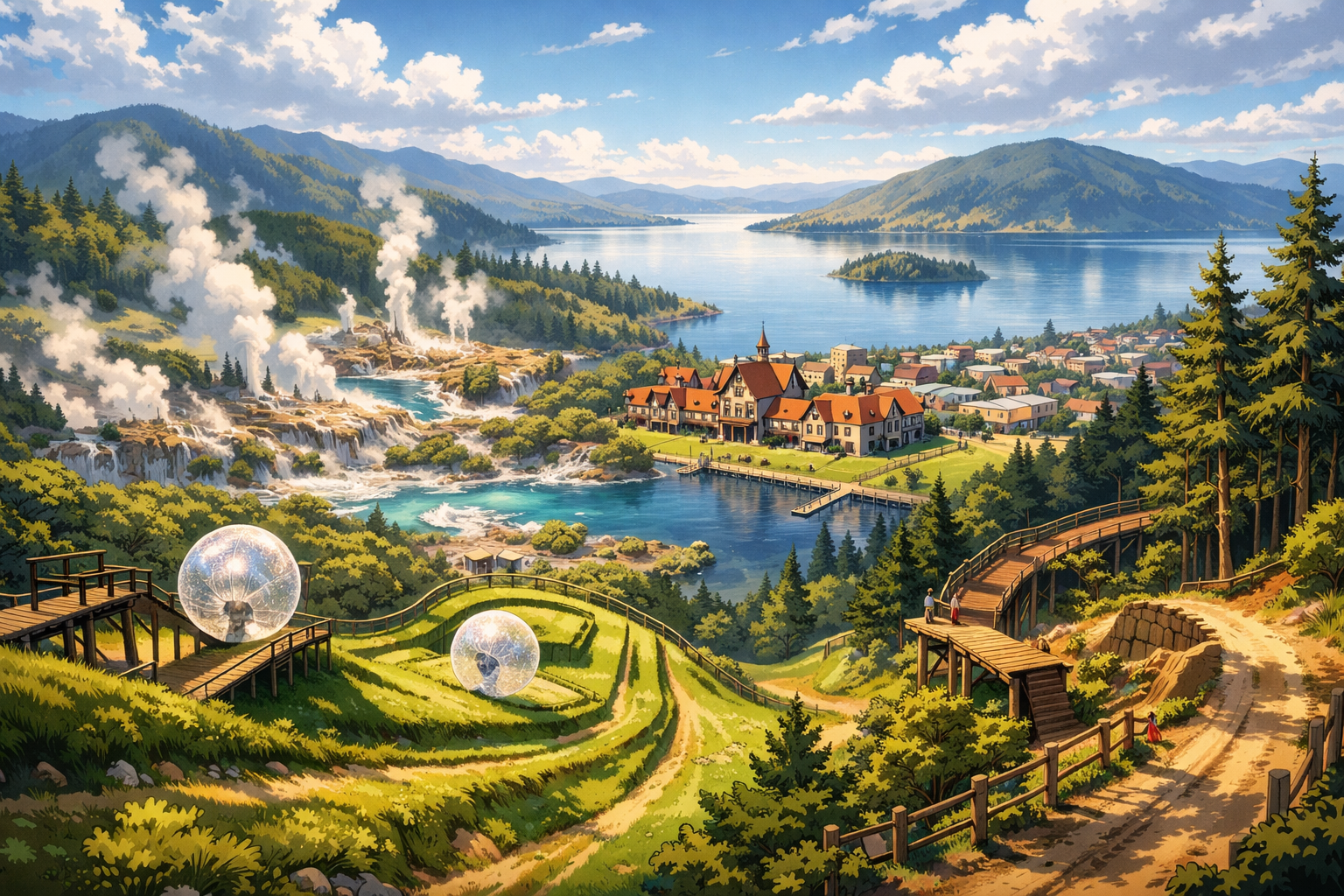
Rotorua is where adrenaline and nature meet, from hurtling downhill in a giant zorb to carving through world-class mountain bike trails. Between the thrills, geothermal routes reveal steaming landscapes, bubbling mud pools, and the raw energy that makes this place unforgettable.

🧭 DAY-BY-DAY ITINERARY

Ready-made country and city routes with daily plans, sights, transport and accommodation. Buy PDF guides for independent travel.

🧭 DAY-BY-DAY ITINERARY


Day 1 — Rotorua: zorbing, panoramas and fast descents

  • 🚕 If you arrive at Rotorua Airport, allow about 15–20 minutes by taxi to the central lakefront hotels and 25–30 minutes by transfer to the Ngongotahā area, where Skyline Rotorua and OGO are concentrated. If you take BayBus Route 10 from the airport to the center, the ride usually takes about 15–20 minutes, after which it is more convenient to switch to a taxi for the activities. This setup saves energy: public transport is good for getting into town, but for a packed adventure day, a direct transfer is the better choice.

  • 🥚 OGO Rotorua is one of the most recognizable "calling cards" of Rotorua and a rare attraction that is almost impossible to confuse with anything else. This is the place where you can ride inside a giant sphere down specially designed tracks, experiencing a mix of childlike excitement, disorientation, laughter, and complete surrender of control. Zorbing in Rotorua is not just a short extreme episode, but a very New Zealand experience in spirit: a little crazy, very friendly, and built around pure enjoyment of movement. It is best to plan your visit for the morning, when your body is fresh and there is still a full day of activities ahead. For check-in, briefing, waiting for your turn, and 1–2 descents, it is reasonable to allow around 1.5–2 hours rather than trying to squeeze zorbing into an overly tight slot.

  • 🚕 Transfer: central Rotorua → OGO Rotorua / Ngongotahā area: about 15–20 minutes by taxi in normal traffic.

  • 🚠 After zorbing, it makes sense to head to Skyline Rotorua — the road is short, usually about 8–10 minutes by car from OGO. This lets you avoid wasting time returning to the center and move straight on to the second part of the day. The Skyline complex is located on the slopes of Mount Ngongotahā and combines a scenic gondola ride, forest views, dining terraces, and access to MTB infrastructure. Even if you are coming here mainly for the bike riding, the gondola itself works as a striking prologue: the town, the lake, and the green waves of the landscape quickly unfold beneath you, making it easy to understand why Rotorua is considered one of New Zealand’s main outdoor hubs.

  • 🚵 Skyline Rotorua Mountain Bike Park offers the kind of riding where you do not have to "earn" every descent with a painful climb: the gondola takes you up, and your energy goes into enjoying the trails. The park is known for gondola access to downhill and gravity tracks, so it is especially appealing for those who want to fit several quality descents into a short time. For a first visit, it is best to allow 2–3 hours of actual riding time, including getting the bike, protective gear, suspension setup, and a couple of warm-up runs. If you are at an intermediate level, do not try to cram in too much — in Rotorua, the joy is in riding technically and with a margin, not in heroically exhausting yourself on the very first day.

  • 🍽️ Leave about 60 minutes for lunch and recovery right in the Skyline area or after the descents. This is critical: after zorbing and MTB, the day already becomes genuinely energy-intensive, and without a break for food and water, the impressions start to blur. It is better to build lunch between activity blocks than to push all the way back to the center on the edge of your strength. After lunch, you can take a short walk around the viewpoints and simply let your body exhale.

  • 🌲 Toward evening, it is great to finish the day with a calmer contrast — a walk in the Redwoods / Whakarewarewa Forest area. If the morning and afternoon were full of adrenaline, here Rotorua shows a completely different face: cool forest air, tall California redwoods, soft light between the trunks, and the feeling that the city dissolves into silence. For an unhurried walk along the short forest paths near the visitor centre, 45–60 minutes is enough. It is the perfect way to "gather" the day, clear your head after the attractions, and restore a sense of space.

  • 🚕 Transfer: Skyline Rotorua → Redwoods Visitor Centre: about 12–15 minutes by car; Redwoods → hotel in the center/by the lake: another 10–15 minutes.

  • 💤 It is best to spend the night in central Rotorua or by the Lake Rotorua waterfront. This is more convenient logistically: the next day includes a geothermal block, and from the center it is quick to reach both Whakarewarewa Village and Te Puia. After a day like this, do not plan a late dinner far from the hotel — it is better to choose a calm evening, a hot shower, an early sleep, and proper recovery.


Day 2 — Rotorua: geothermal routes, Māori heritage and a forest finale

  • 🌋 The second day is best started early and devoted to geothermal Rotorua — that very part of the city where the earth literally breathes steam, bubbles, hisses, and reminds you that this region lives on a volcanic foundation. The best order is Whakarewarewa – The Living Māori Village first, followed by Te Puia. This sequence creates a beautiful dramatic arc: first a more "alive" encounter with the village and its natural landscape, then a more large-scale interpretation of geothermal activity, culture, and craftsmanship.

  • 🚕 Transfer: central Rotorua → Whakarewarewa – The Living Māori Village: about 10 minutes by taxi or 10–15 minutes by car.

  • ♨️ Whakarewarewa – The Living Māori Village is not just a tourist stop, but a rare place where the Māori community and the geothermal environment coexist as part of everyday life. Here it is especially clear that thermal phenomena are not a decorative backdrop, but a living force that has shaped daily life, rhythm, cuisine, and ideas about the land for centuries. The self-guided geothermal routes on the Whaka Geothermal Trails are great because they let you move at your own pace: stopping by steaming lakes, hot pools, and areas where the sulfurous air and damp heat make the landscape feel almost prehistoric. It is reasonable to allow 2–2.5 hours for this section, so you can walk without rushing, stop for photos, and truly absorb the atmosphere rather than just "tick off" the route.

  • 🥾 If you want a deeper understanding of the area, you can choose a guided geothermal trail experience and then leave time for an independent section. But even in the self-guided format, it is important not to arrive too late: the last entries to the geothermal trails are limited by the daytime schedule, so the geothermal block is best made the first major point of the day. Bring water, a light windbreaker, and shoes with good grip — the paths are not extreme, but they can be damp in places, and the air is constantly filled with condensation and a mineral smell.

  • 🚕 Transfer: Whakarewarewa Village → Te Puia: about 5–7 minutes by car.

  • 🌫️ Te Puia is a more monumental version of geothermal Rotorua: powerful steam eruptions, the famous geothermal zone, Māori artistic traditions, and the feeling that you are entering one of the region’s main cultural and natural complexes. This place works especially well as the second half of the day, because after the more intimate contact with the landscape in Whakarewarewa, you already begin to read the details: where the earth "breathes" gently and where the force appears almost theatrically. You should allow about 2–3 hours for visiting Te Puia, especially if you want not only to see the main viewpoints but also to take your time with the cultural side of the complex.

  • 🍽️ After the intense geothermal block, take a long break for lunch and rest — about 60–75 minutes. Geothermal routes are tiring not so much because of the distance, but because of the sheer number of sensory impressions: heat, humidity, the smell of minerals, constant stops, and visual richness quickly build up fatigue. It is better to take a proper break than to try to continue the day on autopilot.

  • 🌲 If you still have the energy, finish the trip with one more forest note in Whakarewarewa Forest — not for active MTB this time, but for a beautiful farewell to Rotorua. This can be a short stretch of walking trails near the Redwoods, where tall trunks, ferns, and soft earthen paths create an almost meditative contrast to the morning’s plumes of steam and the hum of geothermal fields. This structure makes the two-day route feel complete: the first day is adrenaline and movement, the second is earth, culture, and a calm natural rhythm.

  • 🚕 Transfer: Te Puia → Redwoods Visitor Centre: about 10 minutes; Redwoods → Rotorua Airport: about 20–25 minutes; Redwoods → lakeside/central hotels: about 10–15 minutes.

  • ✈️ If your flight is in the evening, leave at least 2 hours of buffer before departure, especially if you need to collect luggage from the hotel. If you are staying one more night, end the day with a calm dinner in the center. This 2-day itinerary is well balanced: it includes must-do zorbing, a полноценный mountain biking block and two different views of geothermal Rotorua — natural and cultural.

Flight tickets

eSIM for travel

Buy PDF guide

Buy PDF guide — 4.28 USD

PDF — 4.28 USD