Buy PDF guide

Buy PDF guide — 25.71 USD

PDF — 25.71 USD

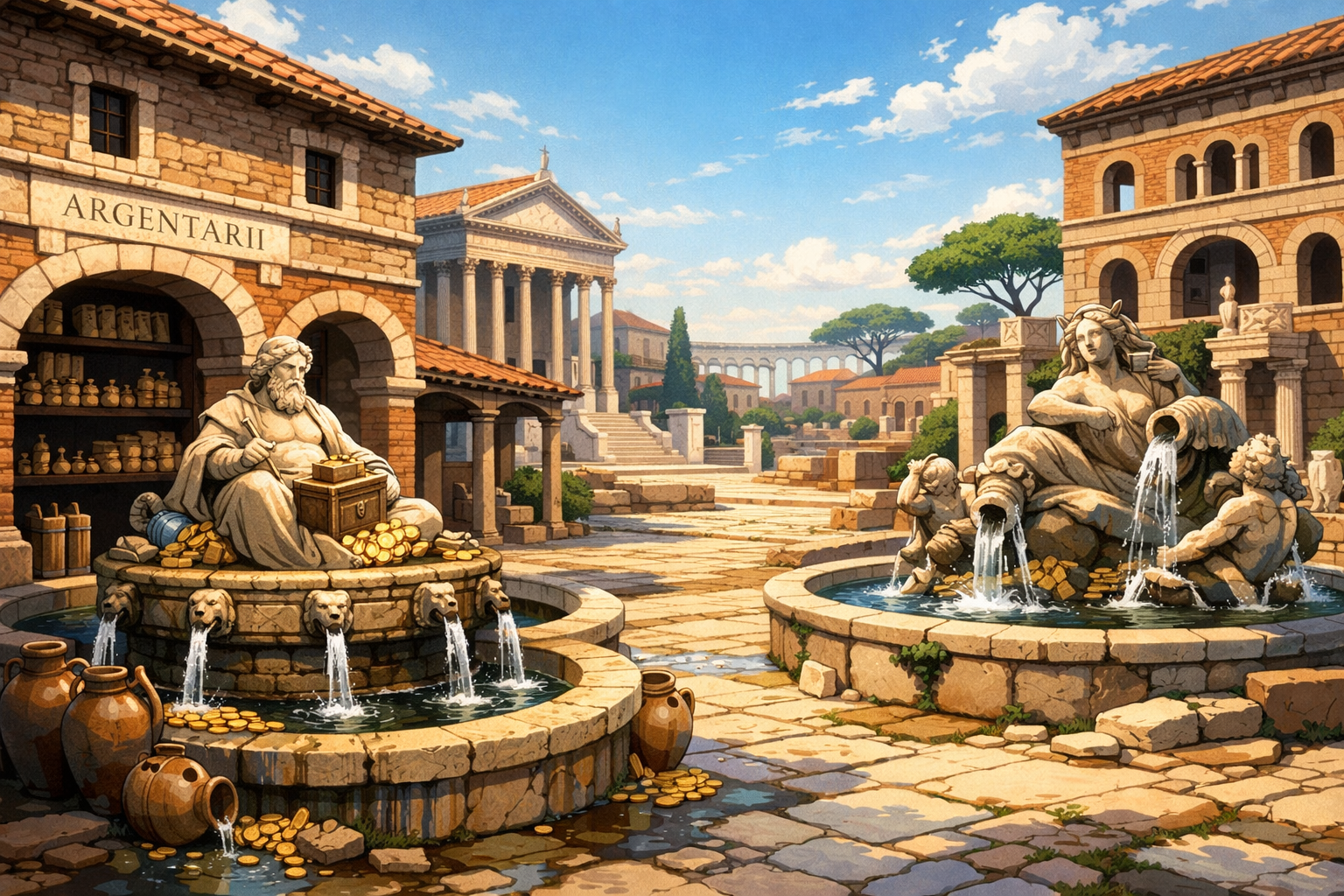
MONEYLENDERS AND FOUNTAINS OF THE ROMAN ERA • OSTIA ANTICA

MONEYLENDERS AND FOUNTAINS OF THE ROMAN ERA • OSTIA ANTICA

Trace Rome’s twin lifelines—commerce and water—from the Aventine and Ostiense to Ostia Antica and the imperial ports of Claudius and Trajan at Fiumicino, then return along the Appia Antica beneath soaring aqueducts. Meet the moneylenders who bankrolled an empire and the fountains that still whisper its story.

🧭 DAY-BY-DAY ITINERARY

Ready-made country and city routes with daily plans, sights, transport and accommodation. Buy PDF guides for independent travel.

🧭 DAY-BY-DAY ITINERARY


Day 1 — Arrival in Rome (Aventine/Ostiense): “tuning” the eye + industrial archaeology

  • ✈️ Transfer from FCO is easiest by Leonardo Express train: ≈32 min to Roma Termini, then metro B (to Piramide) or taxi to the hotel in the Ostiense/Aventine area.

  • 🚶 After check-in — a walk around the Ostiense district: graffiti, the gasometer, and the ruins of old infrastructure create an excellent contrast to the ancient themes ahead. A visit to Centrale Montemartini will show how Rome’s sculpture “sounds” against the backdrop of turbines — a vivid example of dialogue between antiquity and industrial architecture.


Day 2 — Ostia Antica I: the theater, Piazzale delle Corporazioni, and the “port economy”

  • 🚆 Transfer: metro B → Piramide/Porta San Paolo → Metromare line (former Roma–Lido) to Ostia Antica station (≈30–35 min). From the platform to the park entrance — 5–10 minutes via the pedestrian crossing.

  • 🚶 Start with the ancient theater (2nd c.) and the adjacent Piazzale delle Corporazioni: black-and-white mosaics point to the guilds of merchants, shipowners, and carriers. The spatial link “stage → forum of the corporations” reveals the rhythm of the port’s business life, and the layout of the porticoes helps you read an “office quarter” of an ancient logistics hub.

Day 3 — Ostia Antica II: streets, baths, houses, and nymphaea (Roman “urban hydraulics”)

  • 🚶 Walk along the Decumanus Maximus to the Baths of Neptune (mosaics with sea motifs), pop into the House of Diana and the “street of taverns.” Pay attention to the city fountain-nymphaea: the monumental Ninfeo I,XIV,1 at the bend of the Decumanus and the elegant Ninfeo degli Eroti (4th c.) — these are “display façades” of water engineering, combining cult, aesthetics, and a civic function.

Day 4 — Rome: moneylenders and the forum basilicas (antiquity’s financial stage)

  • 🚶 The Roman Forum as a “business center”: by the basilicas (above all the Basilica Aemilia) in the 4th–3rd c. BC there were tabernae argentariae — offices of money-changers and bankers (argentarii). Walk to the Arch of the Moneychangers (Arcus Argentariorum) by San Giorgio al Velabro — a private monument of the corporation, commemorating their contribution to the city.
  • 🏛️ To complement the ruins, drop into Palazzo Massimo (Museo Nazionale Romano): portraits, frescoes, and numismatics create the texture of everyday economics — from coin circulation to the luxury of domus life.

Day 5 — The Ports of Claudius and Trajan: the “gateway of Rome” and imperial logistics

  • 🚌 Travel to the Portus archaeological area (Fiumicino). On site — engineering on a grand scale: Claudius’s rectangular basin and Trajan’s hexagonal harbor with embankments, moles, and warehouse terraces. It is the capital’s “dry port,” where architecture is subordinated to the flows of grain, oil, and wine.

Day 6 — Fiumicino: Museum of Roman Ships + Isola Sacra Necropolis

  • 🚶 In the morning — Museo delle Navi di Fiumicino: five vessels (river and seagoing), hull and rigging technology — a rare chance to “read” ancient shipbuilding in detail.

  • 🚶 After lunch — Necropoli di Porto at Isola Sacra: streets of tombs with workshops and inscriptions show the people of the “port cluster” — from merchants to financial agents (epigraphic traces of coactor/argentarius do occur).

Day 7 — Appia Antica: aqueducts and the Caffarella Valley (Nymphaeum of Egeria)

  • 🚶 Parco degli Acquedotti — an open-air “encyclopedia” of water conduits (Marcia, Tepula, Iulia, Claudia, Anio Novus, etc.). The arcades against the rural landscape help you understand where Rome’s water came from for fountains, baths, and domus.

  • 🚶 In the Caffarella Valley — the Ninfeo di Egeria: a Late Antique “grotto-nymphaeum,” where cult and picturesque architecture meet utilitarian hydraulics. Evening — relax in the park.

Day 8 — Rome: nymphaea on the Esquiline and the Forum museum

  • 🚶 Piazza Vittorio: remains of the gigantic nymphaeum of Alexander Severus (“Trophies of Marius”) — a rare ancient mostra d’acqua within the urban fabric. Then — Mercati di Traiano – Museo dei Fori Imperiali: the urbanism of the imperial forums, commerce, and the representational language of power.

Day 9 — Rome: Musei Capitolini + the Capitoline as the city’s “archive”

  • 🚶 The marbles, bronzes, and epigraphy in the Musei Capitolini reveal the “showcase” of Roman memory: from Marcus Aurelius to administrative inscriptions. The terraces offer panoramas of the Forum — useful for “stitching together” what you saw in the ruins with the museum originals.

Day 10 — Ostia Antica III: “bread and money” (Caseggiato dei Misuratori di Grano and the market district)

  • 🚶 Today’s theme is the supply chain. In the Caseggiato dei Misuratori di Grano — carved measuring units (modius) and the tools of inspectors. Nearby — a possible macellum and fishmongers’ shops; we discuss how trade and credit (argentarii, coactores) underpinned the port’s everyday life.

Day 11 — Lido di Ostia: seaside rest + evening Ostia Antica “in the golden hour”

  • 🌊 A leisurely day on the coast (Lido di Ostia): regain strength before the finale. Toward evening, return to the archaeological park: warm light “draws” the brickwork’s plasticity; mosaics and nymphaea look much more expressive than at noon.

Day 12 — Rome: wrap-up + flight

  • 🚆/✈️ Transfer to FCO (train/taxi) with a time buffer.

  • 🚶 Final loop around the Aventine (Orange Garden, views of the Tiber) — mentally connect the lines of the tour: forums and basilicas (finance), ports (logistics), nymphaea and aqueducts (water), museums (meaning and context).

Flight tickets

eSIM for travel

Buy PDF guide

Buy PDF guide — 25.71 USD

PDF — 25.71 USD