
Buy PDF guide

Buy PDF guide — 8.57 USD

PDF — 8.57 USD

Rhodes - Medieval City, Mandraki Port, fortress, nightlife

Rhodes - Medieval City, Mandraki Port, fortress, nightlife

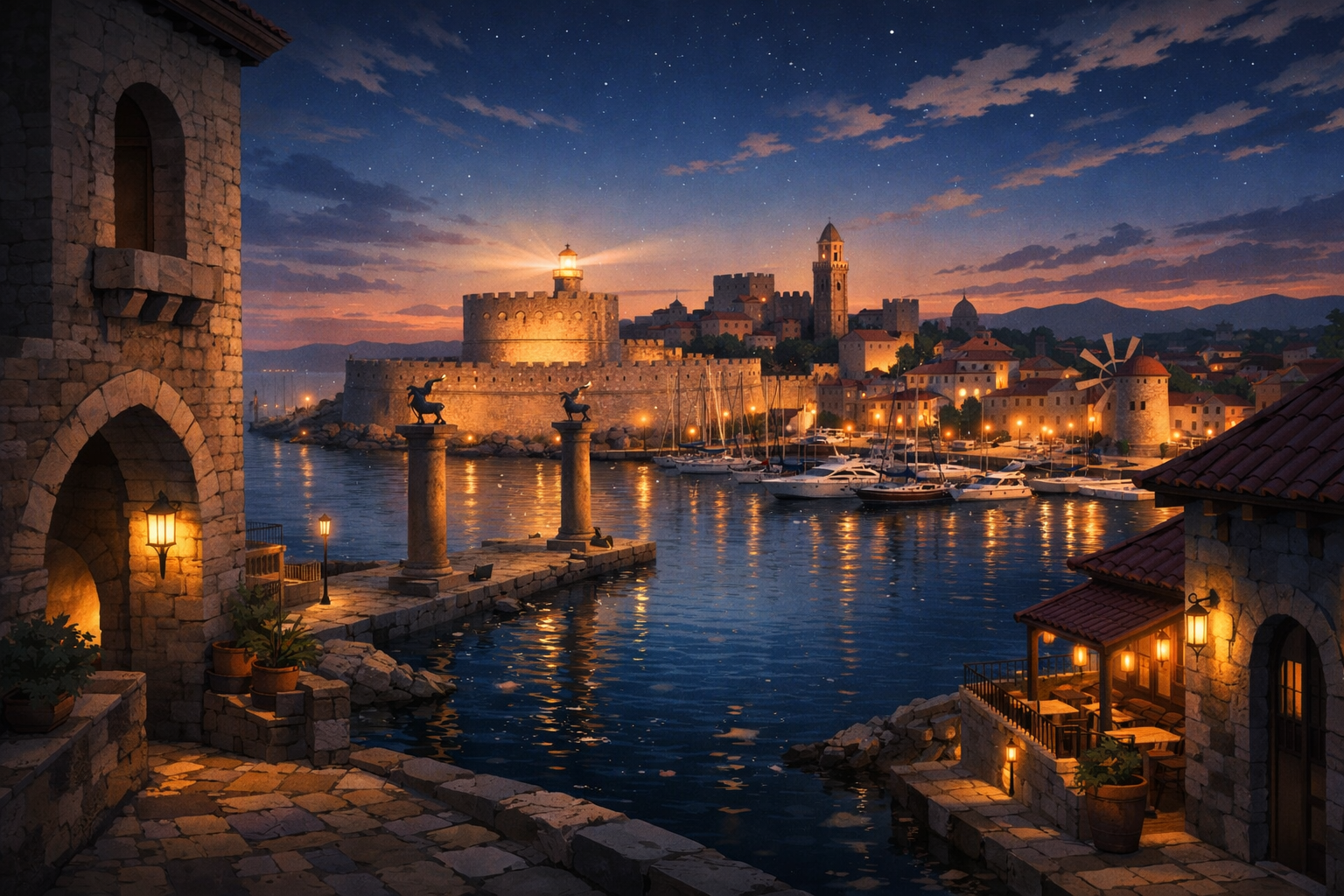
Rhodes blends medieval grandeur with seaside charm, from the stone lanes of the Old Town to the iconic windmills of Mandraki Port. Explore its mighty fortress by day, then slip into the island’s lively evening scene as cafés, bars, and waterfront streets come alive.

🧭 DAY-BY-DAY ITINERARY

Ready-made country and city routes with daily plans, sights, transport and accommodation. Buy PDF guides for independent travel.

🧭 DAY-BY-DAY ITINERARY


Day 1 — Rhodes: arrival, Mandraki, and a first evening by the sea

  • 🚕 After landing at Rhodes International Airport “Diagoras,” allow about 20–30 minutes to get to Rhodes by taxi or private transfer and around 35–50 minutes by RODA bus, depending on traffic and stops. If you choose a hotel in the Old Town, keep one important detail in mind: cars usually do not drive directly to the door inside the medieval lanes, so the last 5–10 minutes are often on foot along stone streets. After check-in, it is better not to overload the first day: leave 1–1.5 hours for rest, a shower, changing, and a calm first walk into town.

  • 🚶 Start getting to know Rhodes at Mandraki Harbor — one of the most cinematic and recognizable parts of the city. Here, sea air, yachts, old forts, elegant Italian architecture, and the feeling that the city lives in several eras at once all come together. A walk along the waterfront is especially beautiful close to sunset: the light softens, the water starts reflecting facades and boat masts, and Mandraki itself turns into an open stage. This is the best place to feel how Rhodes connects ancient legend, Crusader history, and the easy resort mood of the Aegean Sea.

  • 🚶 Be sure to walk to the Fort of Saint Nicholas on the Mandraki mole. It is a compact but very expressive fortress point that guarded the harbor entrance for centuries and still creates that classic “postcard” silhouette of northern Rhodes. On the way, notice the famous deer at the harbor entrance — they have long become a symbol of the city. A round-trip walk from the New Market area to the end of the mole and back, with photo stops, usually takes about 45–60 minutes.

  • 🍽️ It is best to spend the evening without rushing: dinner by the water or on one of the streets between Mandraki and the New Town, then a light walk to the square by the sea and back to the hotel. If you want a gentle start to nightlife, choose an “aperitif + walk” format rather than a long program. Rhodes is wonderful precisely because even the first evening here already feels like a vacation: warm wind, the sound of masts, music from bars, and the illuminated walls of the Old Town.


Day 2 — Rhodes: the Medieval City and the Grand Master’s fortress

  • 🚶 Dedicate the second day entirely to the Medieval City of Rhodes — one of the most impressive and coherent fortified urban ensembles in Europe. It is best to go out early, before the main tourist flow, when the stone streets are not yet overheated by the sun, shutters are only just opening, and the ancient walls feel especially monumental. Here, it is important not just to “tick boxes,” but to walk slowly: the city reveals itself through arches, passages, inner courtyards, coats of arms on facades, and unexpected views of towers and bastions.

  • 🏰 The main point of the day is the Palace of the Grand Masters, the very fortress that sets the scale for the whole medieval panorama of Rhodes. It is not just a beautiful facade, but a symbol of the power of the Knights Hospitaller, a key stronghold, and one of the island’s strongest architectural landmarks. From the outside, the palace gives an impression of stern, almost theatrical military power, while inside the route reveals a more ceremonial side of the place: grand halls, mosaics, thick walls, staircases, and a sense of cold stone majesty. Allow about 1–1.5 hours for the palace itself, and up to 2 hours including the surrounding area and photo stops.

  • 🚶 After the palace, walk along the Street of the Knights — one of the best-preserved medieval streets in Europe and the true backbone of the historic quarter. Here you can almost physically feel the strict logic of the order: facades of former residences, smooth stone, restrained geometry of space, and a historical coherence rare for tourist centers. Then it makes sense to continue to the Archaeological Museum of Rhodes, housed in the former Hospital of the Knights. This combination works especially well: first you see the military and administrative power of the era, and then its cultural and archaeological layer.

  • ☕ Leave 1–1.5 hours for lunch and rest somewhere inside the Old Town, preferably not on the busiest passages. After lunch, it is nice to continue the route through Symi Square, the old gates area, inner courtyards, and, if you still have energy, a walk along the moat and the fortress walls. Even without long museum stops, this day easily fills 7–9 hours at a comfortable pace. In the evening, it is worth returning to the hotel for a short pause and then going out again into the atmosphere of the illuminated Old Town: at night its stone, arches, and lanterns create a completely different, more romantic and cinematic impression.

Day 3 — Rhodes: museums, walls, moat, and evening life

  • 🏛️ Start the morning at a calmer pace: after a history-filled day, it is nice to switch to a museum-and-walking format. The Archaeological Museum works well if you did not visit the day before, or the Museum of Modern Greek Art, with sites near and inside the Medieval City. A day like this makes the itinerary feel fuller: Rhodes is not only a fortress and knights, but also an island with a living cultural scene, marine science, urban memory, and a contemporary artistic layer.

  • 🚶 In the daytime, it is worth giving time to the moat and the outer line of fortifications. The medieval moat of Rhodes is a rare chance to see a defensive system not as a backdrop for photos, but as a large-scale spatial structure. When you walk along the walls, you start to understand much better why this city was considered nearly impregnable for centuries. Here the engineering logic of the fortress is especially tangible: depth, bastion angles, sight lines, the massiveness of the masonry, and the vast defensive perimeter. Allow 1–2 hours for an unhurried walk along accessible sections, with stops and photos.

  • 🌊 Toward evening, you can head to the northern tip of the city — the area near the Aquarium of Rhodes, the waterfront, and the seafront. This is a different Rhodes: more worldly, open, and resort-like. After the dense historical texture of the Old Town, this contrast feels especially pleasant. It is easy to “reset” the route here: sit by the water, have a coffee or a glass of wine, watch the sunset over the sea, and not try to fit in too many points.

  • 🌙 This day is ideal for the required emphasis on evening life. In Rhodes, it is spread between bars and cafés in the Old Town, streets and squares in the New Town, and venues by the sea. The best scenario is to start with an aperitif near the Old Town, then move on to dinner, and after that choose one or two places for cocktails and music. The evening format here is flexible: you can limit yourself to an atmospheric walk among illuminated fortress walls, or head into livelier quarters with bars, late dinners, and the long rhythm of summer. The main thing is not to plan an early start the next morning.

Day 4 — Rhodes: final panorama, free time, and departure

  • 🌅 It is best to make the last day lighter and keep it for a beautiful end to the trip. If your flight time allows, start the morning with a short walk through the Old Town before it wakes up, or return to Mandraki to see the harbor in a completely different atmosphere — without the evening noise, with soft light and the feeling of a slow seaside morning. Usually 45–90 minutes is enough for a repeat visit to your favorite area.

  • 🛍️ Then leave time for a relaxed breakfast and packing, and after that for one final pass through the souvenir shops, craft stores, or wine spots of the Old Town. Rhodes is especially good for “smart souvenirs”: olive oil, local sweets, ceramics, natural cosmetics, spices, and sea and knight-themed items from small workshops. It is important not to delay too much: the stone streets of the Old Town are beautiful, but with luggage they are slower to walk than they seem.

  • 🚕 For the trip from Rhodes to the airport, it is wise to allow extra time: the ride itself usually takes about 20–30 minutes, but in season it is better to leave at least 3 hours before an international flight, especially if you are staying in the Old Town and first need to walk to the pickup point for a taxi or transfer. If you are returning a rental car, add extra time for paperwork and the shuttle/walk to the terminal.

  • ✨ This 4-day itinerary in Rhodes turns out very coherent: you have time to see Mandraki Harbor, experience the Medieval City thoughtfully rather than superficially, feel the fortress character of the island capital, and still leave room for beautiful seaside evenings and a lively nighttime atmosphere. This is not a trip about racing between points, but about the mood of stone, sea, wind, and history.

Flight tickets

eSIM for travel

Buy PDF guide

Buy PDF guide — 8.57 USD

PDF — 8.57 USD