
Buy PDF guide

Buy PDF guide — 25.71 USD

PDF — 25.71 USD

ROME AND THE VATICAN

ROME AND THE VATICAN

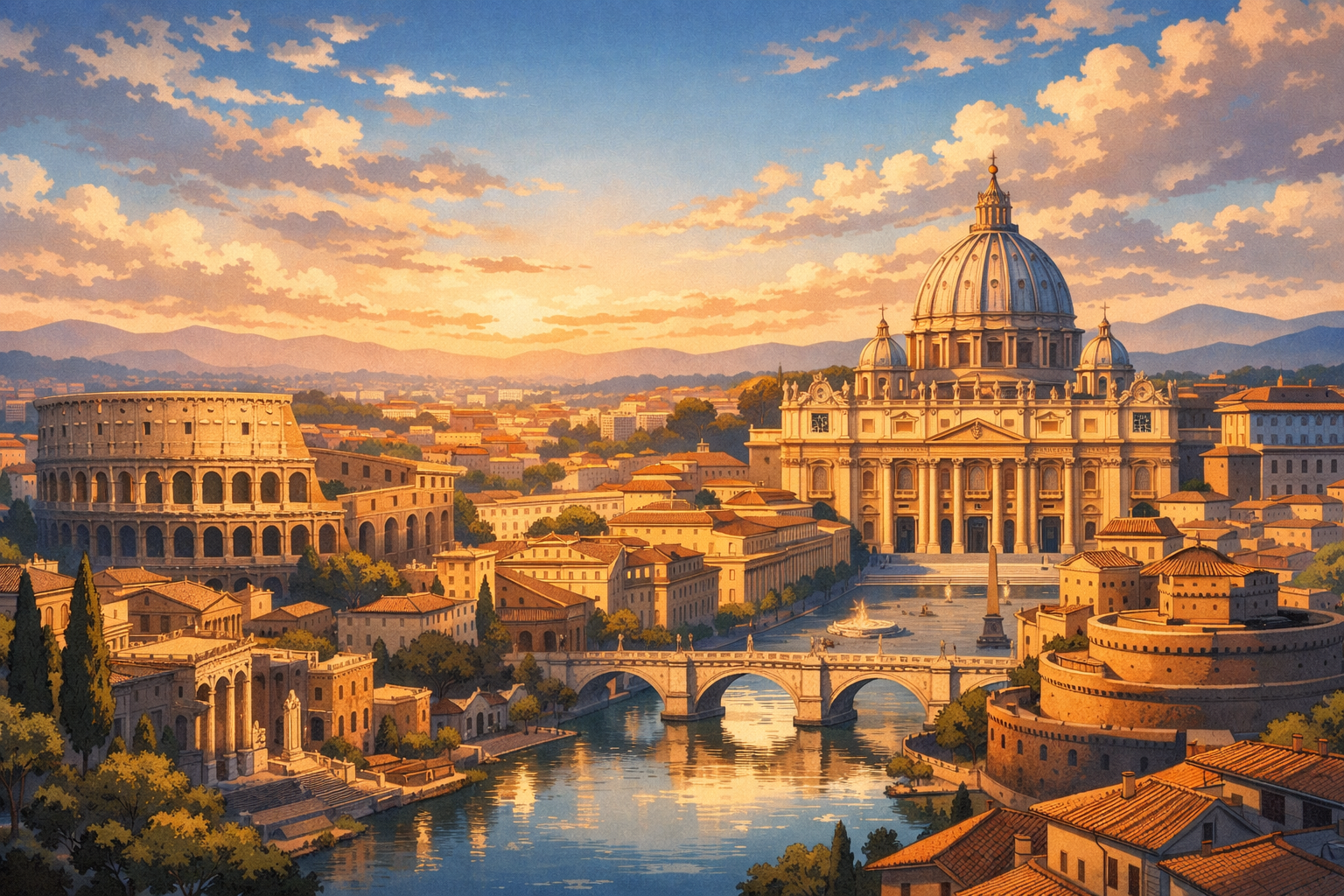
Where ancient empire meets living faith, Rome and Vatican City overflow with art and drama. Stroll from the Colosseum and Baroque piazzas to St. Peter’s Basilica and the Sistine Chapel, then linger over espresso as dusk gilds the stones.

🧭 DAY-BY-DAY ITINERARY

Ready-made country and city routes with daily plans, sights, transport and accommodation. Buy PDF guides for independent travel.

🧭 DAY-BY-DAY ITINERARY


Day 1 — Rome: the Capitoline Hill and “tuning your eye” to antiquity

  • 🚶 Arrival and check-in. Start at Capitoline Square, designed by Michelangelo—here antiquity is literally “fused” with the Renaissance. In the Capitoline Museums, get acquainted with key images of Roman sculpture (Marcus Aurelius, the “Capitoline Wolf,” fragments of colossi). The panorama of the Forum from the terrace is an ideal prologue to tomorrow’s entry into the archaeological park: the street axes, temple podiums, and archways between eras are easy to read.


Day 2 — Colosseum Archaeological Park: Colosseum + Forum + Palatine

  • 🚶 Enter via Parco Archeologico del Colosseo. First—the Colosseum: read it as an “engineering-social machine” (enfilades of arches, radial-ring logic, crowd-flow distribution). Then—the Roman Forum: the Curia, Basilica Julia, the Arches of Titus and Septimius Severus. Finish on the Palatine among the ruins of imperial palaces: here it’s especially clear how the terrain dictates planning and city views.

Day 3 — Imperial Forums and Mercati di Traiano

  • 🚶 Walk along Via dei Fori Imperiali, using the “Museo dei Fori Imperiali — Mercati di Traiano” exhibition as a guide: multi-level blocks with the street Via Biberatica demonstrate urbanism cut into a cliff. Look at masonry techniques, the junctions of supports and vaults, and how commercial and administrative spaces form a “stone quarter” above Trajan’s Forum.

Day 4 — Vatican: Museums and the “classical antiquity halls”

  • 🚶 The Vatican Museums concentrate iconic ancient masterpieces—“Laocoön,” the “Apollo Belvedere,” the Rotunda with sarcophagi. Follow the route early in the morning: it’s easier to feel the proportions, the color of ancient marbles, and how these collections established the canon of European “antiquity.” Finale—the Sistine Chapel: not antiquity, but the culmination of the dialogue with it.

Day 5 — Vatican: St. Peter’s Basilica and Bernini’s square

  • 🚶 Read the square as a “theatrical city mise-en-scène”: the embracing colonnades, the axial perspective, the obelisk. In the basilica—an overlap of ancient scale and the Renaissance idea of a center beneath the dome. Climb the dome (time: about 1–1.5 hours including the queue and ascent): from above you can see the geometry of the city’s layers, where ancient Rome forms the foundational outlines.

Day 6 — Museo Nazionale Romano: Palazzo Massimo + Baths of Diocletian

  • 🚶 Morning—Palazzo Massimo: masterful frescoes (Villa of Livia), portraits and numismatics—the “core material” for understanding the décor and ideology of the Roman home and public spaces. Day—Baths of Diocletian: scale, hydraulic engineering, typology of halls; pay attention to the metrics of the spans and Roman “structural rationalism.”

Day 7 — Appian Way: mausoleums, fortresses, and aqueducts

  • 🚶 The Appian Way is an open-air museum. Route: Mausoleum of Cecilia Metella and Castrum Caetani → sections of the ancient paved road → “Parco degli Acquedotti” (remains of Aqua Marcia/Claudia/Anio Novus). Here nature is a co-author of architecture: aqueduct arcades “draw” the horizon and explain the water infrastructure of the ancient мегаполис.

Day 8 — Ostia Antica: a Roman city by the sea

  • 🚆/🚶 Take the Metromare commuter train (formerly Roma–Lido) to Ostia Antica station, then walk 10–15 minutes. On site—a complete city: decumanus and cardo, warehouses (edges of arches and niches), baths with mosaics, insulae, and a theater with vistas over the port landscape. An ideal day for “reading” the plan and everyday life of Romans without the crowds.

Day 9 — Augustan Rome: the Ara Pacis Museum and the embankments

  • 🚶 Ara Pacis Museum: a marble “political poem” of the Augustan age. Analyze the frieze as a narrative of power and memory; then step out to the Mausoleum of Augustus and the embankments—notice the urban-planning axes from antiquity to the modernism of 20th-century Rome.

Day 10 — Baths of Caracalla + Aventine Hill

  • 🚶 The Baths of Caracalla are the pinnacle of the imperial bath type: grand volumes, a sequence of hot/warm/cold halls, and the skeletons of vaults. By evening—walk on the Aventine (quiet views of the Forum and Circus Maximus): read the silhouettes to “fix” the logic of the ancient landscape.

Day 11 — Tivoli: Hadrian’s Villa

  • 🚌/🚆 Travel from Rome to Tivoli (FL2 from Tiburtina ≈ 45–60 min or Cotral from Ponte Mammolo ≈ 50–60 min). At Hadrian’s Villa—an ensemble of pavilions, baths, and water mirrors (Canopus, Maritime Theater), where the emperor “reassembled” favorite places of the Empire into a single spatial score. Look at the junctions of porticoes and water, the rhythm of colonnades, and the walking scenarios.

Day 12 — Rome: buffer day and “final assembly”

  • 🚶 Return to your favorite spot (Forums/Capitoline/Palatine) or finish remaining details (Palazzo Altemps/Vatican Museums galleries). Sunset—at viewpoints by the Capitoline/Monte Oppio. Sum it up: how ancient engineering, cult, and urban planning shaped the city’s “eternity.”

Flight tickets

eSIM for travel

Buy PDF guide

Buy PDF guide — 25.71 USD

PDF — 25.71 USD