
Buy PDF guide

Buy PDF guide — 8.57 USD

PDF — 8.57 USD

RHINELAND-PALATINATE - Moselle: Cochem, Trier and wine villages

RHINELAND-PALATINATE - Moselle: Cochem, Trier and wine villages

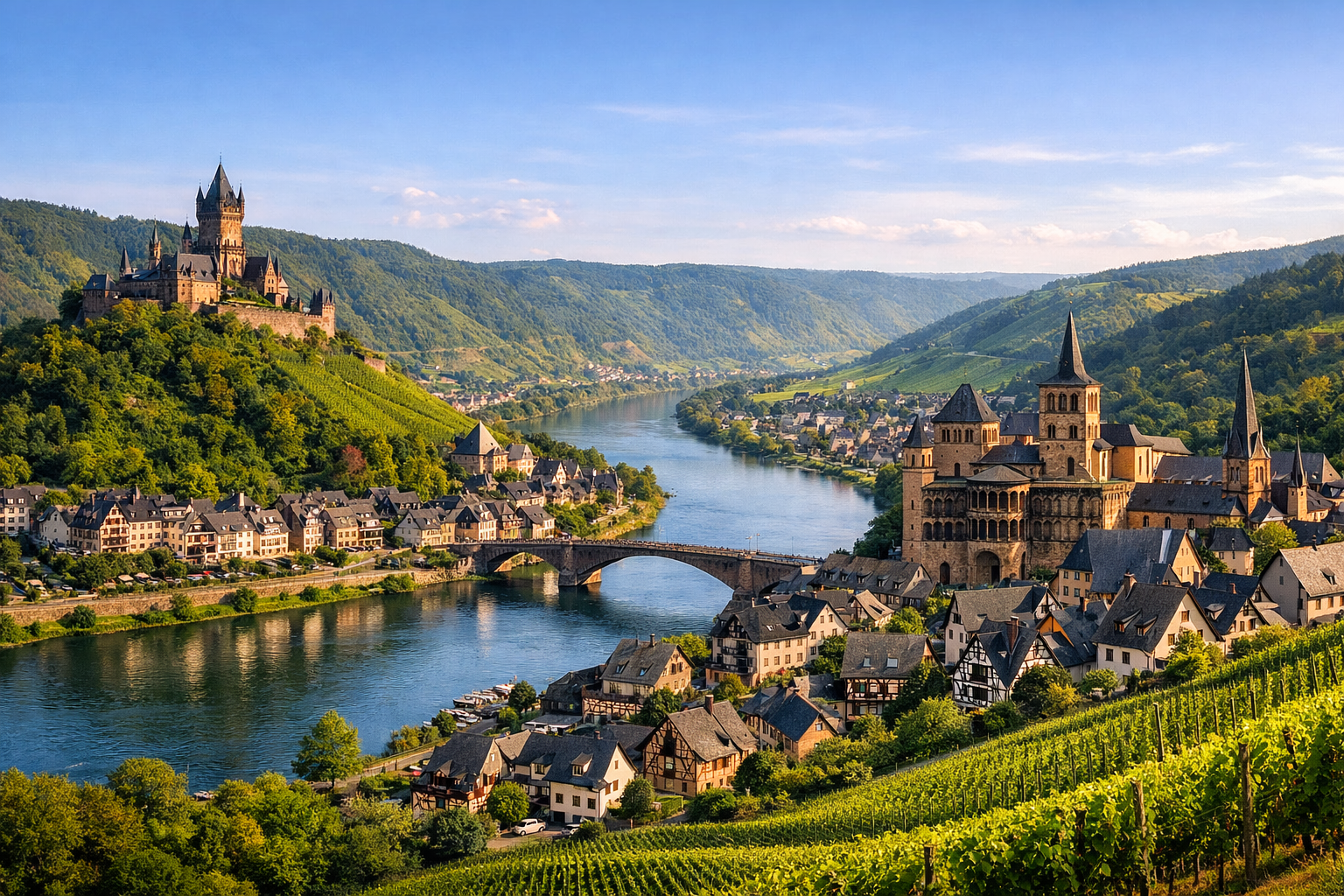
Drift along the Moselle from the fairytale hilltop castle of Cochem to ancient Trier, where Roman history meets lively streets and riverside charm. Along the way, Bernkastel-Kues and the surrounding wine villages invite you in with steep vineyard views, half-timbered houses, and some of Germany’s most atmospheric tastings.

🧭 DAY-BY-DAY ROUTE

Ready-made country and city routes with daily plans, sights, transport and accommodation. Buy PDF guides for independent travel.

🧭 DAY-BY-DAY ROUTE


Day 1 — Cochem: old town, the Moselle promenade and Reichsburg

  • 🚆 Arrival in Cochem. If traveling by rail along the Moselle line, the trip from Trier to Cochem usually takes about 50–60 minutes, and from the station to the town center you can walk in 10–15 minutes. After check-in, it’s best not to overload the day: Cochem is at its best in a slow rhythm, when first impressions are made up of vineyard slopes, church bells, river reflections, and the silhouette of the castle above the town.

  • 🚶 Cochem is one of the most photogenic spots in the entire Moselle Valley, a small town with an almost theatrical beauty: narrow streets, half-timbered facades, wine taverns, towers, a bridge over the river, and the famous Reichsburg Castle, which quite literally reigns over the landscape. This is not a severe and austere medieval center, but rather a romantic version of Rhineland-Palatinate, where every turn seems designed for a postcard. The first walk is especially enjoyable without any rush: stroll through the market square, peek into the lanes of the old town, head to the promenade, and simply watch the riverboats glide beneath the green vineyard terraces.

  • 🚶 The main highlight of the day is Reichsburg Cochem, the castle on top of the hill, for which you should plan not only sightseeing time but also enough energy for the climb. On foot from the center, it usually takes about 15–30 minutes uphill depending on your pace, or in season you can use the shuttle. The castle looks as if it grew out of a romantic legend: battlemented towers, stone walls, panoramic views of the bends of the Moselle and the rooftops of Cochem. Inside, the atmosphere feels less like a dry museum and more like a living historical set — knightly halls, hunting motifs, carved details, heavy furniture, and the sense that the valley lies at your feet.

  • 🍷 In the evening, it’s ideal to leave room for a calm Moselle ritual: a glass of Riesling on the promenade or in a wine stuben. This part of Germany is famous for its mineral, fresh, highly expressive wines, and it is here that it becomes easy to understand why vineyards on steep slopes are considered not just agriculture, but part of the cultural landscape. It’s best to spend the night in Cochem, so there’s no need to hurry on and you can greet the morning among river mist and castle outlines.


Day 2 — Trier: Roman heritage, Porta Nigra and the old center

  • 🚆 Transfer: Cochem → Trier by regional train along the Moselle — usually about 50–60 minutes. This is one of those journeys where you won’t want to sit on your phone: outside the window, vineyard slopes, small stations, villages, and the calm river landscape pass by. Upon arrival in Trier, it’s convenient to leave your bags at the hotel and explore the day on foot, because the historic center is compact.

  • 🚶 Trier has a completely different character from Cochem. If Cochem charms with the romance of a small wine town, Trier impresses with the weight of history: it is Germany’s oldest city, and here the Roman past is felt not as an abstract guidebook note, but as the city’s real architectural framework. It’s easy to spend a day here moving from ancient monuments to squares, cathedrals, and cozy modern streets with cafés, as if traveling between two millennia with hardly any effort.

  • 🚶 Start with Porta Nigra — Trier’s most recognizable symbol and one of the most impressive Roman monuments north of the Alps. The massive dark stone blocks, powerful arches, and unusual state of preservation make a strong impression even on those who are usually indifferent to antiquity. From here, it’s easy to continue your walk to Hauptmarkt, then to St. Peter’s Cathedral and Liebfrauenkirche, where ancient and medieval heritage intertwine into a single whole. Trier’s center does not require rushing: it’s better to walk slowly, step into courtyards, stop for coffee, and let the city reveal its scale gradually.

  • 🏛️ If you still have energy, add one museum visit to the day — for example, Rheinisches Landesmuseum Trier or Karl-Marx-Haus. The first is especially good for understanding Roman Trier and the full archaeological power of the region; the second is for those interested in Europe’s intellectual history. In the evening, Trier becomes softer and more intimate: the tourist flow thins out, the light on the squares grows warmer, and the city turns from an “open-air museum” into a very lively and pleasant place for dinner and an overnight stay.

Day 3 — Bernkastel-Kues: half-timbering, wine and the mood of the Middle Moselle

  • 🚌 Transfer: Trier → Bernkastel-Kues. The town has no direct rail connection, so the most realistic option is a VRT bus or a combination of train + bus. It’s wise to allow about 1 hr 20 min – 1 hr 45 min for the trip depending on the specific service and connections. After Trier, the route changes mood again: from Roman monumentality, you return to the more intimate, wine-centered, and decorative beauty of the Moselle.

  • 🚶 Bernkastel-Kues is perhaps the quintessence of the “postcard-perfect” Middle Moselle: cobbled streets, the dense pattern of old houses, signs for wine cellars, a bridge over the river, and the feeling that the town lives not in a rush, but in the rhythm of tastings, walks, and conversations. The most recognizable part is old Bernkastel with its fairy-tale half-timbering, where the famous Spitzhäuschen looks like a decorative illustration from an old German tale. But behind the beautiful exterior there is real depth here as well: a winemaking tradition, religious history, the figure of Nicholas of Cusa, and a very strong connection between the town and the river.

  • 🚶 This day is best devoted to a walk without a rigid checklist: the market square, the bridge, the old quarter, the promenade, viewpoints, and a long lunch or early dinner with local wine. If you want a panorama, you can add a gentle climb to the ruins of Burg Landshut above the town, or at least choose a viewing point from which it is especially clear how the Moselle embraces the town. It is from above that it becomes clear why this valley is seen not only as a wine region, but also as one of Germany’s most harmonious cultural landscapes.

  • 🍇 In the evening, it’s worth setting aside time for the wine theme not formally, but with pleasure. Moselle Rieslings sound a little different here than in other parts of the valley: freshness, acidity, floral notes, and sometimes honeyed or slate-like tones create a very recognizable style. Even if you don’t plan a major professional tasting, a glass in the right place amid the old town is already part of the experience. It makes sense to spend the night in Bernkastel-Kues, so the next day you can calmly explore the villages and surroundings without a long return trip.

Day 4 — Moselle wine villages: Wehlen, Grafschaft and a peaceful finale

  • 🚗 / 🚌 It’s best to make the final day unhurried and scenic. Instead of trying to fit in another major city, focus on the wine villages around Bernkastel-Kues. For this, a local bus, taxi, or carsharing from Trier will work if you arranged a car in advance and are prepared for the return conditions of the service. Travel between neighboring points usually takes 10–25 minutes, but here it is especially important to leave room for stops, photos, short walks, and breaks on terraces.

  • 🚶 The small villages of the Middle Moselle are the essence of the region in its purest form. There is less staged tourist gloss here and more of a genuine sense of river life: parish churches, winery courtyards, narrow streets, farm gates, signs for family wineries, and endless vine-covered slopes above the water. A good option is to choose 2–3 nearby points, for example Wehlen, Lieser, or surrounding settlements, so that you do not rush around, but instead spend the day at the scale of the valley itself. In places like these, the connection between people and the landscape is felt especially strongly: almost every slope here is the result of centuries of labor.

  • 🍷 If you want a beautiful ending to the route, devote the middle of the day to a tasting at a winery or a long lunch overlooking the river. In the Moselle, not only the taste of the wine matters, but also the context: steep terraces, slate soils, manual work in the vineyards, and the remarkable ease with which a strict German wine culture turns here into a relaxed and very human experience. This is a region not about “checking boxes,” but about enjoying nuances — light on the water, the aroma of a cellar, the sound of bells, a cool glass in the sun.

  • 🧳 End of the tour. For departure, it is convenient to return to Bernkastel-Kues and continue by bus to Trier, to the railway, or to plan a transfer to Hahn Airport if it suits your flight. On departure day, it’s best not to schedule too many activities: better to leave extra time for the road, rest, and possible delays in regional transport.

Flight tickets

eSIM for travel

Buy PDF guide

Buy PDF guide — 8.57 USD

PDF — 8.57 USD