
Buy PDF guide

Buy PDF guide — 4.28 USD

PDF — 4.28 USD

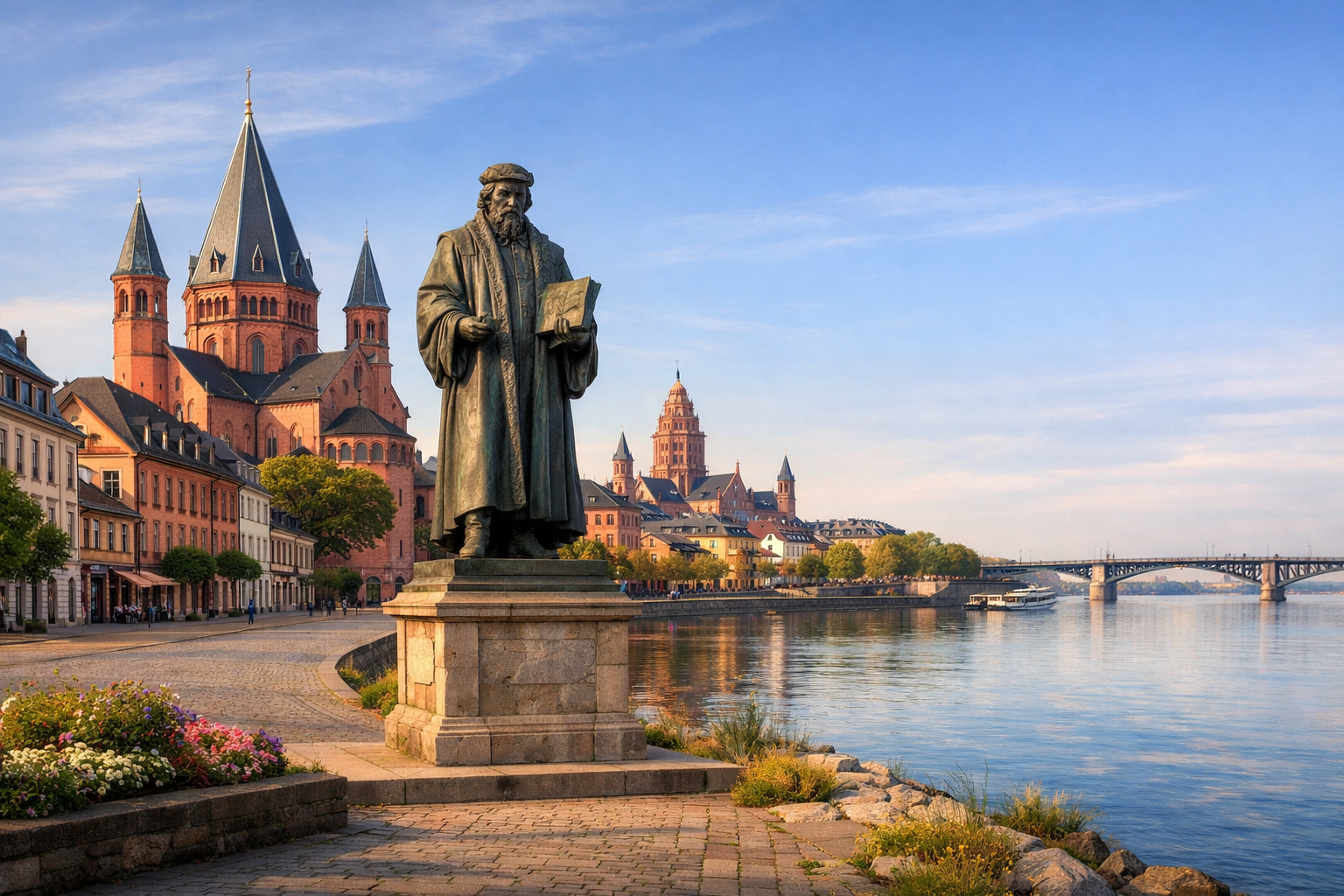
RHINELAND-PALATINATE - Mainz: cathedral, Gutenberg and the Rhine

RHINELAND-PALATINATE - Mainz: cathedral, Gutenberg and the Rhine

Mainz blends history and riverside charm in the heart of Rhineland-Palatinate. Wander from its striking cathedral to the legacy of Gutenberg, then soak up the easy beauty of the Rhine flowing past the city.

🧭 DAY-BY-DAY ITINERARY

Ready-made country and city routes with daily plans, sights, transport and accommodation. Buy PDF guides for independent travel.

🧭 DAY-BY-DAY ITINERARY


Day 1 — Mainz: cathedral, old town and Gutenberg

  • 🚆 It is most convenient to plan your arrival in Mainz via Frankfurt am Main Airport: from Frankfurt Airport to Mainz Hbf, direct suburban S8/S9 trains or regional trains usually run, and the journey itself takes about 35–45 minutes depending on the service and platform. From the main station to Mainz’s historic center, it is another 10–15 minutes by tram or bus, or about 20–25 minutes on foot. This makes Mainz a very convenient city for a short but full trip without unnecessary transport fatigue.

  • 🚶 Start your route from the heart of the city — Mainz Cathedral, known as Hoher Dom zu Mainz. This is not just the city’s main church, but one of the most powerful architectural symbols of the entire Middle Rhine, a monument to almost a thousand years of history, where Romanesque massiveness, late Gothic details, and Baroque accents come together like a living textbook of European church art. The cathedral stands on a spacious square next to the market streets of the old town and makes a special impression precisely in person: the reddish sandstone, strict towers, plasticity of the facades, and the sense of the weight of centuries create here not a tourist postcard, but an almost physically tangible feeling of historical depth. Inside, it is especially worth slowing down: the space does not overwhelm, but draws you into a calm rhythm — stone arches, archbishops’ tombs, subdued light, and the layering of eras remind you that Mainz for centuries was not a periphery, but one of the region’s most important spiritual and political centers. It is reasonable to allow 1–1.5 hours for visiting the cathedral and the square in front of it without rushing.

  • 🚶 Right after the cathedral, it makes sense to walk to the nearby Dommuseum at Domstraße 3. It is a small but very fitting continuation of your acquaintance with the cathedral ensemble: instead of overwhelming you with exhibits, it creates a different feeling — as if you are entering a quiet inner commentary on what you have just seen. The museum contains church treasures, sculpture, liturgical art objects, and fragments of the cultural fabric without which the cathedral itself would be perceived only as a striking shell. For a short two-day route, this is an especially successful stop: not too large, atmospheric, and substantial. A visit usually takes 40–60 minutes.

  • 🚶 Then devote time to the name without which Mainz is impossible to imagine — Johannes Gutenberg. Today the museum operates in the Gutenberg-Museum MOVED format at Reichklarastraße 10 while the main building develops into a new stage of its history. Even in temporary quarters, it remains one of the city’s key cultural points: not a dry museum about “printing technology,” but a space about how the idea of reproducing text changed Europe and the whole world. What is especially valuable here is that the history of book printing is revealed not abstractly, but through a vivid sense of the transition from manuscript culture to the modern age. Exhibitions related to early printing techniques, typefaces, the Gutenberg Bible, and printing demonstrations make it possible to see Mainz not just as the birthplace of a famous inventor, but as the place where one of civilization’s fundamental technologies was born. It is worth setting aside 1.5–2 hours for the museum, and afterward definitely taking a break for coffee or a late lunch in the old town.

  • 💤 After the museum block, do not try to cram too much into the day. The best rhythm for Mainz is to alternate rich content with rest. Leave at least 1–1.5 hours for a calm break: sit on the Markt, turn into the narrow lanes around the cathedral, walk aimlessly past half-timbered facades and wine establishments. Mainz’s old town is good precisely because of this gentle scale: it does not try to overwhelm, but gradually opens up through details — signs, stonework, windows, small squares, and the feeling of Rhineland urban culture, full of warmth and human scale.

  • 🚶 In the evening, head down to the Rhine embankment. The river here is not a decorative background, but the true axis of the space: broad, calm, with lively river traffic, bridges, walking areas, and a long perspective of water. It is especially at the end of the day that you feel why the Rhine for this region is not just geography, but a cultural nerve. A walk along the Rheinufer before sunset or in the soft evening light wonderfully completes the first day: after the stone depth of the cathedral and the intellectual energy of the Gutenberg Museum, another, more open Mainz appears — airy, relaxed, river-oriented. It is reasonable to allow another 2–3 hours for a walk along the embankment and a relaxed dinner.


Day 2 — Mainz: Chagall’s blue light, museums and the Rhine

  • 🚶 It is best to start the second day without rushing and without an early transport dash — Mainz is ideal for a route where almost everything is connected on foot. After breakfast, head to St. Stephan church at Weißgasse 12. The climb there is pleasant in itself: you gradually leave the market bustle behind and ascend to one of the city’s most emotional places. The church is known above all for Marc Chagall’s windows — the only stained-glass windows by this artist in a church space in Germany. Inside, what greets you is not so much architecture as light: dense, deep, almost weightless blue that makes the interior meditative and almost otherworldly. This is a rare case when a famous landmark truly works not only as a “must-see checkbox,” but as a strong personal impression. Here you want to linger, sit in silence, and let your eyes adjust to the shifting light. Allow about 1 hour for the visit together with the short uphill walk and a calm pause.

  • 🚶 Next, it is convenient to walk to Landesmuseum Mainz, located at Große Bleiche 49–51. For a short trip, this is an excellent second museum focus: if the Gutenberg Museum concentrates on text, printing, and intellectual revolution, then the Landesmuseum broadens the perspective and shows Mainz as a cultural hub with ancient, medieval, and artistic heritage. Its strength lies in its variety: here you can see archaeological finds, art from different eras, and objects that help you feel that the city existed long before its modern tourist image. The visit is especially convenient in a two-day format because the museum is located close to the center and combines well with a walk. The optimal time is 1.5 hours.

  • 🚶 If you still have energy and interest, add another compact museum touch — Naturhistorisches Museum Mainz at Reichklarastraße 1. This is a good option not for a “mandatory checklist,” but for a calmer, more varied route: the museum is conveniently located and can provide a light change of mood after church art and historical collections. It is especially appropriate if you are not traveling at maximum speed and want to fill the second day not only with iconic symbols, but also with more intimate urban spaces. 45–60 minutes is enough for a short visit.

  • 🚢 The main focus of the second half of the day is the Rhine. If the schedule and season allow, it is best to include a short river trip on a sightseeing boat or, at the very least, spend a large block of time on the embankment. The very feeling of Mainz changes significantly when you look at it not only from inside the old town, but also turned toward the water: the rhythm of the shoreline, the bridges, the city skyline, and Mainz’s connection with the wider Rhine world become noticeable. Even a short cruise gives a very proper sense of scale — you see that the city does not live in isolation, but as part of a great river civilization. If the sailing time does not fit, replace it with a long walk along the bank with a stop for coffee or a glass of Rheinhessen wine. It is worth allowing 2–3 hours for this block, including rest.

  • 🚶 Before departure, leave time for a calm finish to the route: no new museums, no extra rush, just walk through the center once more, buy a book, postcards, or local gastronomic treats, sit in the square or on the embankment. For two days, Mainz opens up surprisingly fully: the cathedral gives a historical vertical, Gutenberg gives an intellectual dimension, Chagall gives light and silence, and the Rhine ties all this together into a single image of the city. That is why such a compact route works better than an attempt to “see everything at once” across the region.

  • 🚆 For the trip back to Frankfurt Airport or onward through Germany, allow extra time. From the center to Mainz Hbf, you usually need 10–15 minutes by city transport or about 20–25 minutes on foot, and then another 35–45 minutes by train to Frankfurt Airport. In total, it is safest to count on at least 1.5 hours from leaving the hotel to arriving at the terminal, and for evening flights and on days with possible delays — with an additional reserve.

Flight tickets

eSIM for travel

Buy PDF guide

Buy PDF guide — 4.28 USD

PDF — 4.28 USD