
Buy PDF guide

Buy PDF guide — 8.57 USD

PDF — 8.57 USD

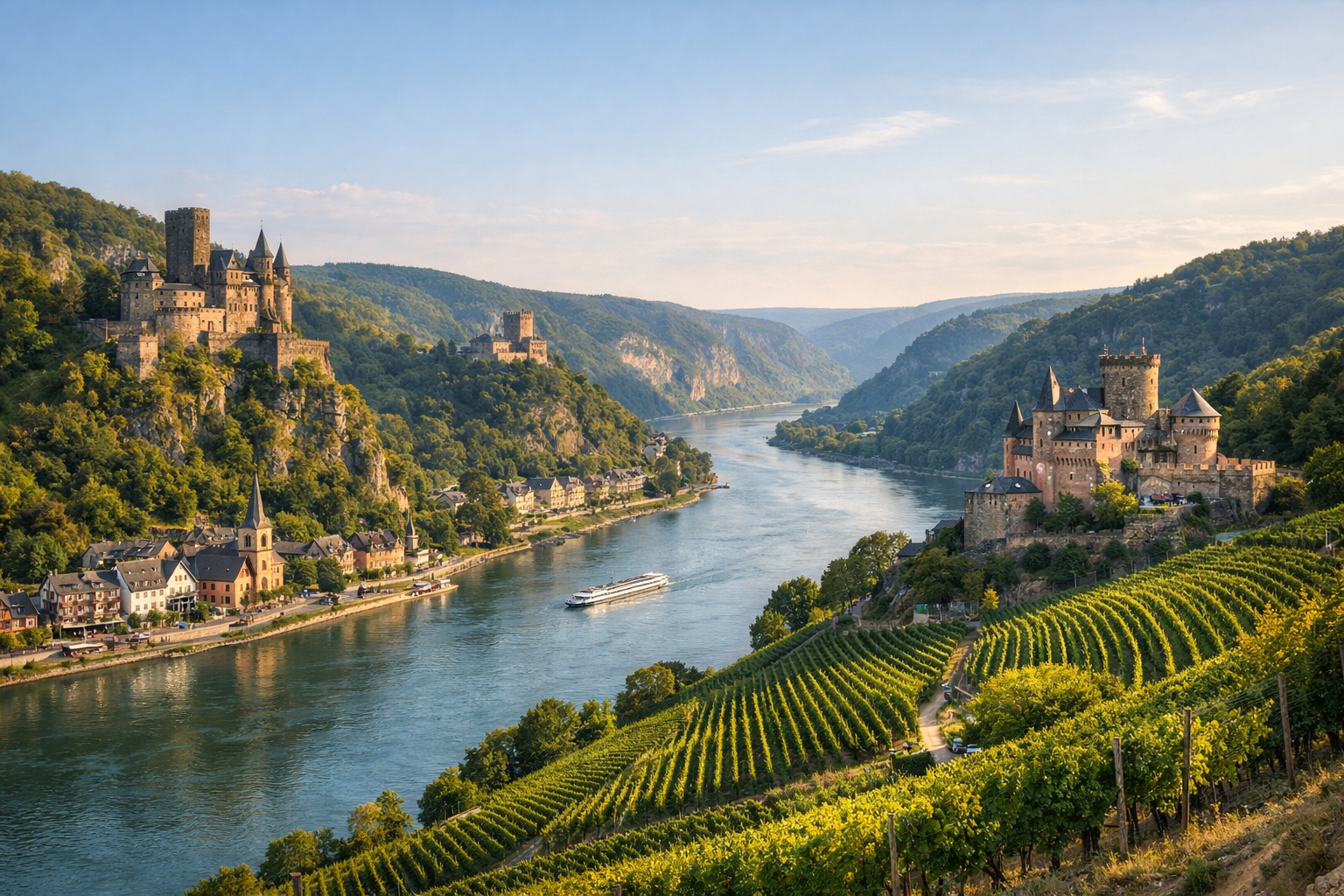
RHINELAND-PALATINATE - Middle Rhine Valley: castles, rocks and vineyards

RHINELAND-PALATINATE - Middle Rhine Valley: castles, rocks and vineyards

Follow the Middle Rhine through a storybook landscape of hilltop castles, steep vineyards and dramatic rock formations. From Bingen and Bacharach to the Loreley and Koblenz, Rhineland-Palatinate blends river romance with timeless medieval charm.

🧭 DAY-BY-DAY ITINERARY

Ready-made country and city routes with daily plans, sights, transport and accommodation. Buy PDF guides for independent travel.

🧭 DAY-BY-DAY ITINERARY


Day 1 — Bingen am Rhein and Bacharach: gateway to the Middle Rhine Valley

  • 🚆 It’s convenient to start the route via Bingen am Rhein: from Frankfurt, the train ride here is usually about 1–1.5 hours with one transfer, and from there the classic Rhine scenery that draws people to this region begins. For the first day, it’s best not to overload the plan: after check-in and a short rest, spend time on the Bingen waterfront, take an easy walk along the Rhine, and get acquainted with the atmosphere of this wine region, where the broad river gradually enters a more dramatic gorge and the slopes become increasingly steep.

  • 🚶 Bingen is a natural “threshold” to the world-famous Middle Rhine Valley, listed by UNESCO. Here you can especially feel the transition from a comfortable riverside town to the romantic landscape of towers, slopes, and vineyards. On the water you can see the famous Mäuseturm, a tower on a tiny island in the middle of the river, and above the town rises Klopp Castle. The town itself is closely associated with Hildegard of Bingen, so it combines medieval memory, Rhine trading history, and the almost resort-like lightness of a walkable town by the water.

  • 🏛️ Be sure to visit Museum am Strom. It’s one of the best museums in the region for a first introduction to the place: the exhibits help explain not only the history of Bingen, but also the whole phenomenon of Rhine Romanticism, shipping, pilgrimage, trade, and the image of the Rhine in European culture. Museum address: Museumstraße 3, 55411 Bingen am Rhein. Allow 1–1.5 hours for a relaxed visit so you don’t end up rushing along like a tour bus.

  • 🚆 After lunch, it’s worth making the short trip to Bacharach: regional trains along the left bank of the Rhine take about 15–20 minutes. This is one of those rides where it’s better not to stare at your phone, because the drama of the valley gradually unfolds right outside the window — cliffs, vineyard walls, towers, old stations, and little piers.

  • 🚶 Bacharach is almost a perfect illustration of why this stretch of the Rhine became a symbol of German Romanticism in the 19th century. The town looks as if it was not so much built as carefully assembled from half-timbered houses, town gates, stone towers, steep vineyard slopes, and narrow lanes that unexpectedly lead down to the river. Here it’s pleasant not to “tick off a list of sights,” but simply to wander: pass through the old fortifications, climb to a viewpoint over the vineyards, stop for a glass of local Riesling, and let the route slow down.

  • 💤 It makes sense to spend the night in Oberwesel or St. Goar so that the next day you are already inside the most impressive part of the valley instead of wasting the morning on unnecessary return trips.


Day 2 — Oberwesel, St. Goar, and the Loreley Rock: the heart of Rhine Romanticism

  • 🚶 Start the morning in Oberwesel, one of the most photogenic towns on the Middle Rhine. Here, massive medieval walls, church towers, and vineyards rising directly above the rooftops come together especially beautifully. Unlike larger cities, Oberwesel feels intimate: this is not a place for a “checkmark,” but for the sensation of a true riverside Middle Ages that has survived the centuries. If you want a wow-effect route without major effort, a walk through the old town and a view over the valley from the Schönburg Castle side are enough.

  • 🏰 Schönburg Castle above Oberwesel is one of the most cinematic spots in the valley. It does not look like a grim ruin; on the contrary, this is one of those rare Rhine castles that gives the impression of a fairy-tale silhouette floating above the river. Even if you’re not staying here, it’s worth allowing time for the climb to the panorama. The stone walls, towers, and gardens above the Rhine are especially beautiful in the morning or near sunset, when the sunlight softens the valley and turns the vineyard terraces almost golden.

  • 🚆 The trip Oberwesel → St. Goar takes very little time — usually about 8–10 minutes on a regional train. That lets you avoid rushing and keeps the day from becoming a race. In St. Goar, take a pause for lunch and some rest by the river: on this part of the route, it’s important to leave at least 45–60 minutes without a rigid plan so that the valley is experienced as a whole rather than in fragments.

  • 🏰 The main historic landmark of St. Goar is the ruins of Rheinfels Castle. Once the largest fortress in the central section of the valley between Mainz and Koblenz, even today, in its partly ruined state, it impresses above all by its scale. Unlike postcard-pretty little towers, Rheinfels shows the defensive Rhine — stern, strategic, controlling trade and the flow of the river. The climb to the castle takes time and energy, so it’s best to allow at least 1.5–2 hours for the visit, including the walk and stops for the views.

  • ⛴️ After the visit, it’s convenient to cross to the right bank on the Fähre Loreley between St. Goar and St. Goarshausen. It’s a short stretch, but an important one in terms of impressions: it’s from the water that you really understand why the Loreley legend is so tightly fused with the landscape. Steep slopes, the bend of the river, and the dense rhythm of castles and cliffs create that dramatic backdrop where the myth feels almost like a natural continuation of geography.

  • 🚶 The Loreley Rock is not just a viewpoint, but a cultural symbol of the entire Rhine. It is a 132-meter slate cliff above a sharp bend in the river, linked to the legend of the siren-like maiden whose singing doomed boatmen. Today people come here primarily for the panorama: from above you can clearly see how the river corridor narrows, how railway and shipping are pressed into the terrain, and how human history has existed here for centuries quite literally between water and stone. It’s best to come in the second half of the day, when the light gives the valley more depth and the opposite bank looks especially picturesque.

  • 💤 For the night, it’s sensible to stay in St. Goar, Oberwesel, or Boppard. This rhythm makes the route comfortable: no long evening transfers, and real time for dinner, a walk, and rest.

Day 3 — Boppard and Braubach: wine terraces, a bend in the Rhine, and a true medieval castle

  • 🚆 The morning trip St. Goar → Boppard by regional train usually takes about 15–20 minutes. It’s a short and very convenient section, so Boppard works perfectly as a more relaxed base: the town is lively enough, with a long promenade, a good choice of cafés, and beautiful views, yet it still keeps the atmosphere of the historic Rhine.

  • 🚶 Boppard is often seen as just a pretty stop on the route, but in fact it is one of the valley’s most pleasant towns for an unhurried day. Here the Rhine seems to “exhale” a little again, there is more room for walking, and the pace of the town becomes softer. The best-known natural scene nearby is Bopparder Hamm, a huge river loop surrounded by famous vineyards. It is here that you especially feel that the Middle Rhine Valley is not only about castles and legends, but also a living winemaking landscape.

  • 🚠 If you want one of the best panoramic views on the route, it’s worth going up to Vierseenblick. It’s best to allow 2–3 hours for this, including the journey, viewpoints, and a break to rest. From above, the Rhine seems split into several lakes because of the bends and terrain, while vineyard slopes, forested sections, and the light on the water make the landscape especially expressive. This is a good day not for a sprint, but for long gazes and slow travel.

  • 🚆 After relaxing in Boppard, continue to Braubach — the trip usually takes about 20–25 minutes via Koblenz or by direct regional connections depending on the timetable. This is where Marksburg is located, one of the most important castles in the entire valley and probably the best choice for anyone who wants to see not a romantic reconstruction and not a ruin, but a real, preserved medieval Rhine castle.

  • 🏰 Marksburg above Braubach makes a very special impression. Unlike many of its neighbors in the valley, it was not turned into an elaborate fantasy palace and did not dissolve into ruins. This is a fortress that lets you feel the everyday and military reality of the Middle Ages: narrow passages, massive walls, striking verticality, a rise above the river, and dominance over the trade route. A visit usually takes time because the very path up to the castle is already part of the experience. It’s best to allow 1.5–2 hours for the visit.

  • 💤 It’s best to spend the evening and night in Koblenz. The trip Braubach → Koblenz is short — about 15 minutes by train — but the next day you’ll wake up already in the largest city on the route, where it’s easy to combine a fortress, museums, and a final panorama from above.

Day 4 — Koblenz: Deutsches Eck, Ehrenbreitstein Fortress, and a museum finale

  • 🚶 Koblenz is the right finale for a trip through the valley because this is where the romantic Rhine meets a major historic city. At the confluence of the Rhine and Moselle lies Deutsches Eck — the German Corner — one of the city’s most recognizable places. It is not just a viewpoint, but a place where you especially clearly understand the geography of the region: the Rhine Valley you have been traveling through opens up here into an urban scale, and the river once again becomes broad and monumental.

  • 🚠 An essential part of the day is the ride on the Seilbahn Koblenz, the cable car between the area near Deutsches Eck and Ehrenbreitstein Fortress. The ride itself is already an attraction: the cabins glide above the Rhine, and the whole city with its two rivers, promenades, towers, and rooftops lies beneath you like a living map of the route. This is one of those rare cases when transport and panoramic attraction match perfectly.

  • 🏰 Festung Ehrenbreitstein is a massive fortress high above the right bank of the Rhine. Unlike the romantic castles on crags, here you feel the scale of state fortification: this is not a fairy-tale tower, but a huge defensive complex looking over the valley with almost imperial confidence. From here you get some of the best views of Koblenz and the lower part of the Middle Rhine. Allow at least 2–3 hours for visiting the fortress and walking around the grounds, especially if you want not only to go up for the view, but also to calmly explore the museums and bastions.

  • 🏛️ In the second half of the day, head to the Mittelrhein-Museum in central Koblenz. It’s an excellent end to the trip: after the real landscapes, castles, and promenades, it becomes especially interesting to see how artists viewed the Middle Rhine Valley and how the visual image of the Rhine was formed in European culture. Museum address: Zentralplatz 1, 56068 Koblenz. If there’s time left, you can round out the day with a walk through the old town and dinner by the river.

  • 🚆 If you’re leaving the same day, Koblenz is very convenient logistically: from here it’s easy to reach Cologne, Frankfurt, Mainz, and other cities by regional and long-distance trains. But it’s better not to plan your departure too early in the evening, so that the last day doesn’t turn into a mere formality and you still have proper time for the fortress, the museum, and a farewell walk.

Flight tickets

eSIM for travel

Buy PDF guide

Buy PDF guide — 8.57 USD

PDF — 8.57 USD