
Buy PDF guide

Buy PDF guide — 6.43 USD

PDF — 6.43 USD

Rethymno, Crete - Venetian old town, fortress, cafes, beach area

Rethymno, Crete - Venetian old town, fortress, cafes, beach area

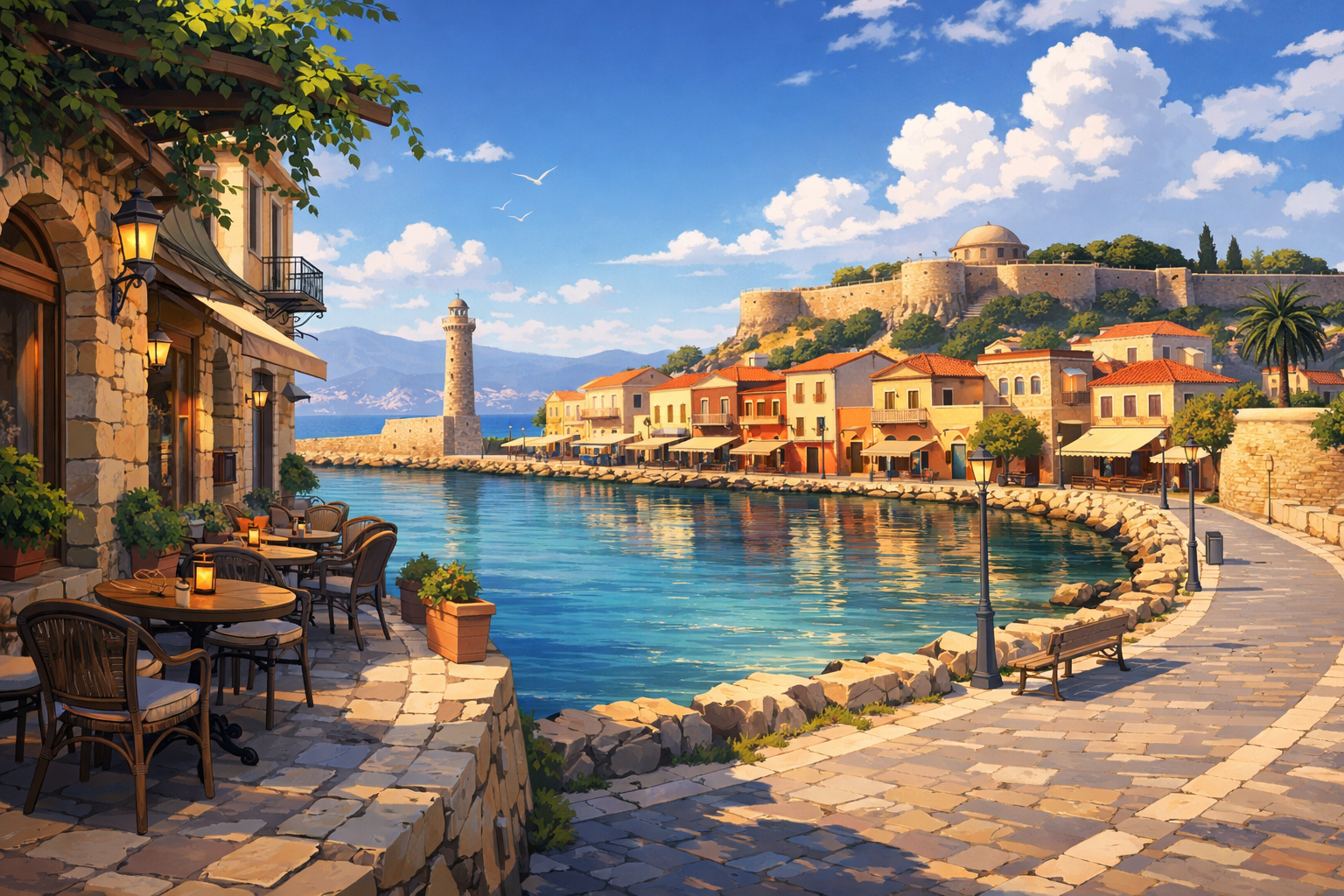
Rethymno blends Crete’s seaside charm with a beautifully preserved Venetian old town, where narrow lanes lead up to the imposing Fortezza fortress. Stroll from lively cafes and the waterfront promenade to the long sandy beach, and you’ll find a town that feels both historic and effortlessly relaxed.

🧭 DAY-BY-DAY ROUTE

Ready-made country and city routes with daily plans, sights, transport and accommodation. Buy PDF guides for independent travel.

🧭 DAY-BY-DAY ROUTE


Day 1 — Rethymno: Venetian old town, harbor, and cafes

  • 🚶 Start your introduction to Rethymno with its Venetian old town — one of the most atmospheric historic centers in Crete, where Venetian elegance and Ottoman heritage are wonderfully intertwined in the narrow lanes. This is a place not for "checking off sights," but for truly dissolving into the city: strolling slowly along the stone streets, noticing arched portals, carved coats of arms above doorways, inner courtyards, wrought-iron balconies, and houses in warm sandy tones that look especially beautiful in the morning light. The old town of Rethymno is officially protected as a historic ensemble, and you can feel it at every step: it does not look like a set for tourists, but remains a living urban space where shops, workshops, small hotels, and cafes operate behind the old facades.

  • 🚶 A logical route for the first half of the day: Porta Guora (Great Gate) → square by the Neratze Mosque → Rimondi Fountain → Loggia → Venetian Harbor. Allow about 2.5–3 hours for this stretch with unhurried stops and photos. The Rimondi Fountain is one of the most recognizable details of Rethymno: an elegant 16th-century urban monument with columns and lion mascarons, where you can always feel the pulse of the old quarter. From there, it is easy to wander off into the small craft streets, where displays of ceramics, textiles, and local products alternate with the doors of old houses. Closer to the harbor, the rhythm changes: the space opens up, with air, sea, boats, and the old lighthouse appearing, and the walk takes on an almost cinematic smoothness.

  • ☕ Lunch and a long coffee break are best planned right in the Old Town or by the Venetian Harbor. In Crete, a cafe is not just a technical stop but part of the urban ritual: it makes sense to set aside 1.5–2 hours for an unhurried lunch, Greek coffee or a freddo espresso, dessert with a view of the water, and simply resting in the shade. It is especially nice to choose a table in one of the inner courtyards of the old quarter: at midday it is cooler, quieter, and the texture of the city comes through better. After lunch, do not overload the day with museums and climbs — leave 1–1.5 hours for a free stroll along the shopping streets, a few small purchases, and a return to the hotel for a short rest.

  • 🌅 In the evening, return again to the harbor and the waterfront. This is when Rethymno becomes especially beautiful: the stone turns honey-colored, the sea dark blue, and the facades of the old houses and the boats in the port take on a soft golden outline. The Venetian Harbor is perfect for a calm first evening without complicated logistics: a walk along the water, dinner in the port area, then 10–20 minutes on foot to most central hotels. Inside the city, all the key points of the day are close to one another, so the route is realistic and comfortable even after a flight or a long transfer from the airport.


Day 2 — Rethymno: Fortezza fortress, museums, and city panoramas

  • 🚶 Dedicate the second day to the Fortezza fortress — the main landmark of Rethymno and one of the most impressive Venetian fortresses in Crete. It is best to climb up in the morning, while the light is soft and the heat has not yet become intense. From the Old Town to the entrance, it is usually about a 10–20 minute walk depending on your starting point. Allow at least 2–3 hours for the fortress itself: this is not just one viewpoint, but a large fortified space with bastions, gates, open wall sections, the Mosque of Sultan Ibrahim, and wide panoramas of the city, the sea, and the long shoreline. This is where the scale of Rethymno is felt especially well: below lies the dense fabric of the Old Town, ahead is the harbor, and along the coastal arc stretches the city beach area.

  • 🏛️ After touring the fortress, it makes sense to visit the Archaeological Museum of Rethymno, located by the Fortezza. It is a compact but very substantial museum, where you can see artifacts from different periods of the region’s history — from the Late Neolithic and Bronze Age to the classical period. It works especially well as a continuation of the fortress walk: first you see the city and its defensive history in space, and then the cultural layers of the area through objects, sculpture, ceramics, and inscriptions. It is convenient to allow 45–60 minutes for the museum without overloading the day.

  • 🏛️ In the second half of the day, leave time for one of the city museums in Old Rethymno — for example, the Historical and Folklore Museum or the Museum of Contemporary Art of Crete, depending on your interests. The first helps you feel the everyday life of Crete through crafts, textiles, domestic life, and objects of traditional culture; the second adds a contemporary cultural layer to the route and contrasts well with the Venetian walls and Ottoman domes seen in the morning. Between museum stops, be sure to take a break for coffee or a light lunch for 1–1.5 hours: a day with the fortress involves climbs, open sun, and a lot of walking, so rest here is not an option but an important part of the rhythm.

  • 🌇 Spend the evening returning to the viewpoints by the Fortezza or taking a walk along the upper edge of the Old Town. At sunset, Rethymno looks especially dimensional: the roofs, minaret, bell towers, harbor, and distant line of the beach come together into a complete image of a port city. If you want a calmer pace, you can end the day with dinner in the old quarter without going far. In terms of time, this day remains compact: all the main points are located in the historic core and are accessible on foot, and the total pure walking time between sites usually does not exceed 1–1.5 hours for the whole day.

Day 3 — Rethymno: beach area, city promenade, and seaside relaxation

  • 🏖️ Leave the third day for the beach side of Rethymno — this is exactly what makes the city such a successful format for a short trip, when the historic center and the sea are connected almost effortlessly. The city beach begins practically at the eastern part of the center and stretches in a long strip along the waterfront, so the beach area can be reached on foot from most central hotels in 5–20 minutes. The beach is known for its length, convenient entry into the sea, and developed infrastructure; the municipal beaches of Rethymno are regularly awarded the Blue Flag, making them one of the most reliable options for comfortable urban swimming.

  • 🚶 It is best to spend the morning calmly: head to the sea early, while the beach is still not crowded, and devote 2–3 hours to swimming and relaxing. If you want a more active format, you can walk east along the seafront promenade, choosing a section with a more relaxed atmosphere, and then return to the center for a late breakfast or coffee. This kind of day should deliberately not be overloaded with excursions: after two full historical days, Rethymno is especially good precisely in "sea + city" mode. Plan a proper beach pause of at least half a day.

  • ☕ After the beach, arrange a long daytime break in one of the cafes by the sea or on the parallel streets. An unhurried lunch of 1.5–2 hours works very well here: Cretan salads, fresh fish, seafood, iced coffee, dessert, or a glass of local wine. Then you can have a short rest at the hotel and save your energy for a beautiful final evening. If the trip is short and without a car, this rhythm is especially valuable: everything is close by, there is no need to spend the day on complicated logistics to distant bays, and the feeling of a seaside holiday still remains complete.

  • 🌅 Dedicate the final evening to connecting the whole route into one walk: beach line → waterfront → Venetian Harbor → the last streets of the Old Town. This loop can easily be done on foot in 1.5–2 hours without rushing. It is the best way to end a trip to Rethymno: in the morning you experience it as a seaside resort, and in the evening you see it again as a historic city with a fortress, port, and old facades. It is precisely this combination — fortress, Venetian streets, cafes, and beach area within one compact walkable environment — that makes Rethymno one of the most convenient and aesthetically pleasing destinations for a three-day route in Crete.

Flight tickets

eSIM for travel

Buy PDF guide

Buy PDF guide — 6.43 USD

PDF — 6.43 USD