
Buy PDF guide

Buy PDF guide — 29.99 USD

PDF — 29.99 USD

FIFTH AVENUE AND ROCKEFELLER CENTER

FIFTH AVENUE AND ROCKEFELLER CENTER

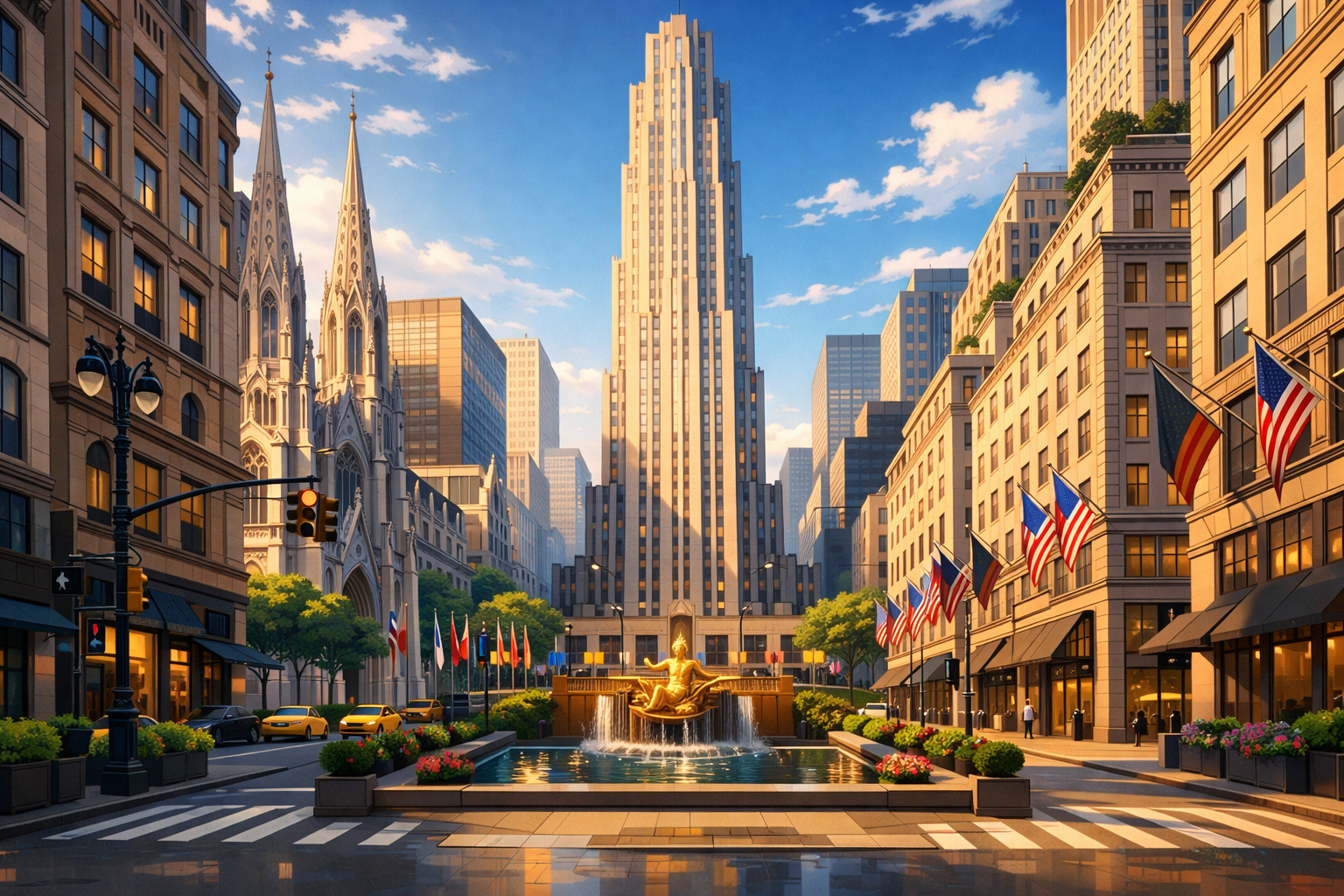
Fifth Avenue and Rockefeller Center put you in the heart of Midtown Manhattan, where iconic skyscrapers, flagship stores, and timeless New York energy meet. From the buzz of Rockefeller Plaza to the elegance of Central Park South and the grandeur of Grand Central, this stretch captures the city at its most classic and cinematic.

🧭 DAY-BY-DAY ITINERARY

Ready-made country and city routes with daily plans, sights, transport and accommodation. Buy PDF guides for independent travel.

🧭 DAY-BY-DAY ITINERARY


Day 1 — Arrival in Midtown Manhattan and a gentle introduction to the area

  • 🚶 On the first day, it’s better not to overload yourself with a “must-see program”: after the journey, it’s best to take a beautiful but gentle acclimatization walk through Midtown. If you arrive at JFK, getting to the Fifth Avenue and Rockefeller Center area usually takes about 60–90 minutes by public transport and about 45–75 minutes by taxi or pre-booked transfer, not counting heavy traffic; from LaGuardia the trip often takes around 35–60 minutes by car, and from Newark about 50–80 minutes. After check-in, set aside 1–1.5 hours to rest, shower, and have a light snack, then head out for a short evening route: walk to St. Patrick’s Cathedral, see the Fifth Avenue shop windows, and continue to Rockefeller Plaza. In the evening, this area feels especially cinematic: the glass of the skyscrapers catches the sunset light, the facades shimmer with ads and lighting, and the flow of people creates that very feeling of the “heart of Manhattan” that draws visitors here.


Day 2 — Rockefeller Center, the complex plaza, and Top of the Rock

  • 🚶 It’s best to dedicate this day to the main point of the route — Rockefeller Center. Start in the morning, when the area is not yet overcrowded: the complex itself covers several blocks between 48th and 51st Streets, and it is important to see it not as a single tower but as a whole ensemble with striking Art Deco architecture, public spaces, flags, storefronts, and the constant movement of the city. Explore Rockefeller Plaza, walk to the famous rinkside plaza, peek into the passageways and interior connections, and then head up to Top of the Rock. It makes sense to allow at least 1.5–2 hours for the observation deck, including security screening, the elevator line, moving between levels, and time for photos. From here, Manhattan opens up in a particularly rewarding way: to the north stretches the green line of Central Park, to the south runs the forest of Midtown towers, and the city itself looks like perfectly assembled geometry. After going up, take a long coffee or late lunch break — the area is dense, noisy, and visually насыщенный, so a 45–60 minute pause here is not a luxury but the right part of the route.

Day 3 — Fifth Avenue: storefronts, facades, St. Patrick’s Cathedral, and the city rhythm

  • 🚶 Today, focus on Fifth Avenue as an experience in itself. It’s important not to see it only as a shopping street: it is one of New York’s most recognizable urban axes, where luxurious retail display meets monumental facades, a cathedral, office towers, and a flow of people from all over the world. Walk the stretch from 49th to 59th Street slowly, stopping for details — the stone sculpture of St. Patrick’s Cathedral, the contrast between the old verticality of the church and modern skyscrapers, polished display windows, the glow of lobbies, flags, and the stream of taxis. For the walk itself, with visits inside a few buildings, short photo stops, and rest, it’s comfortable to allow 4–5 hours. After lunch, it’s good to shift into a calmer rhythm: for example, turn into Paley Park — a tiny but very New York pocket park with a water wall, where in just a few minutes the noise of the avenue turns into a soft background.

Day 4 — MoMA and a cultural day in Midtown

  • 🚶 After two visually intense days outdoors, it’s a good idea to switch to a museum format. The Museum of Modern Art, MoMA, is located very nearby and is ideal for this kind of “immersion without transfers.” Don’t try to cover the whole museum in a rush: choose 2–3 areas of interest — for example, classic modernism, design, photography, or a temporary exhibition — and spend 3–4 hours inside at a comfortable pace. MoMA is valuable because here New York is felt not through the street, but through the city’s intellectual energy: it is a space where 20th- and 21st-century art is not simply displayed, but woven into the rhythm of modern life. After the museum, don’t plan the rest of the day too tightly: at most, a calm walk along 53rd Street, a souvenir shop, dinner, and an early evening. A day like this is necessary so the trip does not turn into a checklist marathon.

Day 5 — Central Park South and the boundary between stone and greenery

  • 🚶 Today, make a beautiful transition from Fifth Avenue to the southern edge of Central Park. This is one of the most striking transitions in New York: over just a few blocks, dense commercial Midtown gives way to air, trees, open sky, and a slower pace. Start in the Grand Army Plaza area at the park’s southeastern entrance, then walk along the park’s southern line or head inside for 1–2 hours without setting yourself the goal of “seeing all of Central Park.” Here, coverage matters less than mood: benches, rocks, paths, carriages, runners, dogs, people with coffee, and the city noise that gradually becomes distant. For the walk with rest, it’s reasonable to set aside half a day. After lunch, you can return to Fifth Avenue and spend the evening without a strict program — this day balances the whole route well.

Day 6 — New York Public Library and Bryant Park

  • 🚶 One of the most beautiful and underrated days on the route is the pairing of the New York Public Library and Bryant Park. Start with the famous library building on Fifth Avenue at 42nd Street: it is not just a “useful institution,” but a true urban stage with marble staircases, solemn interiors, and the feeling of intellectual New York existing alongside the tourist one. It makes sense to allow 1.5–2 hours for the library, especially if you love architecture and atmospheric public spaces. Then step out into Bryant Park — a well-kept urban park that works like a huge open-air living room: people read, have lunch, meet up, sit alone, play board games, and work on laptops. This day is not about “ticking boxes,” but about the rhythm of the city. A great format is a long 45-minute pause in the park, followed by an unhurried return toward 5th Avenue.

Day 7 — Grand Central Terminal and Midtown East

  • 🚶 Today, head a little farther east — to Grand Central Terminal. Although it is a transport hub, it should be seen as a full-fledged attraction: both the famous main hall with its celestial ceiling, the staircases, the balconies, and the constant sense of movement matter here. The walk from Rockefeller Center or Fifth Avenue to the terminal usually takes 15–20 minutes, so the day feels comfortable and logical without using the subway. It is convenient to devote 2–3 hours to exploring the terminal itself, a bit of shopping, coffee, and photos. After that, walk through Midtown East — here Manhattan feels more businesslike and less theatrical, but that is exactly its charm: strict facades, old office buildings, lobbies with brass shine, and quiet side streets. The evening can be left free for rest or a nice dinner near the hotel.

Day 8 — Museum day of your choice: The Frick Collection or a calm walk up Museum Mile

  • 🚶 After a busy week, it’s convenient to make the day a little more elegant and measured. One of the best options is to go up Fifth Avenue to the Upper East Side to visit The Frick Collection or simply walk part of Museum Mile at your own pace. The trip by bus or taxi from Midtown takes about 15–30 minutes; on foot, the route is longer and suitable only for those who enjoy major urban walks. This route is great because it shows Fifth Avenue in a different register: not storefront-oriented and not businesslike, but more noble, museum-like, almost ceremonial. If you choose the Frick, allow 2–3 hours for the visit and at least another hour for calm rest afterward — this format requires attention and quiet. In the evening, return to the Rockefeller Center area without extra activities.

Day 9 — Design, interior passageways, and a second look at Rockefeller Center

  • 🚶 It’s best to make the ninth day the “second layer” of the route: return to Rockefeller Center not for repetition, but for the details that usually slip by on a first visit. Explore the public areas, artistic elements, storefronts, Art Deco in the lobbies, and visit the shops and food spaces. Once the first wave of admiration has passed, the complex begins to feel deeper: like a well-designed urban machine where business, tourism, culture, and architecture are tied together with remarkable density. Add a walk through the neighboring blocks around 49th–51st Streets, short coffee stops, and some observation of the city flow. Travel time between points is minimal — usually 5–12 minutes on foot — so the day is physically easy but visually very rich. It’s nice to end it with a visit to a rooftop bar or simply an evening walk along illuminated Fifth Avenue.

Day 10 — A free day for shopping, pauses, and your own rhythm

  • 🚶 Be sure to leave one day without a rigid structure. The Fifth Avenue and Rockefeller Center area is ideal for this format: you can return to shops you liked, calmly go into places you did not have time for earlier, take a break in a park, sit in a café, and feel the city without the pressure of an itinerary. In New York, days like this are especially important because the city is very intense and impressions accumulate faster than it seems. If you feel tired, confidently reduce the plan to a late breakfast, one walk, and one beautiful place. If, on the contrary, you have energy, you can add neighboring blocks — Radio City Music Hall from the outside, several buildings along Avenue of the Americas, an evening loop to 6th Avenue and back to 5th.

Day 11 — St. Patrick’s Cathedral, sacred silence, and contrast with the metropolis

  • 🚶 Today is a good day for a more intimate route around St. Patrick’s Cathedral. What makes this place especially impressive is precisely the contrast: Gothic verticality, stone carving, stained-glass light, and almost meditative silence are literally squeezed in between skyscrapers, tourist flows, and the business rhythm of Manhattan. It’s best to come in the first half of the day, when it’s calmer inside. You can allow 1–1.5 hours for the cathedral itself, quiet contemplation, photos outside, and a short rest, then continue the day without rushing through the neighboring blocks. This is a good moment not to “collect even more,” but rather to slow down and give the route depth. In the evening, you can make a small loop to Rockefeller Center and see how the strict daytime architecture once again turns into a striking urban stage set.

Day 12 — A grand walk: Fifth Avenue from the library to the cathedral and onward to 59th Street

  • 🚶 One of the most beautiful days is to walk the key stretch of Fifth Avenue as a unified urban composition. Start from the library and Bryant Park area, then move north through office blocks, storefronts, and historic facades, past St. Patrick’s Cathedral, Rockefeller Center, and farther toward the Plaza and the southern edge of Central Park. At a normal pace, this route with stops, coffee, window displays, and short rests easily takes 5–6 hours, but that is exactly the point: not to rush and to experience the street gradually. As you move, not only the architecture changes, but also the social energy of the space — from more businesslike and transit-oriented to more luxurious and promenade-like. This day is highly photogenic and at the same time surprisingly coherent.

Day 13 — Evening Manhattan: sunset views, glowing facades, and the last full outing

  • 🚶 The penultimate day is best built around the evening city. Leave time before lunch for rest, a slow breakfast, or shopping, and move the main program to the second half of the day. A good scenario is a light walk around Midtown, an early dinner, and then either going up to an observation deck or simply taking a long route around Rockefeller Center and Fifth Avenue after dark. New York in the evening is not just prettier — it becomes more theatrical: glass turns into mirrors of light, storefronts begin to work like a stage, and the movement of taxis and the flow of people create a sense of endless energy. Feel free to allow 4–5 hours for the evening block, including a dinner pause and time without rushing. This is the kind of format that gathers all the impressions of the trip into one emotional chord.

Day 14 — Final day: favorite spots, souvenirs, and a calm ending

  • 🚶 The last day should not be turned into a race for the final sights. It’s better to make a “return loop”: stop by one or two favorite places in the area, buy gifts or books, walk once more past the cathedral, Fifth Avenue, or Rockefeller Center plaza, and allow yourself to say goodbye to the city calmly. If you are heading to the airport the same day, it is wise to leave at least 3–4 hours before departure for packing and the trip, and even more during rush hour. If time allows, end the trip with a slow coffee overlooking the street and a short walk without a map. For this route, that is the ideal ending: not another “must-see spot,” but the feeling that the area has become a little familiar and understandable to you.

Flight tickets

eSIM for travel

Buy PDF guide

Buy PDF guide — 29.99 USD

PDF — 29.99 USD