
Buy PDF guide

Buy PDF guide — 25.71 USD

PDF — 25.71 USD

THE PSKOV LAND

THE PSKOV LAND

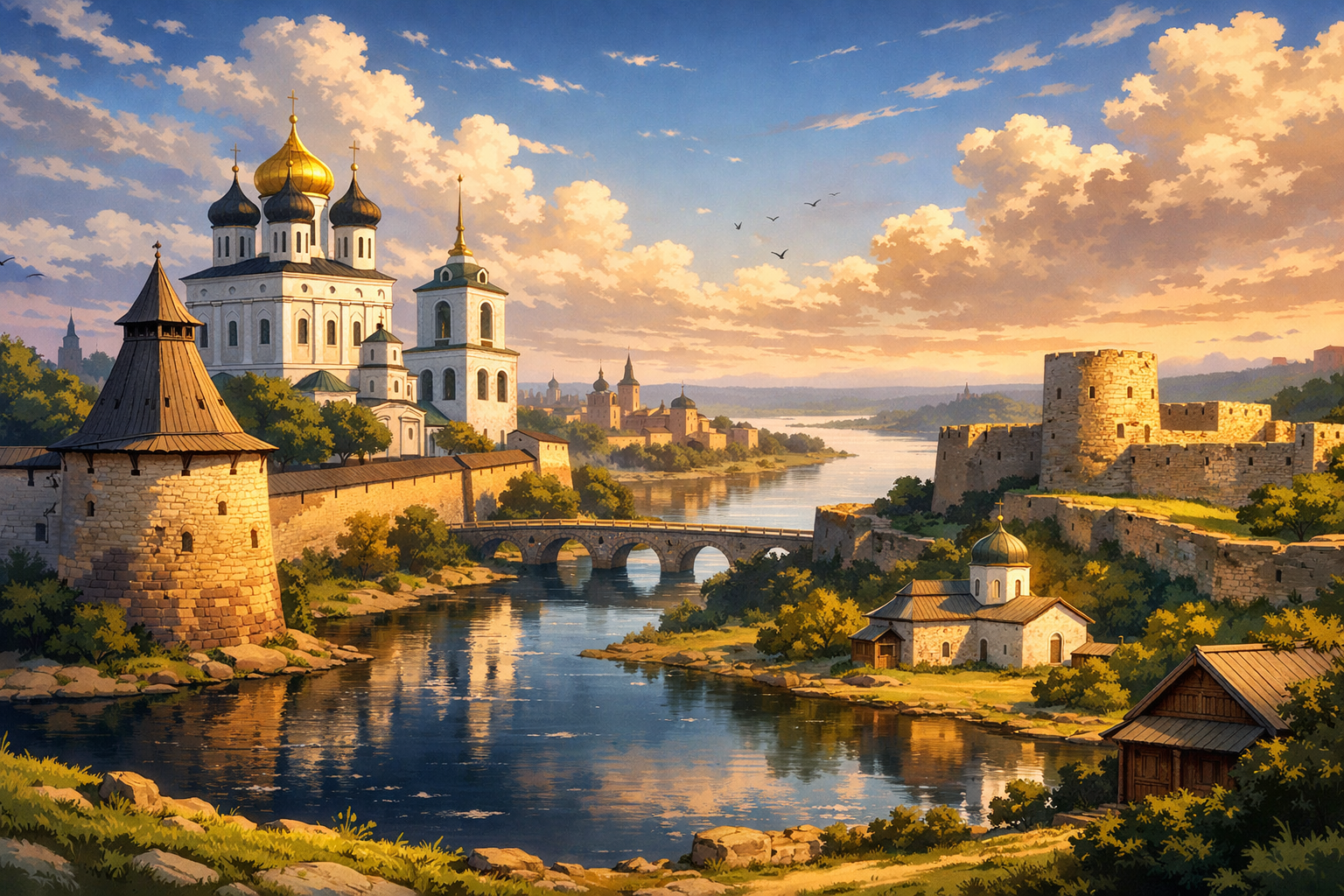
Pskov and Izborsk reveal Russia’s medieval soul: the Krom and Trinity Cathedral gleam above the Velikaya, while Izborsk’s stone fortress watches over rolling hills and spring-fed lakes. Cobblestone streets and echoing ramparts bring centuries of chronicles to life in the soft northern light.

🧭 DAY-BY-DAY ITINERARY

Ready-made country and city routes with daily plans, sights, transport and accommodation. Buy PDF guides for independent travel.

🧭 DAY-BY-DAY ITINERARY


Day 1 — Arrival in Pskov: first walk and a view of the Krom

  • 🚆/🚌 Arrive on the morning “Lastochka” from Saint Petersburg or on an overnight train from Moscow. Check in, have lunch, and take a gentle start. Toward evening, head to the embankments of the Velikaya and Pskova rivers: from here the Pskov Kremlin (Krom) reads as a single defensive organism—the walls “sit” on the capes between the rivers, and the towers mark the breaks in the terrain.


Day 2 — Pskov Kremlin (Krom) and Trinity Cathedral

  • 🚶 Start at the museum info center by the Prikaz Chamber and climb up onto the walls: the “fortress-as-panorama” format shows how engineers integrated defense into the river channels. Trinity Cathedral is a white vertical accent above the slopes; inside—dense Baroque iconography and the feeling of an ancient see where Pskov identity took shape.

  • 🎯 Focus: reconstructed towers (Ploskaya/Pokrovskaya), the viewing platform, traces of Dovmont’s Town; the logic of gates and descents to the water—the “nerves” of the medieval city.

Day 3 — Dovmont’s Town, towers, and passages

  • 🚶 Walk around the Krom in an arc: from the Vlasyevskaya Tower to Pokrovskaya, catching the “roll call” of defensive volumes with the riverside terraces. Dovmont’s Town is Pskov’s “archaeological notebook”: church plans, foundations, markers of ancient levels. It helps to look with sketches—outlines read better than in photos.

Day 4 — Mirozhsky Monastery: pre-Mongol 12th-century frescoes

  • 🚶 The Spaso-Preobrazhensky Mirozhsky Monastery holds an extremely rare collection of 12th-century frescoes in natural light. The architecture here is “modest” in scale but refined in proportion: a cross-in-square volume, soft light from the river, and the intimate interior make the encounter with the painting almost personal. Take a pause after your visit—the impressions need “quiet” time.

Day 5 — Snetogorsky Monastery: a cloister above the cliffs of the Velikaya

  • 🚶 The Nativity of the Mother of God Snetogorsky Monastery is an ensemble with ancient layers: the cathedral of 1310–1311, later refectories, surviving fresco fragments. The line of the walls and Holy Gate is perfectly “read” off the riverbank ledge; from here it’s easy to understand how Pskov monasteries became “suburban fortresses.”

Day 6 — Pskov’s stone chambers: 17th-century merchant architecture

  • 🚶 Pogankin Chambers and the Art Gallery immerse you in 17th-century “stone everyday life” and the region’s art collections. Thick walls, asymmetrical windows, arcaded friezes, and the “stern” whiteness of the facades—a language related to Pskov’s fortress and church forms.

Day 7 — The “museum quarter”: Postnikov Yard and the Chambers by Sokolya Tower

  • 🚶 Postnikov Yard is a reconstructed environment with craft-themed stories and urban daily life. The Chambers by Sokolya Tower (the Priest’s House) are a rare example of a civic home with a “ceremonial” porch-staircase and secret passages. A day for details: stove tiles, floor structures, stairs, roof construction.

Day 8 — Transfer to Izborsk + the 14th-century Izborsk Fortress

  • 🚌 Pskov → Old Izborsk (by bus, see transport).

  • 🚶 The Izborsk Fortress on Zheravya Hill is the “dry” power of limestone: walls without excess, watchtower “guards,” and St. Nicholas Church inside the perimeter. It’s important to walk all the way around—the way the walls sit on the terrain changes, construction stages become readable, and the “dialogue” with the valley appears.

Day 9 — Truvor’s Hillfort and the Slovenian Springs

  • 🚶 Truvor’s Hillfort is an archaeological hill with legends of the first princes, traces of ramparts, and St. Nicholas Church on a rise. Below is the cascade of the Slovenian Springs: limestone cliffs, gushing springs, and the mirror-smooth surface of Gorodishchenskoye Lake. The landscape “works” as a natural amphitheater for the fortress.

Day 10 — Unhurried Izborsk: towers, views, and merchant estates

  • 🚶 Return to the towers (Lukovka, Talavskaya), drop into the museum’s merchant-house exhibitions: how a “museum town” shows the texture of everyday life. By evening—views from the walls over the Izborsk–Maly Valley: the relief here is an equal “architect.”

Day 11 — Return to Pskov + a “mosaic” of small churches

  • 🚌 Old Izborsk → Pskov (by bus).

  • 🚶 A day for the “small forms” of Pskov architecture: single-domed white-stone churches with characteristic belfry walls, asymmetrical porches, zakomaras, and low narthexes—this is where the school’s “handwriting” is most audible. In the evening—a final walk along the embankments.

Day 12 — Departure: summing up

  • 🚆 Pskov → Saint Petersburg (“Lastochka”) or an overnight train to Moscow. Compare the line “fortress → monasteries → chambers → archaeology”: Pskov and Izborsk come together into a coherent story about borders and style.

Flight tickets

eSIM for travel

Buy PDF guide

Buy PDF guide — 25.71 USD

PDF — 25.71 USD