
Buy PDF guide

Buy PDF guide — 6.43 USD

PDF — 6.43 USD

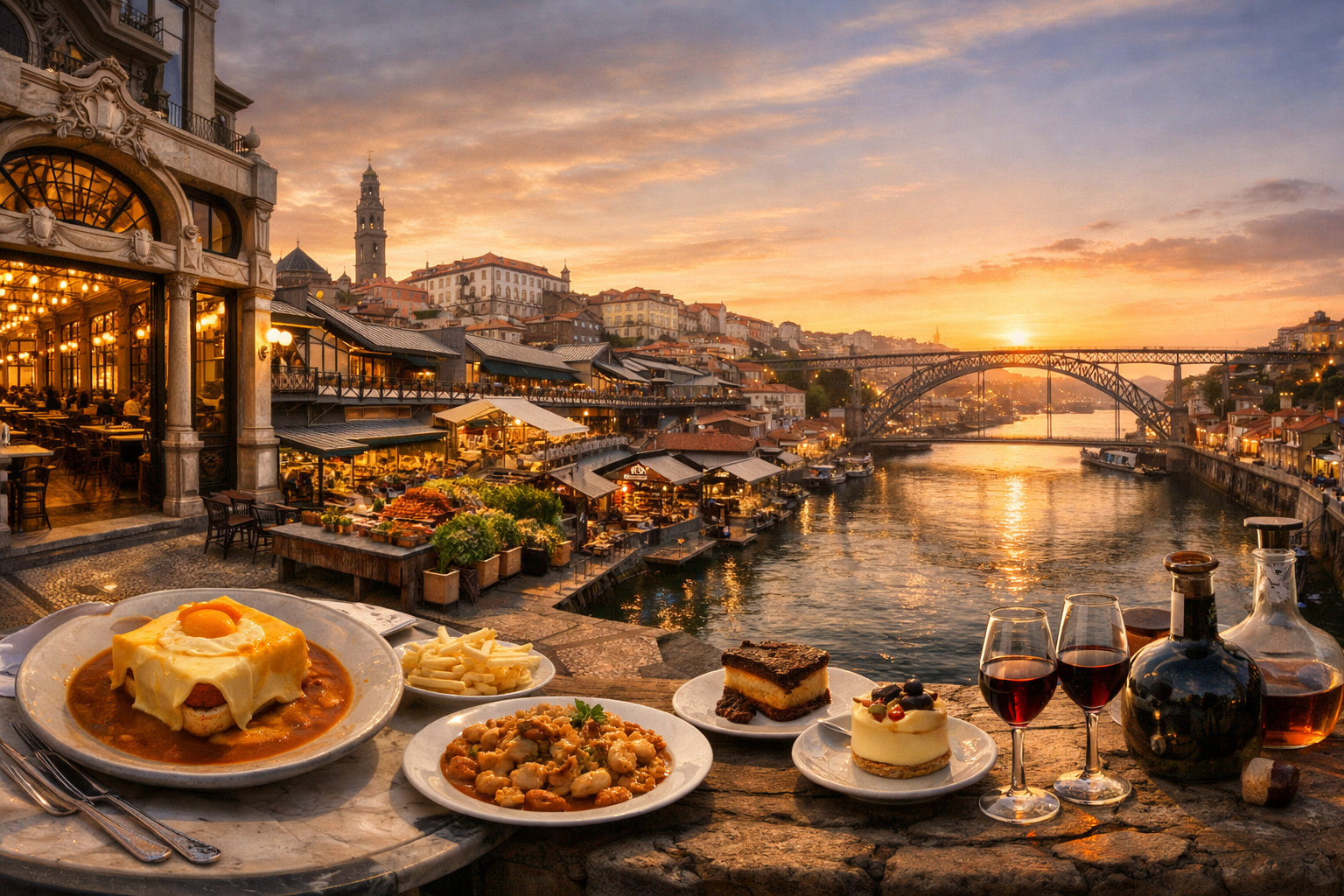
Portugal, Porto. An introduction to Porto cuisine through the historic Café Majestic, the Mercado do Bolhão market, the Abadia do Porto restaurant, and Taylor’s wine cellars in Vila Nova de Gaia: francesinha, tripe, desserts, and port wine.

Portugal, Porto. An introduction to Porto cuisine through the historic Café Majestic, the Mercado do Bolhão market, the Abadia do Porto restaurant, and Taylor’s wine cellars in Vila Nova de Gaia: francesinha, tripe, desserts, and port wine.

Begin in Porto with the city’s rich culinary soul, from the elegance of Café Majestic and the bustle of Mercado do Bolhão to classic dishes at Abadia do Porto. Cross to Vila Nova de Gaia for Taylor’s famous port wine cellars, then return with the flavors of francesinha, tripe, sweet pastries, and port lingering long after the last glass.

🧭 DAY-BY-DAY ROUTE

Ready-made country and city routes with daily plans, sights, transport and accommodation. Buy PDF guides for independent travel.

🧭 DAY-BY-DAY ROUTE


Day 1 — Porto: Café Majestic, Rua de Santa Catarina, and Mercado do Bolhão

  • 🚶 The first day of this short gastronomic route is best started in the heart of Baixa — on the pedestrian Rua de Santa Catarina, where the noise of the shopping street is unexpectedly interrupted by the atmosphere of old Porto. Here you’ll find the legendary Café Majestic, one of the city’s most recognizable historic cafés, opened in the belle époque era and still preserving a theatrical sense of luxury: carved wood, mirrors, brass details, soft light, and the feeling that you’ve come not just for breakfast, but for a small ritual of getting acquainted with the city’s gastronomic memory. It makes sense to plan this stop for the morning: officially, the café usually operates from Monday to Saturday roughly from 09:00 to 23:00, and there are many visitors, so reservations are especially advisable in high season and for late breakfast. This is not the place to expect “cheap coffee on the go” — Majestic is more about the experience, beautiful presentation, and historical atmosphere. A fitting order for a first introduction: an espresso or galão, pastel de nata, house-style rabanadas, or a more substantial late breakfast. The menu also features francesinha in a more “salon-style” version, but for the first day it’s better to leave it for lunch or another meal. For travelers with dietary restrictions, it’s important to ask in advance about allergens and the availability of non-alcoholic or less sweet options; the staff can usually guide you on the ingredients in desserts and sandwiches.
  • 🚶 After breakfast, it makes sense to walk about 8–10 minutes down Santa Catarina to Mercado do Bolhão, Porto’s main market and one of the best places to understand northern Portuguese cuisine without museum-like distance. Historically, the market has been connected with the city’s everyday life, and today it once again functions as a lively gastronomic hub: stalls with fresh fish, meat, vegetables, herbs, cheeses, sausages, olives, sweets, and regional products create that very “real” backdrop where Porto’s cuisine becomes understandable through smell, color, and seasonality. The market itself is usually open Monday to Friday from 08:00 to 20:00, on Saturdays until 18:00, and closed on Sundays; meanwhile, restaurant spots inside the complex may operate longer, roughly until midnight. It’s convenient to allow 1.5–2 hours for a relaxed visit: first walk the inner perimeter and fresh produce area, then look for gourmet counters with local cheeses, preserves, presunto, chouriço, honey, jams, and sweet pastries. For a thoughtful food tour, it’s useful not only to buy but also to observe what local residents actually choose: this quickly reveals the region’s real food base. If you don’t eat meat, Bolhão is especially good because it’s easy to put together a tasting selection of bread, cheeses, fruit, nuts, olives, and desserts; if you’re intolerant to gluten or lactose, it’s also easier to control what you buy than in a restaurant.
  • 🍽️ For lunch on this day, you can stay in the Bolhão area and focus not on a “venue marathon” but on a thoughtful tasting of local products. The idea of the day is to try the northern gastronomic code through small portions: good Portuguese cheese, bread, canned fish, seasonal fruit, and simple sweets. If you want something more substantial, choose a restaurant spot in the market or nearby and order dishes that aren’t too heavy, because there will still be an evening walk and, if you wish, a dessert tasting. The important logic of the route is not to overload the first day with food that is too fatty or overly abundant, so you still have room for Porto classics over the next two days. If your goal is specifically a gastronomic tour rather than a “dish checklist,” then at Bolhão it’s worth spending time talking with vendors about regional products, the origin of cheeses, types of sausages, and the seasonality of vegetables.

  • 🚶 In the second half of the day, walk around the neighborhoods surrounding Bolhão, Santa Catarina, and Aliados. This is a convenient area for a leisurely gastronomic stroll with pauses for coffee, chocolate, local pastries, or buying edible souvenirs. In terms of distances, everything is compact: from Café Majestic to Bolhão is just a few minutes on foot, from Bolhão to Avenida dos Aliados about 10 minutes, and to São Bento around 15 minutes. A day like this requires almost no transport and works perfectly as a gentle acclimatization after a flight.

  • 💡 Practice of the day: if you want to add a workshop already on the first day, look for an evening pastel de nata class in central Porto or Sé. The city regularly offers sessions in a 1.5–2.5 hour format, sometimes with a glass of port wine and a tasting. It’s a good option for those who want not only to taste but also to “get hands-on” with the Portuguese dessert tradition. It’s best to book such classes in advance, especially for Friday and Saturday. For vegans and people with dairy intolerance, separate vegan versions of workshops can sometimes be found — this needs to be clarified before payment.


Day 2 — Porto: traditional lunch at Abadia do Porto, the history of tripas, and the gastronomic quarters of the center

  • 🚶 The second day is devoted not to the market, but to dining-room cuisine — hearty and historically rooted Porto cooking. The day’s main stop is Restaurante Abadia do Porto, a traditional restaurant in the center near the Bolhão and Batalha area, long considered one of the most recognizable addresses for discovering classic city gastronomy. It makes sense to come here for lunch, especially if your goal is to try what is associated with Porto’s home-style and festive cooking: tripas à moda do Porto, bacalhau dishes, hearty meat options, and classic desserts. The logistics are very convenient: if you’re staying at a central hotel, you can almost certainly walk there in 10–20 minutes. Abadia’s atmosphere is more “traditional urban” than trendy, and that is exactly what makes it a good fit for this route.
  • 🍽️ The key gastronomic focus of the day is tripas à moda do Porto, the famous dish without which it is difficult to talk about the city’s gastronomic identity. It is a rich stew based on tripe and white beans, often with sausages and additional meat components, meaning it is a distinctive, textured, and fairly heavy dish. It’s better to order it for lunch rather than late in the evening. For those who are not ready for offal, Abadia still remains a good option: places like this usually have bacalhau, meat, soups, sides, and desserts, so the restaurant can still fit into the route even for more cautious eaters. If someone in your group doesn’t eat pork or offal, it’s worth planning an alternative in advance and not expecting the kitchen to deeply adapt a traditional dish. At the same time, people with allergies should definitely ask about ingredients, because classic Portuguese cuisine often uses eggs, dairy products, pork, and meat-based sauces.
  • 🍷 After a substantial lunch, don’t try to immediately continue a tasting marathon. It’s much better to take a long walk through the historic center: go to Praça da Batalha, then to São Bento, descend toward Ribeira, or head to viewpoints above the Douro. Porto is a city of elevation, so a walk after such a lunch serves two functions at once: it helps digest the food and beautifully connects gastronomy with the city’s topography. The walk from Abadia to São Bento takes about 8–12 minutes, and to the Ribeira waterfront around 20–25 minutes including descents and photo stops.

  • 🍰 The evening of the second day is best made lighter and more dessert-focused. You can return to the central quarters and concentrate on the sweet side of Porto: coffee, almond and egg-based desserts, rabanadas, pudim, another variation of pastel de nata, or a small chocolate tasting. If you didn’t make it to a workshop on the first day, the evening of the second day is often convenient for it logistically: after your daytime walk, you return to the center and go to your pre-booked pastel de nata class. This balances the heavy lunch at Abadia well and makes the day not only about “food on a plate,” but also about technique, craft, and the local pastry tradition.

  • 💡 Practice of the day: for lunch at Abadia, reservations are not always strictly necessary on weekdays, but for guaranteed seating, especially on Friday, Saturday, or during the tourist season, it’s better to book in advance. It’s useful to arrive a little earlier or at the beginning of the lunch window if you don’t want to wait for a table. For people with dietary restrictions, this is the hardest day on the route, because traditional Porto cuisine is often meat-heavy, rich, and not especially adapted; therefore, in the reservation notes it’s worth indicating vegetarian, lactose-free, gluten-free, or no pork in advance if that matters.

Day 3 — Vila Nova de Gaia: Taylor’s, port wine above the Douro, and a final francesinha

  • 🚶 The third day is logically devoted to the other side of the city’s gastronomic image — port wine and views over the Douro. After two days in Porto’s historic center, moving to Vila Nova de Gaia gives a sense of a change of scenery, although in fact everything is very close by. From Ribeira or São Bento, you can walk across either the lower or upper level of the Dom Luís I Bridge and then climb to Taylor’s Port Cellars. If walking from Porto’s waterfront, you should allow about 20–35 minutes for the crossing and the ascent to the cellars, depending on your pace and the heat. An alternative is a short taxi/TVDE ride, which is especially sensible on a wine-tasting day.
  • 🍷 Taylor’s is one of the most famous historic port wine houses, and for a first introduction it is a very successful choice: reputation, a well-structured visit route, clear museum context, and a tasting component. The complex is located on Rua do Choupelo in Gaia; visiting usually requires a separate ticket, and the most convenient time slots, especially after midday and in high season, are best booked online in advance. The basic visit format is usually a self-guided audio tour of the cellars with a tasting, and in the classic version guests are offered several port samples, often including white Chip Dry, LBV, and 10-year-old tawny. This is a good set for feeling the difference between styles and understanding why port wine in Porto is not just a “dessert wine,” but an entire cultural system with its own ritual of consumption, aging, and gastronomic pairings.
  • 🧀 To make your visit to Taylor’s truly gastronomic and not just “wine-focused,” don’t come on an empty stomach and plan the tasting as part of lunch or an early afternoon experience. Port wine is especially well perceived together with cheeses, nuts, chocolate, and desserts, rather than as an isolated alcohol stop. If your group includes people who do not drink alcohol, they can still be included in the day: views over Porto, the historic cellars, the museum narrative, and a leisurely walk through Gaia make this part of the route interesting even without the tasting. Non-drinkers and people with medical restrictions should clarify in advance whether it is possible to substitute or skip part of the tasting experience.

  • 🏛️ After Taylor’s, it’s worth walking around Gaia’s panoramic terraces and, if you still have the energy and interest, visiting the WOW cultural quarter or simply lingering for the views over the city. This part of the route works as a beautiful finale: Porto reveals itself through terracotta roofs, the river, bridges, and wine warehouses, and the whole tour comes together into a single story — from the coffee luxury of Majestic and the product-rich Bolhão to the home-style heartiness of Abadia and aged port wine on the opposite bank.

  • 🍽️ The final dinner can be dedicated to francesinha. If you haven’t tried this dish yet, the last evening is the best fit: after the walk and tasting, you already understand the city’s gastronomic character and are ready for its most famous “heavy hit.” Francesinha is not just a sandwich, but a true symbol of the city’s carnivorous cuisine: bread, several types of meat, melted cheese, and a signature sauce, often with fries on the side. Within this route, you can either try a more elegant version at Café Majestic, if that matches the day and opening hours, or choose one of the trusted traditional places in the center or in the city’s food quarters for a final dinner. For vegetarians and people avoiding meat, it is essential to look for a special vegetarian francesinha or choose an alternative in advance — the classic version is almost always meat-based and comes with plenty of sauce.
  • 💡 Practice of the day: be sure to reserve the tasting at Taylor’s in advance, especially if you need a specific audio guide language or a convenient time. Do not plan to drive after alcohol. If you want to keep the day completely relaxed, use a taxi or TVDE back to Porto. If you wish, you can replace the final dinner with a lighter format: a cheese plate, dessert, and one more coffee with a view of the evening Douro — especially appropriate if over the three days you have already managed to get acquainted with both tripas and francesinha.

Flight tickets

eSIM for travel

Buy PDF guide

Buy PDF guide — 6.43 USD

PDF — 6.43 USD