
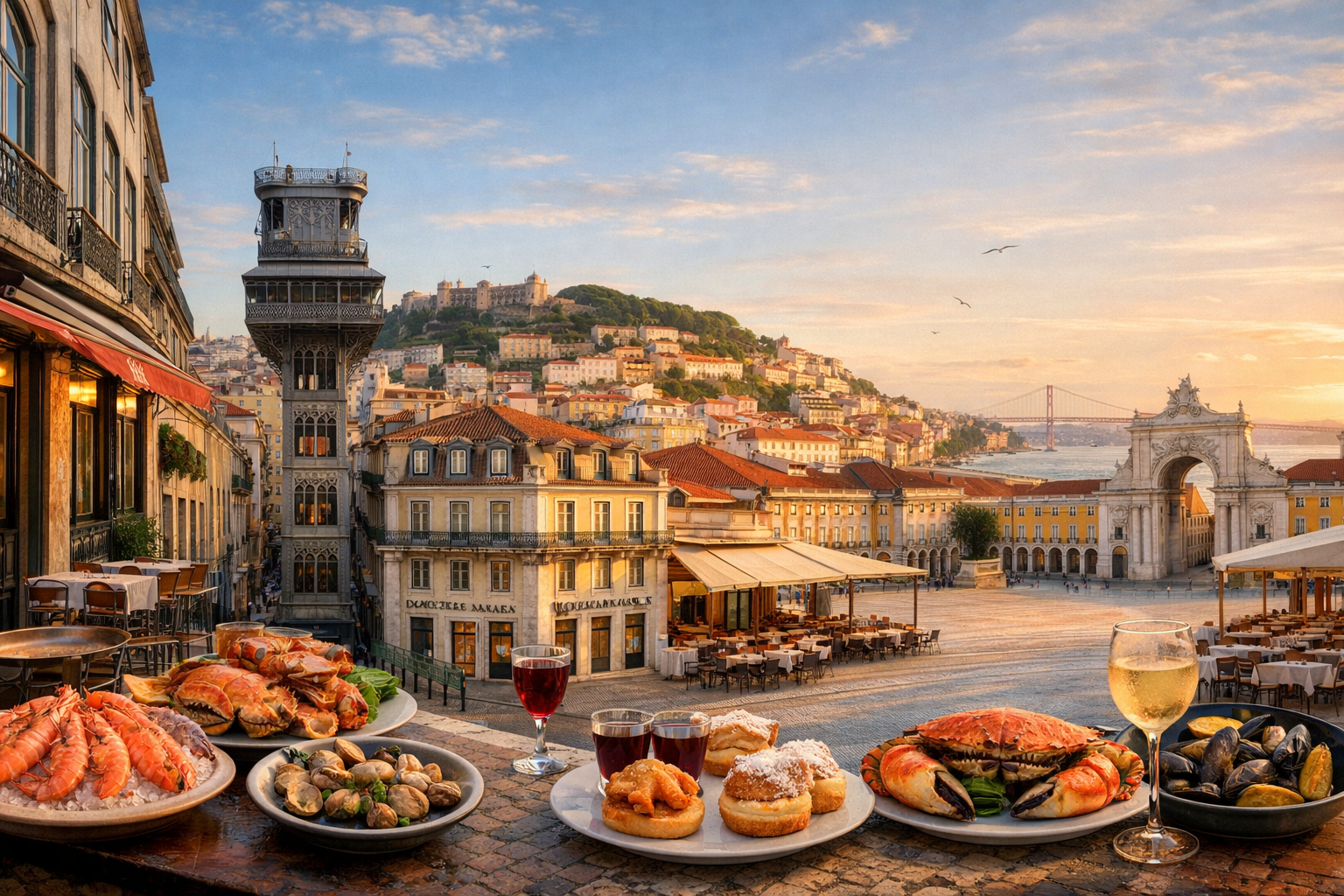
Day 1 — Baixa, Restauradores, and Intendente: sweet classics, ginjinha, and a grand seafood evening
🚶 Begin your gastronomic introduction to Lisbon in the historic center, in the Baixa district, where after the 18th-century earthquake the city was rebuilt in a strict street grid, and today the capital’s oldest culinary addresses hide between elegant facades. It is convenient to build the morning around Praça da Figueira and Rossio: it is easy to stay here, simple to reach from the airport by metro, and most key points of the first day are within a 10–25 minute walk. This is a great day for a slow immersion into the tastes of Lisbon: first an old pastry shop, then the cherry liqueur ginjinha, followed by a walk through the center and a big evening at one of the city’s most famous seafood cervejaria.
🥐 The first stop is Confeitaria Nacional, Praça da Figueira 18B, a historic pastry shop operating in this location since the 19th century. This is not just a café, but an important part of Lisbon’s gastronomic memory: here it is especially fitting to try not only pastel de nata, but other Portuguese sweets as well, so the route does not revolve around a single dessert. For breakfast, order a strong bica coffee, a pastel de nata, and also one or two items from the traditional display — for example, travesseiro, queijada, or seasonal pastries if they are available. This is a particularly good spot in the morning: sweets are perceived here as an introduction to Portuguese cuisine, not as a random pause. For travelers with dietary restrictions, it is important to remember that classic Portuguese pastries almost always contain wheat flour, eggs, and dairy products, so in case of severe allergies it is safer to ask the staff about the ingredients in advance.
🥃 From Confeitaria Nacional, a few minutes on foot will bring you to Largo de São Domingos for a short but very Lisbon-like stop at A Ginjinha — a tiny historic establishment where, for many, acquaintance with the city ritual of drinking ginjinha begins. This sour cherry liqueur is usually ordered in a small portion; you can ask for the version with the berry or without it. In essence, this is not a full bar visit, but rather a cultural tasting: two or three sips, the noise of the square, conversations at the counter, and the feeling that you have touched old Lisbon, where culinary tradition lives on the scale of a single window. If you do not drink alcohol, simply skip this stop and replace it with an extra coffee break in the center.
🚶 After sweets and liqueur, give yourself time for a walk through Baixa and Restauradores. The logistics here are very convenient: from Rossio to Praça dos Restauradores it is about a 10-minute walk along flat central streets. This is a good interval to restore your appetite before lunch or a late lunch, admire arcades and historic squares, and feel how the city’s rhythm changes from the morning pastry shop to more theatrical boulevards. If you want to add another gastronomic context, you can make a short detour to Mercado da Ribeira / Time Out Market and see how traditional Portuguese gastronomy lives in the modern format of a market and food hall, but on this day it is better not to overeat: the main event is still ahead.
🍤 For a late lunch or early dinner, choose Pinóquio, Praça dos Restauradores 79–80. This is a classic restaurant in the center, known for its attachment to seafood and convenient as an intermediate or main gastronomic stop for the first day. The restaurant usually operates from 12:00 to 23:00, so it is convenient to come either for a late lunch around 14:00, or keep it as an earlier dinner if you want to lighten the evening. Here it makes sense to order Portuguese seafood classics: arroz de marisco to share, amêijoas à Bulhão Pato, shrimp, squid, or the fish of the day if it is on the menu. If the main focus of the trip is Ramiro itself, at Pinóquio you can limit yourself to one or two appetizers and a glass of vinho verde or white vinho da casa. For guests who do not eat shellfish, it is better to choose fish or more neutral options; if you have a crustacean allergy, you should tell the staff directly about the risk of cross-contact in the kitchen.
🚕 After resting at the hotel or taking a short break, head toward Intendente / Avenida Almirante Reis. From the center, you can realistically get here by taxi or TVDE in about 10–15 minutes, while on foot it will take around 20–30 minutes depending on your starting point and pace. The evening is intentionally arranged so that the culmination of the day is Cervejaria Ramiro — one of Lisbon’s most recognizable addresses for seafood lovers. This place is worth planning in advance: for a comfortable visit, it is best to book a table, especially for dinner, and avoid arriving too late on impulse.
🦐 Cervejaria Ramiro, Avenida Almirante Reis 1H, is a gastronomic legend of Lisbon, where people go not for formal fine dining but for a concentrated, noisy, joyful celebration of Atlantic products. Here you should build dinner around tasting several categories of seafood: garlic shrimp, large tiger prawns or scarlet shrimp, sapateira crab, shellfish if available, as well as other seasonal items of the day. The atmosphere is usually lively, seating is tight, service is quick, and the table fills with plates in waves — that is exactly how this place should be experienced. It is important to come here hungry and not try to order everything at once without pauses: it is better to start with shrimp and shellfish, then move on to crab or a larger dish. For those who do not eat seafood, Ramiro is not the best focus of the route; an alternative may be to accompany the group and order simpler dishes, but the tour itself is designed specifically around the gifts of the sea.
🍺 A practical tip about budget and the rhythm of the day: both key restaurants on this route are popular and not the cheapest addresses in the center, and seafood prices especially depend on the season and the day’s offerings. So it is wise to allow for a flexible budget, choose 3–5 strong items instead of ordering chaotically, and leave room for the end of the evening. After a hearty seafood dinner, you may not want to plan dessert: it is better to return calmly to the hotel and save your energy for the second day, when there will be a market, a culinary experience, and another important sweet chapter of Lisbon’s gastronomy.