
Buy PDF guide

Buy PDF guide — 10.71 USD

PDF — 10.71 USD

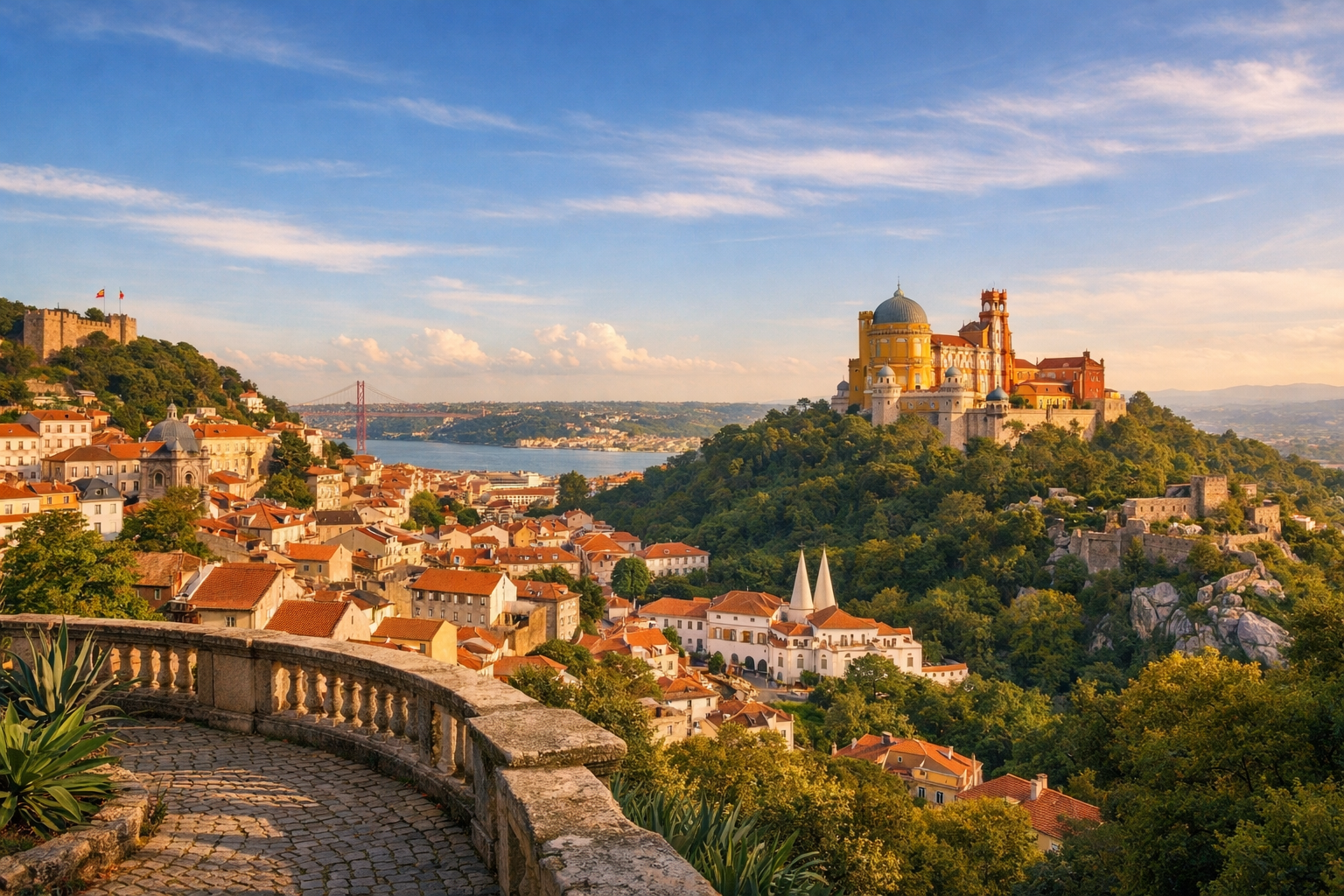
Portugal, Lisbon and Sintra. A budget trip around the capital, viewpoints, old quarters, and the palaces of Sintra with accommodation outside the city center.

Portugal, Lisbon and Sintra. A budget trip around the capital, viewpoints, old quarters, and the palaces of Sintra with accommodation outside the city center.

Discover Lisbon on a budget, wandering through sunlit old quarters and stopping at sweeping viewpoints above the city’s tiled rooftops and the Tagus. Then escape to Sintra for its fairytale palaces and misty hills before returning to the capital, with smart stays just outside the center keeping the trip affordable.

🧭 DAY-BY-DAY ITINERARY

Ready-made country and city routes with daily plans, sights, transport and accommodation. Buy PDF guides for independent travel.

🧭 DAY-BY-DAY ITINERARY


Day 1 — Lisbon: arrival, an affordable base outside the center, and a first evening in the old town

  • 🚇 For a budget-friendly start, it is more convenient not to stay right in the center, but to choose a quiet and more affordable base near transport hubs outside the historic core — for example, in the Oeiras/Porto Salvo area or near the airport/metro line. From Lisbon Airport, you can get into the city by metro: Aeroporto station is connected to the metro network, and the trip to the main central interchanges usually takes about 20 minutes. If you want to cut costs on separate tickets on arrival day and also prepare for your trip to Sintra, look into the 24-hour Carris/Metro/CP ticket: it covers the metro, Carris buses/trams, and CP suburban trains, including the Sintra line. This is one of the most practical ways to avoid overpaying for separate rides.

  • 🏘️ After checking in, head to Baixa and then continue on foot to Alfama — this is one of the best scenarios for a budget introduction to the city. Baixa is the post-earthquake rebuilt heart of Lisbon, with straight streets, arcades, squares, and a light sense of an old Atlantic capital, while Alfama is a completely different world: a labyrinth of stairways, white-and-yellow facades, laundry on balconies, old doors, churches, and narrow stone alleys where the city reveals itself not as a display window, but for real. This is where you feel “old Lisbon” best: the district should not be “checked off by points,” it should be experienced on foot, climbing higher and higher from the waterfront and cathedral to the viewpoints.

  • 🌅 In the evening, head up to Miradouro de Santa Luzia and Miradouro das Portas do Sol. These two viewpoints are close to each other and offer that classic view of Alfama’s red rooftops, domes, church towers, and the Tagus. Santa Luzia is more intimate and romantic, with tiles, greenery, and shady terraces, while Portas do Sol is more open, with a wide panorama over the São Vicente slope and the neighborhood’s maze of streets. It is an almost perfect free evening: beautiful light, minimal expenses, and a very high emotional payoff already on the first day.

  • 🍽️ Keep dinner simple: a small tasca, a café by the station, or an inexpensive place with prato do dia. For a budget trip, a reasonable food guideline in Lisbon is about €8–15 for a simple main dish or set lunch, €2–5 for pastries/soup/a snack, and €1.5–3 for coffee. Prices are often higher in tourist hotspots, so dinner near your base outside the center is often noticeably cheaper and calmer.


Day 2 — Lisbon: Alfama, Sé, the castle from outside, Graça, and the best free panoramas

  • 🚶 Start the day early with a walk past Sé de Lisboa — the city’s oldest cathedral — and continue uphill through the old streets of Alfama. Morning is especially pleasant here: the crowds are still thin, shops are opening, there is the smell of pastries in the air, and the city’s uneven terrain becomes the main character of the walk. This day is designed to be almost entirely on foot and budget-friendly: thanks to the concentration of historic quarters on the hills, you get many impressions without expensive tickets.

  • 🏰 Castelo de São Jorge can be seen as the anchor point of Lisbon’s entire topography. Even if you do not go inside, the area around the castle and the approaches to it are already worth your time: walls, old gates, sharp changes in elevation, and views over the Tagus create the feeling that the city still preserves the defensive logic of a medieval fortress. For a budget trip, this is a good compromise: if your budget is limited, you can save the paid entry for a day with clear weather and a great mood, and make the route around the hill itself the main value of the day.

  • 🌇 Then continue up toward Graça to Miradouro da Senhora do Monte. This is one of Lisbon’s strongest free panoramas: from here you can see Saint George’s Castle, the river, Baixa, the rooftops of the old districts, and the more modern part of the city stretching northward especially clearly. Unlike some “postcard” spots, this viewpoint gives a sense of the capital’s scale and at the same time shows how Lisbon consists of different layers — Moorish, royal, port, and everyday.

  • 🥪 In the middle of the day, aim for the simplest possible food: a bakery, soup, bifana, a sandwich, pastel de nata, fruit from the supermarket. The budget rhythm in Lisbon works especially well this way: a hearty breakfast, an inexpensive lunch without a long sit-down, and a more relaxed dinner in the evening. It is also practical because you will be walking a lot, and the hills quickly become tiring.

  • 🚋 If your legs get tired, use public transport selectively rather than constantly: one or two rides by bus/tram or metro per day are usually enough. A single Carris/Metro ticket is relatively inexpensive, but with several rides in a row the 24-hour option is already better value. On this day, the important thing is not to try to “cover everything,” but to leave time for breaks, water, shade, and a calm return to your hotel outside the center.

Day 3 — Sintra: a budget train day trip, palace silhouette, and the old center

  • 🚆 Sintra is best done as a separate early trip from Lisbon. CP trains run on the Sintra line, and you can depart, among other places, from Rossio, Oriente, or Entrecampos stations. The trip to Sintra usually takes about 40–50 minutes depending on the departure station and the service. If you use the 24-hour Carris/Metro/CP ticket, it covers both the train and public transport in Lisbon, which is especially good value on the day you go to Sintra.

  • 🏞️ For a strictly budget scenario, do not try to pay for all the palaces in one day. It is much more sensible to choose one main paid site and complement it with the old center, views, and a walk. The most striking symbol of Sintra is Palácio da Pena, a fairytale romantic palace on top of the ridge, as if painted in shades of ochre, terracotta, and old gold. It looks like a set piece from a 19th-century European fantasy: towers, battlements, arches, forest mist, bright walls, and the sense that the architecture here was created not for strictness but for impression. It is one of those places people come to Sintra for in the first place.

  • 🚌 From the railway station to Pena, people usually take bus 434. It is important to keep in mind that the uphill climb is tiring, and private car traffic is restricted on the approaches to the monuments, so public transport here is not just a convenience but the most realistic strategy. Allow half a day for the whole complex and getting around: the journey, waiting, ascent, entry, and the walk around the grounds take noticeably more time than it seems on the map.

  • 🏘️ After the palace, head down to Sintra’s historic center and give yourself an unhurried break. The National Palace of Sintra, with its two recognizable white conical chimneys, literally defines the silhouette of the old town and feels more “grounded” and royal than the fantastical Pena. Even if you do not go inside, the space around Largo Rainha D. Amélia, the little streets, pastry shops, and the cool air of mountain Sintra create a completely different mood compared to Lisbon: less scorching sun, more damp greenery, and more of the feeling of an old countryside residence.

  • 🍰 In Sintra, it is also best to keep food spending under control: coffee and pastries, soup, a sandwich, an inexpensive menu do dia. Tourist restaurants around the main squares may be pricier, so it is better value to walk a couple of streets away. In the evening, return to Lisbon without overloading the program — the day is already long, and a calm evening at your base outside the center helps you avoid burnout by the end of the trip.

Day 4 — Sintra or Lisbon depending on the weather: Quinta da Regaleira / backup city day

  • 🌿 It is convenient to keep the fourth day flexible. If the weather in Sintra is good and you are ready for a second trip, devote the day to Quinta da Regaleira — one of the most mysterious ensembles in the region. This place is loved not only for the palace but for the atmosphere of its symbolic garden: little towers, grottoes, terraces, staircases, tunnels, ornamental ponds, and the famous initiation well create the feeling of traveling not just through an estate, but through a carefully constructed myth. Unlike Pena, the main effect here comes not from a silhouette on a mountain, but from the gradual unfolding of the space.

  • 🚶 Quinta da Regaleira is located not far from Sintra’s historic center, so this day is easier and cheaper than a route with a larger number of mountain transfers. You can arrive by train, walk from the center, explore the estate itself, and still leave time for Park da Liberdade or simply for an unhurried walk. This is a good option for those who want one more “big” site but without complicated logistics and excessive fatigue.

  • ☁️ However, Sintra is sensitive to weather and access restrictions. Official services periodically publish warnings about temporary closures of parks and monuments because of wind, rain, forest risks, or trail conditions. If you see a bad forecast or restrictions, do not insist on going at any cost — turn this day into a backup Lisbon scenario instead: MAAT from the outside and the waterfront in Belém, a walk through Baixa and Chiado, a market/café, viewpoints, or an affordable museum like Museu do Fado.

  • 🎶 If you stay in Lisbon, the Alfama + Museu do Fado route works very well. Fado is not just a music genre but an emotional language of the city, and the museum helps connect what you hear in the old quarters with the history of the tradition itself. Even without an evening show, you begin to understand better why Lisbon is so often perceived not as a collection of sights, but as a mood.

  • 💡 The budget logic of this day is simple: either one quality trip to Regaleira, or a calm city backup day without chaotic spending. Do not try to squeeze Regaleira, Pena, and the Moorish Castle into one block — at that point it stops being a budget-friendly and realistic itinerary.

Day 5 — Lisbon: a final day without rushing, the waterfront, souvenirs, and departure

  • 🌊 It is best to make the last day light and logical in terms of logistics. If your flight is late, leave your bags at the hotel and spend a few hours in the flatter part of the city — for example, in Baixa, Chiado, or by the Tagus waterfront. After the hills of Alfama and the trips to Sintra, it is pleasant to end the journey in an open urban space: arcades, wide squares, river light, and wind offer a completely different, calmer reading of Lisbon.

  • 🛍️ For souvenirs, avoid the most touristy display windows near the main postcard spots and stick to ordinary grocery stores and small shops instead: a good budget set is canned goods, a bar of chocolate, olive oil in a small bottle, postcards, soap, and inexpensive ceramics. This way, you take Portugal home without unnecessary expense and without the feeling that you overpaid for “must-buy items.”

  • ☕ The finale can be devoted to simple things: one more cup of coffee, a pastel de nata, a short walk through your favorite part of the old town, or a return to a viewpoint you liked. This is especially right for a short 5-day itinerary: it is better to end the trip with a sense of completeness than to try to squeeze in one more demanding site in the last few hours.

  • 🚇 Leave extra time for the journey to the airport. The metro remains the most budget-friendly and straightforward way to get there, and if you have an early-morning or late-night flight, check taxis/ride-hailing in advance. Even on a compact itinerary, it is important to remember: transport schedules, security screening times, weather conditions, and access to some sites can change, so the final day should stay a little “breathable,” without rigid overload.

Flight tickets

eSIM for travel

Buy PDF guide

Buy PDF guide — 10.71 USD

PDF — 10.71 USD