
Buy PDF guide

Buy PDF guide — 10.71 USD

PDF — 10.71 USD

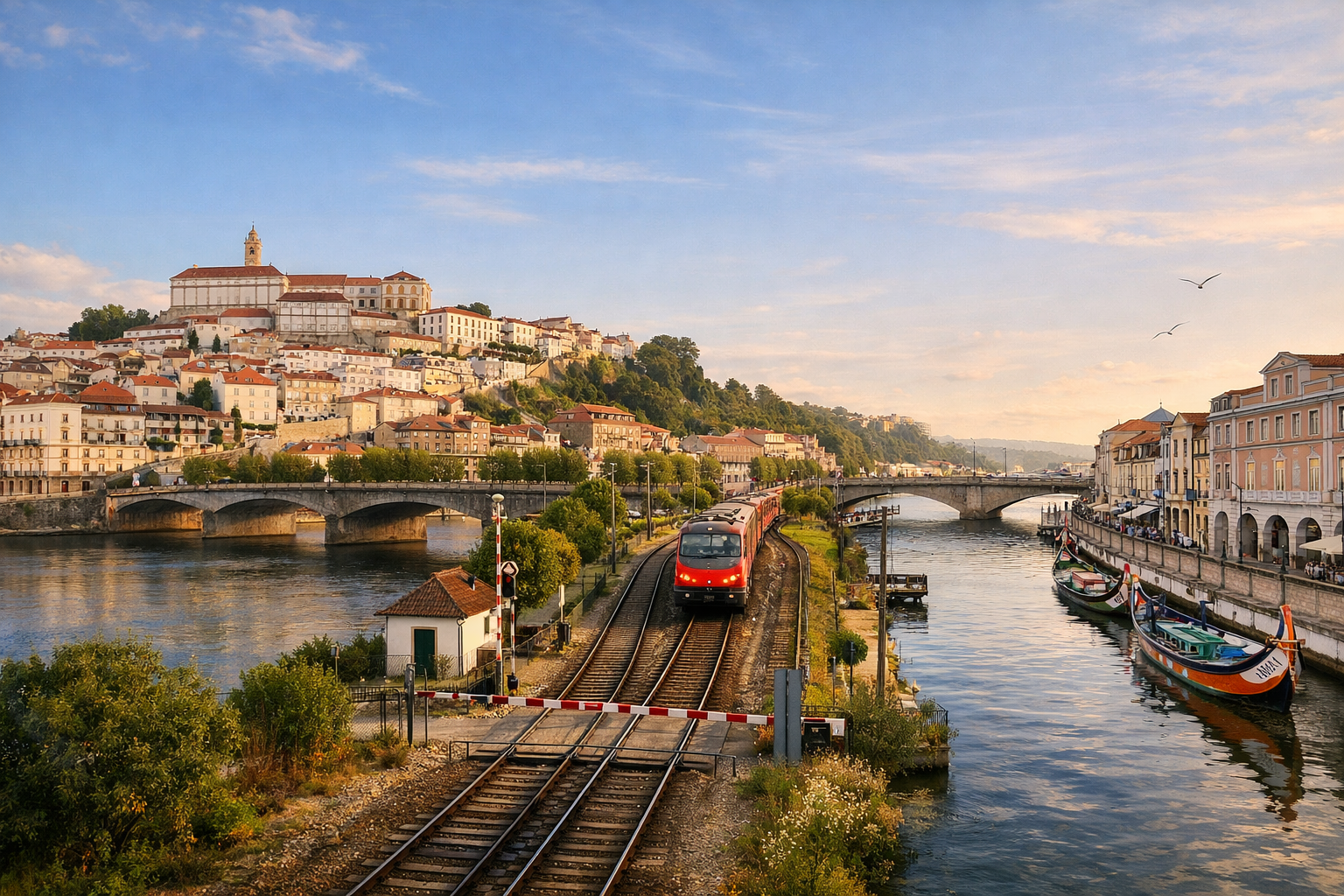
Portugal, Coimbra, and Aveiro. A budget route through the university city and the Portuguese “little Venice” with train transfers.

Portugal, Coimbra, and Aveiro. A budget route through the university city and the Portuguese “little Venice” with train transfers.

Travel from Coimbra’s storied university streets to Aveiro’s canals and colorful boats, then continue to Costa Nova for striped seaside houses and Atlantic air. This easy budget route links central Portugal’s culture and coast with simple train connections and a refreshing day-trip rhythm.

🧭 DAY-BY-DAY ROUTE

Ready-made country and city routes with daily plans, sights, transport and accommodation. Buy PDF guides for independent travel.

🧭 DAY-BY-DAY ROUTE


Day 1 — Coimbra: the old town, the university hill, and first panoramas

  • 🚶 Coimbra is one of those cities where almost the whole best day comes together on its own without expensive tickets: all you need are comfortable shoes, a bottle of water, and readiness to climb old stairways. The historic center lives here on a slope above the Mondego River, and this terrain is exactly what makes the walk especially expressive: below are livelier streets and the station area, above are academic courtyards, bell towers, and stone facades that make Coimbra feel both alive and very ancient. Start your route calmly, without rushing, so as not to overload the day after the journey: walk from the lower town to the university district, stopping at viewpoints and in shaded passages. This is the best budget way to “read” the city: not through museum display cases, but through the atmosphere of old buildings, church facades, arches, and the student environment that has shaped Coimbra’s character for centuries.

  • 🚶 The main star of the day is the University of Coimbra, one of the country’s symbols and the heart of the whole route. Even if you skip many paid options, the climb to the complex itself, the Paço das Escolas courtyard, and the city views make a very strong impression. Here you feel both the scale of academic history and the special ceremonial nature of the space: high walls, austere facades, the sound of the tower, sharp light on limestone, and the red roofs below create an almost theatrical scene. If the budget allows, you can choose a combined tourist ticket for the university complex, but plan it so you make the most of its validity period: with the tourist visit, some sites are accessible over two days, and the Joanina Library is assigned a separate time slot. This is especially convenient for a short economical trip, because some university interiors can be postponed to the next day without buying another ticket.

  • 🍽️ For budget meals on the first day, it is best to stick to the areas around Baixa and the streets between Coimbra-A station and the climb to the old center: here it is easier to find inexpensive set lunches, bakeries, soup spots, sandwich bars, and cafés with daytime menus. A realistic reference point for a budget traveler is about €6–10 for a simple lunch and €2–4 for breakfast at a bakery. In the evening, it is better not to build an overly packed program: after climbing the hills, it makes sense to leave time for rest, an early night, and adjusting to the city’s rhythm.

  • ⚠️ Coimbra is safer and easier to explore during the day and early evening, but the streets in the old center are steep, slippery in places, and uneven, while heat and stairs quickly become tiring. Information about safety, weather, road conditions, and route accessibility may change. Before your trip, check official warnings, the weather forecast, transport schedules, and any possible trail restrictions. No destination can be considered completely safe.


Day 2 — Coimbra: university interiors, Machado de Castro, and the Mondego riverfront

  • 🚶 The second day is logically devoted to places where Coimbra reveals itself more deeply, but still without unnecessary expense. If you bought a university ticket the day before, today is a convenient time to return to the spaces you did not want to rush through: the Joanina Library, palaces, and scientific areas are better experienced without hurry and without the feeling that you need to “see everything at once.” Inside the university complex, the contrast between outward austerity and the decorative richness of the interiors is especially striking: the baroque library makes a strong impression not by size, but by the solemn rhythm of shelves, lacquer, gilding, and almost stage-like light. It is one of those rare places where a paid entry is truly justified even on a budget trip, if you limit yourself to one or two key tickets for the whole route.

  • 🏛️ After the university, head to the Museu Nacional de Machado de Castro, one of Portugal’s most important museums, located near the university hill. Even those who usually do not like “big museums” often find it interesting here because of the combination of several layers of the city in one place: collections of religious art, archaeology, and especially the Roman cryptoporticus create the feeling that you are descending beneath familiar medieval Coimbra to an even older foundation. For a short trip, this is a very successful museum: it does not require a whole day, lies logically along the route, and provides strong cultural context without the need to travel around the surroundings.

  • 🚶 In the evening, it is worth changing the dense historical atmosphere for a more relaxed walk along the Mondego. The embankments and green riverside sections are perfect for an inexpensive and pleasant end to the day: there is no need to pay for transport, and the view of the city from below helps you see the same university hill in a new way, now in softer light. If you still have energy, you can add Portugal dos Pequenitos as an easy and unusual stop, especially if you want something less academic. But for a budget pace, it is better not to overload the day: Coimbra shines best when there is time between points simply to look at the city.

  • 💶 Daily spending guide at an economical pace: city bus if needed — about €1–3 per ride or the equivalent under current local fares, one paid museum/university zone — roughly an inexpensive or mid-range city ticket, meals — about €10–18 for the whole day when combining a bakery, a daytime menu, and a simple dinner. Check current prices before your trip: in Coimbra, temporary changes to bus traffic are possible due to works and city events.

Day 3 — Transfer to Aveiro: canals, art nouveau, and an evening in the “Little Venice”

  • 🚆 Transfer: Coimbra-B → Aveiro by CP Regional / InterRegional train usually takes about 50–60 minutes. This is the key leg of the whole route: short, inexpensive, and realistic, which is exactly why the railway makes the Coimbra + Aveiro combination one of the best budget trips in central Portugal. It is better to leave in the morning after a relaxed breakfast so the day does not turn into pure logistics. Keep in mind that some long-distance trains and connections in Portugal go through Coimbra-B rather than the more central Coimbra-A, so the route to the station is worth planning in advance.

  • 🚶 Aveiro has a completely different mood: if Coimbra is built on hills, memory, and academic austerity, then Aveiro works through water, light, reflections, and a lighter urban rhythm. The center is easy to explore on foot and without expensive activities. Walk along the central canals, look at the moliceiros — traditional boats thanks to which the city gained its image as the “Portuguese Little Venice” — and pay attention to the art nouveau facades, bridges, and bright urban details. Even without a paid boat ride, the city offers plenty of impressions: the water constantly changes the perspective, and the central streets are compact enough to wander without transport costs.

  • 🏛️ In the second half of the day, it is convenient to visit the Museu de Arte Nova or simply build your walk around the neighborhoods with modernist architecture, and then continue to the Museu de Aveiro / Santa Joana if time and energy allow. Aveiro is appealing because cultural sites here are not scattered too far from one another: canals, churches, museums, and inexpensive cafés can all be combined within one walkable radius. For budget travel, this matters: less time lost, fewer transport expenses, and more flexibility in the schedule.

  • 🍽️ A budget evening in Aveiro is best built around simple family restaurants, snack bars, bakeries, and menu do dia offers slightly away from the most touristy canal-side spots. The same guideline applies: around €7–12 for a simple dinner without extras. If you want to try the local sweet ovos moles, it is better to buy a small portion as a culinary introduction rather than turn it into a full dessert stop with a tourist-area markup.

Day 4 — Aveiro and Costa Nova: market, Santa Joana Museum, the beach line, and striped houses

  • 🚶 Morning in Aveiro is best started without rush: walk through the center to the places you did not manage to see the day before, visit the Museu de Aveiro / Santa Joana, or limit yourself to an exterior look at the historic quarters and canals. This museum is especially suitable for a route of this kind: it gives an idea of the city’s religious and artistic heritage while remaining within the real urban fabric rather than somewhere far outside the tourist zone. If you want a very economical day, you can focus on the walking part and keep just one inexpensive museum ticket.

  • 🚌 After lunch, head toward the coast — to Costa Nova. It is quite realistic to get there from Aveiro by public transport, and that is exactly what makes the outing appropriate for a budget tour. Costa Nova attracts visitors not only with the beach, but also with its recognizable visual image: the striped palheiros houses look almost toy-like, yet against the backdrop of wide sky, sand, and lagoon they create a very photogenic and truly Portuguese scene. It is a good contrast to the city days: after university courtyards and canals, you get Atlantic air, a long horizon line, and a more relaxed pace.

  • 🚶 If the weather is favorable, take a long walk along the wooden boardwalks, the beach line, or beside the lagoon, without turning the day into an expensive resort outing. For a budget traveler, this is almost an ideal scenario: transport is public, the main impressions are free, and the rest feels complete. Wind, sun, and open space can quickly become tiring here, so it is important to plan for breaks, water, sunscreen, and the option to return earlier if the weather turns harsh.

  • ⚠️ On the coast, conditions change faster than in the city: wind, waves, heat, fog, and the state of walkways can noticeably affect comfort. Information about safety, weather, road conditions, and route accessibility may change. Before your trip, check official warnings, the weather forecast, transport schedules, and any possible trail restrictions. No destination can be considered completely safe.

Day 5 — Return to Coimbra: a calm finale, market, park, and departure

  • 🚆 Transfer: Aveiro → Coimbra-B by CP Regional / InterRegional train usually takes about 50–60 minutes. Returning to Coimbra on the last day is convenient for two reasons: it makes logistics for the next leg of the trip easier, and Coimbra itself is good for an unhurried finale without any mandatory “maximum program.” If you arrive or depart via major cities, it is often from Coimbra that it is more convenient to continue by rail or transfer.

  • 🚶 The last day should be kept light and flexible. Depending on your departure time, you can choose one of two scenarios. The first is historical: catch the quarters of the old town that you moved through too quickly at the beginning of the trip, step into a church or viewpoint, have coffee on a quiet square, and once again walk the route between Baixa and the university hill. The second is relaxed: spend a few hours by the park and river areas, without museums or climbs, to finish the tour without fatigue. For budget travel, this kind of ending is especially useful: it requires no extra expense, and the impression of the trip remains cohesive.

  • 🛍️ If you want souvenirs without overpaying, it is better to buy them not in the first tourist shop near the main postcard spots, but in ordinary stores in the center or at food stops along the way. Small gastronomic purchases, postcards, simple ceramics, or local sweets will cost more reasonably if you do not buy them in the most expensive area. For the road, it is convenient to buy pastries, sandwiches, and water in advance — this is almost always cheaper than buying food at the station at the last moment.

  • 💶 Roughly, the whole 5-day route in a very economical style can fit within a budget range: accommodation in affordable hotels or simple central lodgings, two intercity rail transfers, occasional use of city buses, 1–3 paid sights of your choice, and meals without restaurant splurges. The final cost depends heavily on the season, booking date, and day of the week, so all prices should be treated only as a guideline and checked again before payment.

Flight tickets

eSIM for travel

Buy PDF guide

Buy PDF guide — 10.71 USD

PDF — 10.71 USD