
Buy PDF guide

Buy PDF guide — 6.43 USD

PDF — 6.43 USD

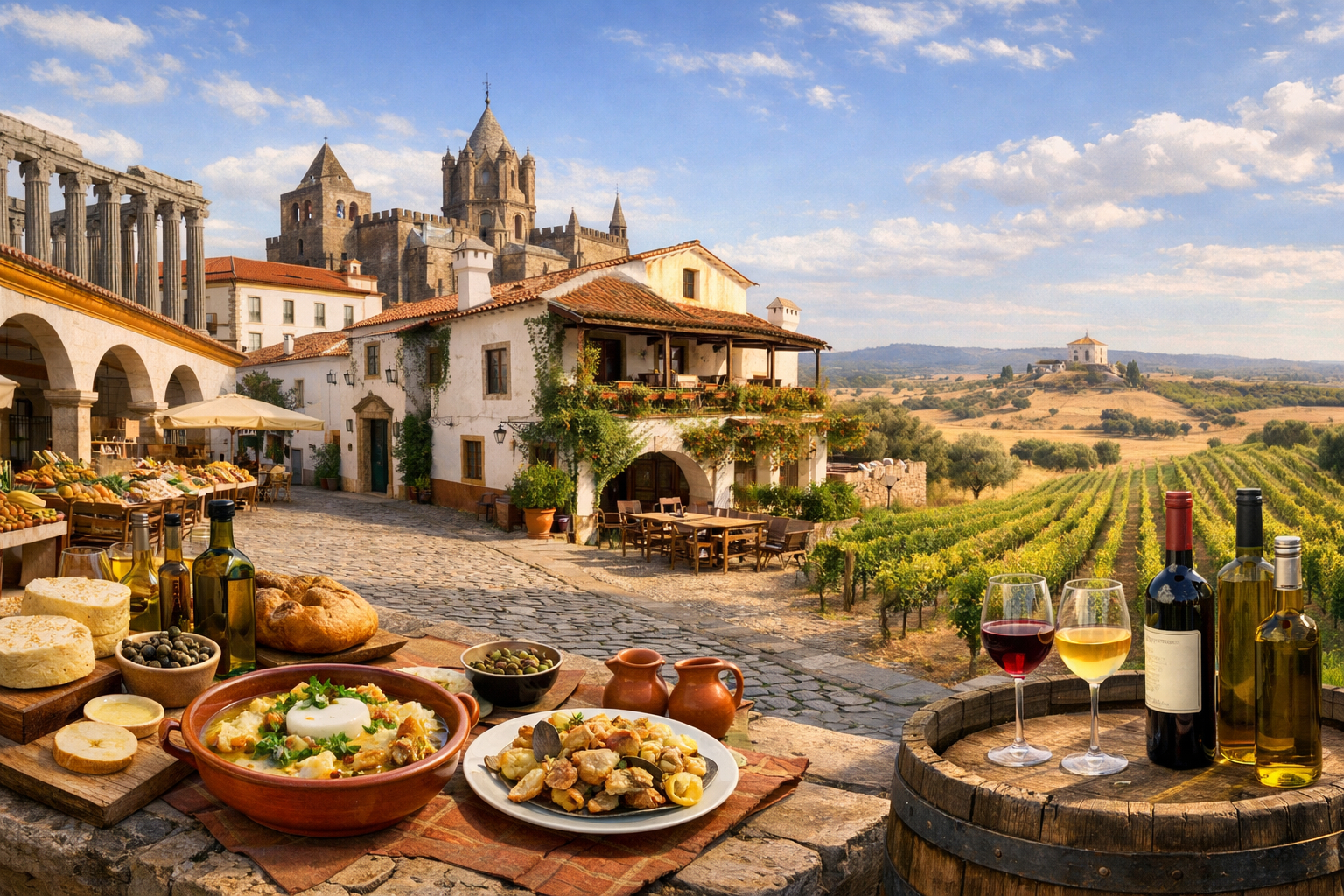
Portugal, Évora and Alentejo. A trip for Alentejo cuisine with the Mercado Municipal de Évora market, the Fialho restaurant, and the Cartuxa winery: açorda bread soup, pork with clams, sheep’s cheeses, olive oil, and regional wines.

Portugal, Évora and Alentejo. A trip for Alentejo cuisine with the Mercado Municipal de Évora market, the Fialho restaurant, and the Cartuxa winery: açorda bread soup, pork with clams, sheep’s cheeses, olive oil, and regional wines.

Évora is the perfect gateway to Alentejo, where whitewashed streets lead to deep, generous flavors. Browse the Mercado Municipal de Évora, linger over classic dishes at Fialho, and taste Cartuxa wines alongside rich olive oil, sheep’s cheeses, açorda, and the region’s famed pork with clams.

🧭 DAY-BY-DAY ROUTE

Ready-made country and city routes with daily plans, sights, transport and accommodation. Buy PDF guides for independent travel.

🧭 DAY-BY-DAY ROUTE


Day 1 — Évora: discovering the taste of Alentejo through Mercado Municipal de Évora and the historic center

  • 🚆 The most convenient way to plan your arrival in Évora is from Lisbon: the Intercidades train to Évora usually takes about 1 hr 20–1 hr 35 min, the direct Rede Expressos bus about 1 hr 45 min, and the drive from Lisbon Airport to central Évora takes around 1 hr 30 min without serious traffic. For a gastronomic route, it makes sense to stay in a hotel within or near the historic walls so that most tastings and dinners are within walking distance and you won’t need a car in the evening.

  • 🚶 Start the day at Mercado Municipal de Évora on Praça 1º de Maio — one of the best places to feel Alentejo not as a postcard, but as the region’s real everyday gastronomy. It is especially interesting to come in the morning, when trading in fresh vegetables, seasonal fruit, bread, cheese, meat delicacies and local olive products is at its liveliest. The market atmosphere is very “alive”: not a sterile food hall, but a true city market where locals, suppliers from the surrounding area and travelers meet side by side, all wanting to understand why Alentejo cuisine seems simple but is in fact built on precision of ingredients. Look for sheep cheeses of different ages, rustic bread for açorda, jars of olives, local olive oil and products tied to seasonal cooking. This is a great moment for your first mini gastronomic breakfast: a piece of bread, cheese, fruit, coffee, and watching Évora wake up around the square.

  • 🍽️ What to try in the first half of the day: Alentejo sheep cheeses, rustic pão alentejano-style bread, olives and extra virgin olive oil. If you do not eat meat, the market is especially convenient for getting to know the region: bread, cheeses, vegetables, olives, honey and sweets make it possible to put together a very authentic vegetarian selection. If you are lactose intolerant, focus on bread, olives, fruit and oil, and ask vendors about the age and ingredients of the cheeses.

  • 🚶 After the market, take a leisurely walk through Évora’s historic center, where gastronomy naturally connects with architecture. On the way to the Roman Temple of Évora and Largo Conde de Vila Flor, you will see how Roman heritage, medieval streets and shop windows with local products coexist in the city. This is a pleasant district not to rush through: old stone, white facades, warm light, signs for wine shops and small stores make the walk part of the gastronomic experience. Alentejo in general reveals itself better not through a “mad dash between sights,” but through a slow rhythm in which coffee, cheese, a glass of wine and short walks gradually create a sense of the place’s richness.

  • 🏛️ For a cultural pause, stop by the Museu Nacional Frei Manuel do Cenáculo. It is not about food, but it provides exactly the right context for the region: the museum helps show that Évora is not just a convenient base for wine trips, but one of the most important historic cities in southern Portugal. After the museum, it is nice to take a short break in Jardim Público de Évora — a convenient green pause before dinner, especially in the hot season when daytime temperatures can be tiring.

  • 🍷 In the evening, plan dinner at Restaurante O Fialho, one of Évora’s most famous and historically important restaurants, operating since the 1940s and long a symbol of serious Alentejan cuisine. It is best to book a table in advance: this is not a spontaneous random tavern, but a place people truly travel here for. This is exactly where it makes sense to order the dishes around which you are building the whole trip: açorda alentejana, or açorda bread soup, pork dishes, and if the season and menu allow, variations on the traditional Portuguese pairing of pork and clams. Also pay attention to local cheeses, house desserts and the wine list with a strong focus on Alentejo. Guests with dietary restrictions should write to the restaurant in advance: a gluten-free version of açorda is usually impossible because of the bread base, but you can ask for simpler meat or vegetable dishes without sauces; vegetarians and pescatarians should clarify in advance which options are available on a given day.

  • 💤 After dinner, do not try to squeeze in another intense activity. It is better to leave the evening for a walk through illuminated Évora: around Praça do Giraldo and the surrounding streets, the city becomes especially cinematic, and after a hearty Alentejan dinner, a slow pace is exactly what helps you feel the style of the region. Overnight in Évora.


Day 2 — Évora and Alentejo: Cartuxa wine, olive oil and regional products

  • 🚗 It makes sense to build the second day around the products of Alentejo, not just around city food. In the morning after a relaxed breakfast, head to Adega Cartuxa / Enoturismo Cartuxa, located about 2 km from Évora’s historic center, at Quinta de Valbom, Estrada da Soeira. By car or taxi it is a short trip of about 10 minutes; in good condition and mild weather it is theoretically possible to walk, but for a comfortable gastronomic day a taxi is more convenient. A wine visit here requires time discipline: the main visits run on fixed slots, the standard duration is about 1 hr 30 min, and advance booking is highly advisable.

  • 🍷 Cartuxa is not just a “tick-the-box tasting,” but an important place for understanding modern wine Alentejo. The visit takes place in the historic setting of Quinta de Valbom and usually combines a story about the place, an overview of the evolution of winemaking and a tasting component. The official program includes visits without tasting and visits with a tasting of several wines; the venue also focuses not only on wine but on olive oil as well, which is especially valuable for a gastronomic route. This is a good place to compare the flavors of the region: the depth of Alentejo reds, the softness of the whites, the fruity profile of the oils and how all of this connects with bread, cheeses, pork, aromatic herbs and the region’s unhurried rural cooking. If you do not drink alcohol, the visit may still be worth considering for the cultural context and to buy olive oil, but it is best to clarify the format and availability of non-alcoholic alternatives in advance.

  • 💶 For budget planning, it helps to know the basic pricing logic: a visit without tasting starts at about €15 per person, the classic format with a winery visit and tasting of three wines is around €35, and an extended premium tasting is about €60. Prices and wine selections may change, so be sure to double-check before the trip. On site, it is also worth allowing time for the brand shop: bottles, gift sets and local products often become an important part of the gastronomic day.

  • 🍽️ After Cartuxa, return to Évora for a late lunch and build it around regional products rather than a second heavy dinner. A good tactic is to choose a place with local cuisine and order a set of small portions: sheep cheeses, olives, Alentejo bread, seasonal vegetable dishes, perhaps the soup of the day or a simple meat option. If you do not want to overload the route with a second formal high-level restaurant, this works better: it preserves energy and leaves room for shopping for products. For vegetarians, the second day is often even more convenient than the first: after the winery, it is easier to focus on cheeses, bread, salads, vegetables, mushrooms, egg dishes and regional snacks.

  • 🫒 In the second half of the day, devote time to gastronomic shopping in the city. Évora is great because within short walking distances you can put together an “edible portrait of Alentejo”: a bottle of local olive oil, sheep cheese, jars of olives, convent-style sweets and wine to take home. It is important to remember logistics: if you are flying with hand luggage only, larger bottles of oil and wine should either go in checked baggage or be bought only in sizes allowed by transport rules.

  • 🏛️ As a slow cultural addition toward evening, visit Igreja de São Francisco e Capela dos Ossos on Praça 1º de Maio. It is one of Évora’s best-known monuments and a very convenient stop near the market area. Even on a gastronomic trip, a site like this works not as a distraction but as a balance: after wine, food and shopping, the city opens up again through history, and the evening becomes richer in impressions than just a series of tables.

  • 🍮 For dinner, it is better to choose a lighter format: for example, soup, local snacks, a cheese plate, bread with olive oil and one glass of regional wine. If you had a big dinner at Fialho the day before, there is no need to overload the second evening. For travelers with dietary restrictions, this is also the most manageable meal of the whole trip: it is easier to ask for certain ingredients to be removed, skip meat, or choose less salty or less dairy-heavy options. Overnight in Évora again.

Day 3 — Alentejo at a slow pace: food for the road, a farewell lunch and departure

  • 🌅 It is best to make the third day gentle and logical in rhythm, without long trips deep into the region. This is not the kind of route where you need to urgently “add five more villages”: the value lies precisely in letting Évora and Alentejo finish speaking through flavors. Start the morning with breakfast at the hotel or in a calm city café, and then, if the day of the week and opening hours fit, return to the area around Mercado Municipal de Évora for what you want to take with you: bread, cheese, olives, sweets or gastronomic souvenirs. A repeat morning visit to the market is especially good because you already know your way around the flavors and understand what you genuinely liked in the region.

  • 🧀 This is the best moment for a thoughtful purchase of Alentejo sheep cheeses. Look for textural differences between younger and more aged options, and ask about shelf life and transport conditions. If you are carrying products in hot weather, bring a thermal bag and do not leave your purchases in the car for long. For those who do not drink alcohol, cheeses, bread, oil and sweets are exactly what make the route complete even without the wine component.

  • 🚶 Then devote a few hours to a final walk through Évora: Praça do Giraldo, Rua 5 de Outubro, and the viewpoints near the temple and museum quarter combine well into a farewell route. It is pleasant to pop into gastronomic shops and craft stores here, because Alentejo is not only about food as a meal, but also about material culture: ceramics, cork, textiles, the packaging of oils and wines, the aesthetics of convent sweets and the tradition of slow dining.

  • 🍽️ Make your farewell lunch meaningful and not too late. If on the first day you focused on Fialho, then on the third it is better to choose a shorter lunch format in Évora with dishes you have not yet had a chance to try: Alentejo-style vegetable soup, a simple meat dish, a cheese plate, eggs with local additions, seasonal snacks or a convent-style dessert. If it is important for you to complete the gastronomic theme specifically with a “pork and clams” dish, this lunch is your last convenient chance to check availability at a specific restaurant in advance by phone.

  • 🥗 For travelers with dietary restrictions, the third day is the safest: do not plan a complicated tasting set before the road. Choose predictable options, ask for sauces on the side, clarify the presence of gluten in soups and bread-based dishes, and in a vegetarian scenario rely on cheeses, eggs, vegetables, salads and sweets. In Alentejo, many traditional dishes are very bread-heavy and often based on broths or meat, so the earlier you mention your restrictions, the easier it is for the staff to help.

  • 🚆 / 🚌 / 🚗 In the second half of the day — departure from Évora. If you are returning to Lisbon by train, allow extra time to get to the station and do not schedule a heavy lunch too close to departure. If you are traveling by bus, it is more convenient to arrive at the terminal a little early, especially in high season. If you are using a car, do not forget to pack your purchases so that wine and oil are protected from heat and bumps. This is a very fitting way for this short three-day route to end: not through the number of stops, but through the density of flavors — from açorda and pork with seafood to cheese, oil and a glass of Cartuxa.

Flight tickets

eSIM for travel

Buy PDF guide

Buy PDF guide — 6.43 USD

PDF — 6.43 USD