
Buy PDF guide

Buy PDF guide — 8.57 USD

PDF — 8.57 USD

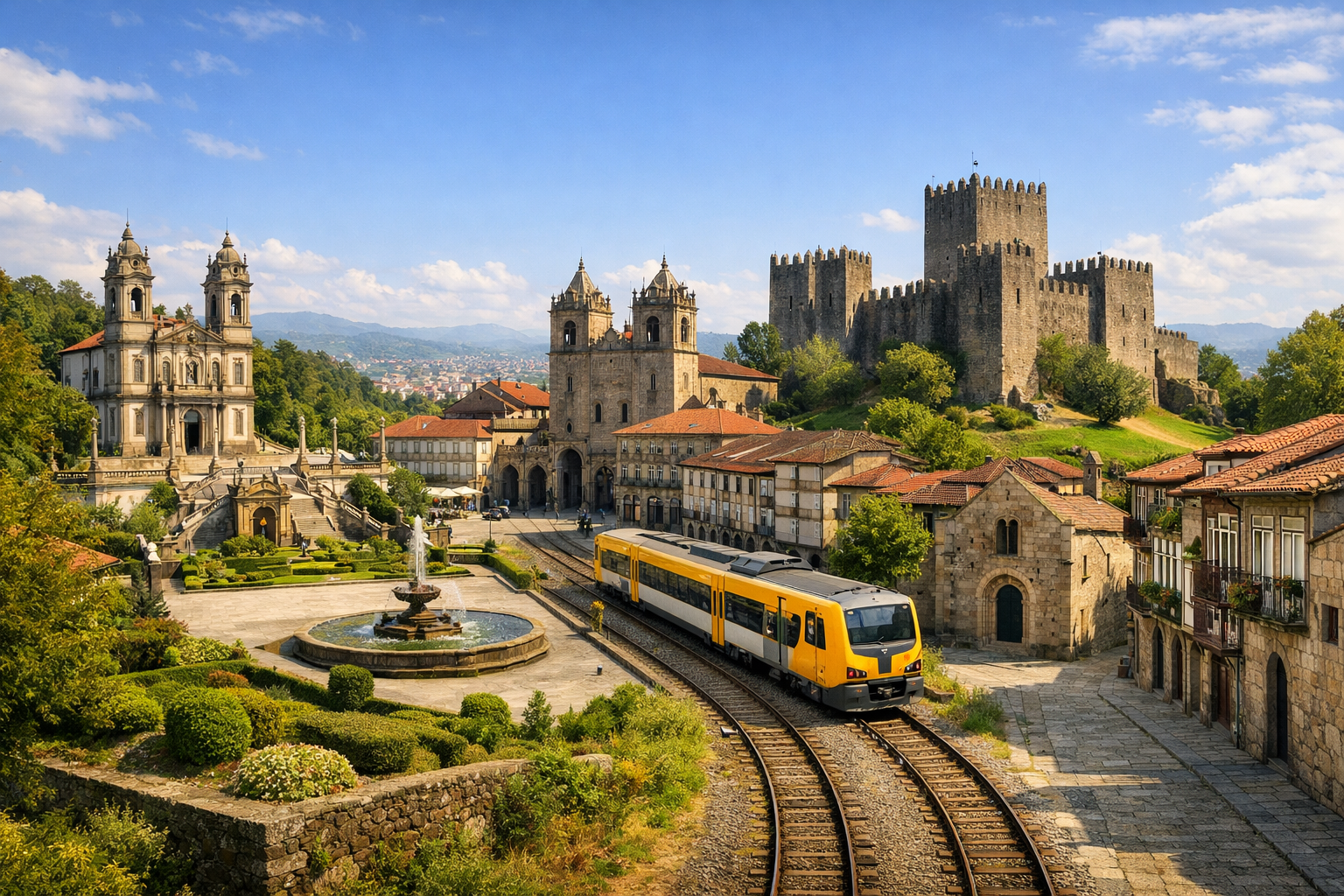
Portugal, Braga and Guimarães. An affordable trip through historic cities with cathedrals, castles, squares, and convenient travel on regional trains.

Portugal, Braga and Guimarães. An affordable trip through historic cities with cathedrals, castles, squares, and convenient travel on regional trains.

Discover Northern Portugal with a relaxed, affordable trip through Braga and Guimarães, where grand cathedrals, medieval castles, and lively old squares are never far away. With easy regional train connections between the two cities, it’s a simple and rewarding four-day escape into the heart of Portuguese history.

🧭 DAY-BY-DAY ROUTE

Ready-made country and city routes with daily plans, sights, transport and accommodation. Buy PDF guides for independent travel.

🧭 DAY-BY-DAY ROUTE


Day 1 — Braga: historic center, cathedral, and old squares

  • 🚆 The basic logic of this budget route is simple: it is most convenient to plan your arrival via Porto, then continue to Braga by public transport. The Porto São Bento / Campanhã → Braga train on the Urbanos do Porto line takes about 1 hour–1 hour 15 minutes depending on the service. This is one of the most sensible and affordable ways to reach the northern part of the country without renting a car. After arrival, it is best to check into a simple city hotel near the center and spend most of the day exploring on foot.

  • 🚶 Start getting to know Braga from its historic core — one of the most atmospheric old cities in Portugal, where baroque facades, church towers, narrow streets, and lively squares come together into a very cohesive picture. Braga is often seen as the country’s “religious capital,” but in reality it does not feel frozen like a museum: here, old heritage blends with university life, cafés, markets, and the calm rhythm of a northern city. For a budget trip, the center is especially convenient because many key sights are very close to each other, so there is no need to spend money on constant transfers.

  • ⛪ The main highlight of the day is Sé de Braga, the oldest cathedral in Portugal, located on Rua D. Paio Mendes. This place feels not just like a church, but like a layered historical knot where a Romanesque foundation, Gothic elements, baroque chapels, and museum spaces are combined into one rich composition. Even if you do not buy the full museum route, the cathedral’s surroundings, its square, and architectural details already give a strong sense of the city’s depth and age. It is worth allowing about 1.5–2 hours to visit the complex, and it is best to double-check opening times in advance, since some parts of the route may be restricted during services.

  • 🏛️ After the cathedral, it makes sense to walk to Praça da República and then along the central streets of old Braga. It is especially pleasant here to stroll without rushing: looking at arcades, fountains, house facades, little pastry shops, and city storefronts. It is easy to keep the day budget-friendly: some of Braga’s impressions require no tickets at all, and the strongest emotions here are often born not at ticket counters, but while walking — on a sunny square, by old stone, near a church portal, or in the shade of a narrow lane.

  • 🍽️ For inexpensive meals, look for simple pastelaria, snack-bars, and daytime menu do dia spots near the center: usually this means soup, a main dish, a drink or coffee at a moderate price. A realistic food budget for such a day is about 12–22 € per person if you avoid full restaurant dining. It is best to spend the night in Braga: this reduces unnecessary transfers and gives the trip a calm start.


Day 2 — Braga: Bom Jesus do Monte, gardens, and a museum day

  • 🚌 In the morning, head to the sanctuary of Bom Jesus do Monte — a symbol of Braga and one of the most striking religious panoramas in all of Portugal. The cheapest way to get there is by TUB city bus, then continue on foot up the famous baroque staircase. This option not only saves money, but also gives the strongest impression: you literally make your way upward through a cascade of stairs, terraces, fountains, and geometrically arranged landings, where the architecture becomes almost theatrical.

  • ⛪ Bom Jesus do Monte is not just a church on a hill, but a whole ensemble where pilgrimage symbolism, viewpoints, green slopes, and the grand staircase work together. It is best to make the climb without rushing, with short stops for photos and rest. At the top, a wide view opens over Braga and its surroundings, and it is here that you especially feel how the city is set into the soft landscape of northern Portugal. If you want to minimize costs as much as possible, you can skip extra paid activities and limit yourself to walking around the grounds and viewpoints.

  • 🌳 After returning to the center, devote the second half of the day to one or two inexpensive museums. A good choice is Museu de Arqueologia D. Diogo de Sousa, Rua dos Bombeiros Voluntários, 4700-025 Braga. This museum is especially well suited to a route through historic cities: it helps you see Braga not only as a baroque and religious center, but also as the heir to Roman Bracara Augusta. The exhibition is devoted to the archaeology of Northern Portugal and materials from prehistoric times to the Middle Ages, so your walk through the city after the museum will feel much deeper.

  • 🏛️ Another worthwhile stop is Museu dos Biscainhos, Rua dos Biscainhos, 4700-415 Braga. This palace-museum space with historic interiors and a garden allows you to look at urban life, decorative art, and Braga’s aristocratic architecture. If your budget is very tight, choose only one museum for the day; if you want more context, you can combine both, but then it is better to check opening hours and your sightseeing pace in advance.

  • 💤 Spending the second night in Braga is still the most sensible choice. It is cheaper and more logical than changing bases too early. In total, the day usually remains moderate in cost: round-trip bus fare, one or two entrance tickets, and simple meals usually fit into about 18–35 € on top of accommodation.

Day 3 — Guimarães: castle, ducal palace, and medieval streets

  • 🚆 Today is the transfer Braga → Guimarães by CP regional train. Depending on the specific service and connections, the trip usually takes about 1 hour–1 hour 20 minutes. It is a convenient and budget-friendly transfer that works especially well in a compact 4-day route: the cities are close to each other, yet the change in atmosphere is very noticeable — from church-filled and baroque Braga to the more medieval, “stone-built” Guimarães.

  • 🏰 The main historical focus of the day is Castelo de Guimarães. The castle is connected with the early history of Portuguese statehood and is seen as one of the country’s most important national symbols. Its powerful walls, towers, and severe form are less about luxury and more about the feeling of the country’s origins, a military frontier, and the early Middle Ages. Even a short visit here is very expressive, especially if you come in the morning, when there are fewer people and the light on the stone is softer.

  • 🏛️ Very close by is Paço dos Duques de Bragança, Rua Conde Dom Henrique, 4800-412 Guimarães. This is a completely different type of historical experience: not a fortress, but a representative palace with monumental halls, collections, and architecture in which you feel a palace logic rather than a defensive one. If the castle gives a sense of origin and stern strength, then Paço dos Duques shows how Guimarães’s historical memory unfolds toward status, representation, and museum storytelling.

  • 🚶 After the two key monuments, head down into the historic center, which is included on the UNESCO list. Largo da Oliveira, Praça de Santiago, and the surrounding lanes are the perfect setting for a long walk without major expenses. It is pleasant here simply to walk on the cobblestones, looking at balconies, arches, old stone houses, and small church facades. Guimarães is very compact, and that is one of its great budget strengths: a full day comes together with almost no transport at all.

  • 🍽️ In the historic center, look for inexpensive lunch menus, bakeries, soups, sandwiches, pastries, and simple northern dishes. A realistic food budget is about 12–24 € per day. Spending the night in Guimarães will let you avoid rushing in the evening and enjoy the next day in the same city without an early return trip.

Day 4 — Guimarães: squares, a museum focus, and a calm finale

  • 🏛️ It is best to make the final day gentler in pace and not overload it with distant trips. Start with Museu de Alberto Sampaio, Rua Alfredo Guimarães, 4800-407 Guimarães. The museum is located right in the historic setting of the old town and is especially good for closing the route: after the castle and palace, it adds religious art, decorative collections, and a subtler, more “interior” layer of history. This order makes the trip feel complete: first the city as fortress and symbol, then the city as a space of memory, art, and everyday culture.

  • 🚶 Then leave time for an unhurried walk through the center without a strict plan. In Guimarães this works especially well: you can return to familiar squares, photograph details, step into a church, have coffee on a terrace, walk once more through Largo da Oliveira, or turn into a quiet street where there is almost no tourist noise. For a short trip, such a slow finale is more valuable than trying to squeeze in one more distant sight.

  • 🌳 If you still have time and energy, you can add a walk to green areas near the center or a short ride by city bus, but within a budget tour it is wiser not to complicate the logistics. The main idea of the final day is to preserve the rhythm of the historic route, give yourself a breather, and avoid spending extra money on unnecessary movement.

  • 🚆 Next comes departure from Guimarães by train or bus toward Porto/the airport depending on your return route. For the final day, not counting the longer journey out of the region, 10–20 € is usually enough for food and local expenses, plus the approximate cost of the intercity ticket. The whole 4-day tour, if you choose budget hotels, public transport, and a moderate number of paid entries, remains quite economical and realistic.

Flight tickets

eSIM for travel

Buy PDF guide

Buy PDF guide — 8.57 USD

PDF — 8.57 USD