
Buy PDF guide

Buy PDF guide — 8.57 USD

PDF — 8.57 USD

Pomorie - sea, salt and SPA

Pomorie - sea, salt and SPA

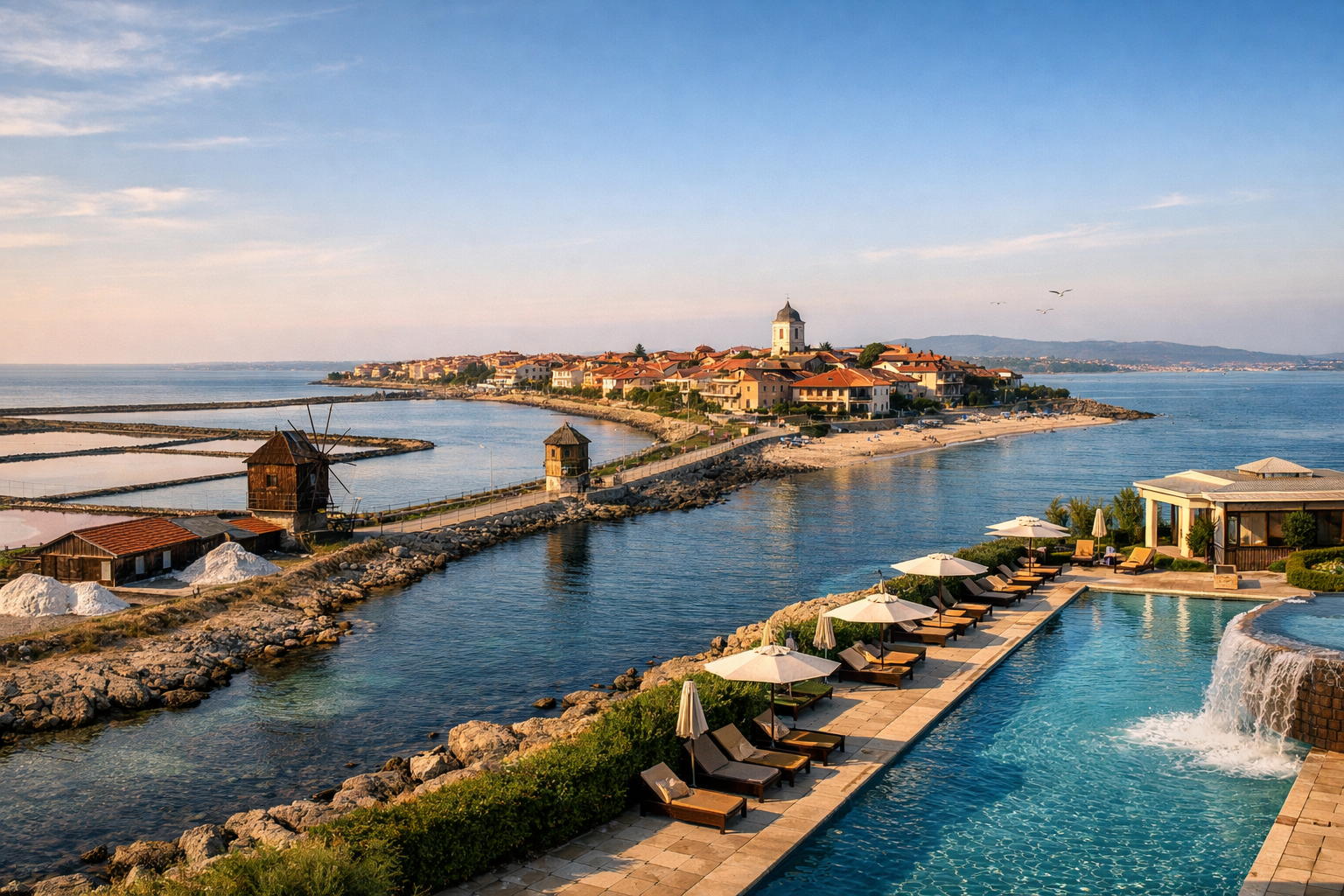
Pomorie blends the charm of its Old Town with the healing calm of its famous salt lake and the Black Sea beyond. Wander sunlit streets, breathe in the sea air, and unwind with the spa rituals that make this coastal town so restorative.

🧭 DAY-BY-DAY ITINERARY

Ready-made country and city routes with daily plans, sights, transport and accommodation. Buy PDF guides for independent travel.

🧭 DAY-BY-DAY ITINERARY


Day 1 — Pomorie: getting acquainted with the Old Town and the seaside promenade

  • 🚶 It’s best to devote the first day to easing gently into the rhythm of Pomorie. After arriving from Burgas Airport and checking in, leave yourself time not only for the journey but also to adapt: depending on the transfer, the trip usually takes about 15–25 minutes by car, and with baggage claim and getting into a taxi/transfer, it’s reasonable to allow about 1–1.5 hours from the moment you leave the terminal to reaching the hotel. Then head to the Old Town — this is exactly where Pomorie reveals itself not just as a resort, but as an old Black Sea town with narrow streets, bright facades, tiled roofs, and a sense of unhurried, almost homelike seaside life.

  • 🌊 It’s convenient to start your walk from the central part of the peninsula and move toward the sea without rushing, with stops for coffee, ice cream, and short photo pauses. The architectural complex of old Pomorie houses is especially appealing because it doesn’t look “museum-like”: it’s a living fabric of the city, where old heritage is not isolated but continues to coexist with modern everyday life. It’s pleasant here simply to walk, look at the bay windows, wooden balconies, wall textures, and the way the town literally opens out to the water.

  • 🏛️ Then it makes sense to visit the Pomorie Historical Museum, so you can immediately gather the basic context: ancient Anchialos, the Roman and medieval layers, and the role of salt, trade, and the sea in the city’s destiny. After the museum, head toward the promenade and finish the day with a long walk along the sea. In Pomorie, what feels especially pleasant is not a “list of sights” but the very way of looking at the space: the old town to the left, a bright horizon line ahead, sea air nearby, and an almost constant feeling of open sky. If you still have energy, have an early dinner by the water and don’t overload the first day — the city truly suits a slow pace.


Day 2 — Pomorie: Salt Museum, Pomorie Lake, and the SPA rhythm

  • 🧂 On the second day, focus on what truly makes Pomorie different from many seaside resorts in Bulgaria: salt, brine, healing mud, and the special landscape between the sea and the lake. In the morning, head to the Salt Museum — from most hotels in the central and coastal parts of town, the journey usually takes about 10–20 minutes by taxi or 20–40 minutes on foot depending on your base. This is not just a small exhibition, but an important point for understanding the whole town: salt production here is not a decorative theme for tourists, but part of Pomorie’s historical and economic identity.

  • 🌾 After the museum, continue your route along Pomorie Lake. The landscape here is very distinctive: the geometry of the salt fields, the shimmer of the water, the pale paths, the smell of salt, and the broad horizon create a feeling of a space that is both natural and cultural. If you want a calmer, more contemplative format, visit the visitor center “Pomorie Lake” and choose a viewpoint for birdwatching and a panoramic look at the protected area. This is a good day for photos, but even better for slow observation.

  • 💆 After lunch, leave at least 2–3 hours for SPA or balneo relaxation. Pomorie is especially valued not only for the sea, but also for the opportunity to combine a beach holiday with wellness: mineral and salt pools, lye and mud treatments, and a calm style of rest without constant rushing. It’s best to spend the evening gently: a short walk to the sea, dinner without complicated logistics, and an early return to the hotel. This is exactly how Pomorie’s main character reveals itself — it’s a resort where it is useful not to “see everything,” but to allow your body and mind to truly slow down.

Day 3 — Pomorie: Thracian domed tomb, St. George Monastery, and the resort strip

  • 🏺 Dedicate the third day to historical sites beyond the dense center. In the morning, head to the ancient Thracian domed tomb — it is located about 5 km west of Pomorie, so it’s most convenient to allow about 10–15 minutes by car or 15–20 minutes by taxi from the urban area, plus a little extra time for waiting for transport. This is one of the most unusual ancient structures on the coast: from the outside the place looks restrained, but inside the architecture has a very strong effect — a circular chamber, a hollow central column, a sense of ancient ritual space, and a rare feeling of contact with deep history outside major capital-city museums.

  • ⛪ After visiting the tomb, return to town and head to St. George Monastery. This place shifts the tone of the route well: after an ancient funerary monument, you enter a living spiritual space where a completely different layer of time can be felt — the Bulgarian Revival, Orthodox tradition, the monastery courtyard, silence, tree shade, and a more intimate atmosphere. It’s best not to rush: even a short 30–40 minutes here works like a pause and gives the route inner balance.

  • 🏖️ Leave the second half of the day for relaxing by the sea. You can choose a more developed city beach, rest by the hotel pool, or simply take a long walk along the resort strip. After the насыщенного historical block, this is especially pleasant: Pomorie switches again from a “city of monuments” to a “city of air, light, and recovery.” If your trip falls in the warm season, it’s a good idea to end this day with a sunset walk along the shore, when the sea line turns golden and the town itself looks at its softest and most resort-like.

Day 4 — Pomorie: free morning, sea, and departure via Burgas

  • 🌅 It’s best not to overload the last day with new distant points. Pomorie works especially well as a place of final calm: a late breakfast, a walk by the sea, a short stop at your favorite café, buying salt, cosmetics based on Pomorie brine, or small local souvenirs. If you are staying near the shore, simply go out to the water earlier: in the morning the town is especially quiet, and this is exactly when its main quality is felt best — a combination of sea openness and almost sanatorium-like softness.

  • 🩴 If your departure is not early, you can add one more short walk through the Old Town or return once again to the salt lake, this time focusing not on sightseeing but on the mood. In a 4-day itinerary, this is a very fitting ending: instead of chasing one more checkmark, you return to the part of town you liked most. Pomorie is remembered not for the number of “must-see” places, but for the physical feeling of rest — sun, salt, wind, warm promenade stone, and the unhurried movement of the day.

  • 🚕 Allow about 15–25 minutes by car for the road to Burgas Airport depending on traffic and your departure point, but together with waiting for the car and possible seasonal delays, it’s better to leave with extra time. If you plan to take a bus, add time for walking to the stop and possible waiting for the service. For an international flight, it is reasonable to leave at least 2 hours before departure at the airport. This kind of ending makes the trip feel organized and calm: no rush, one last look at the sea, and the feeling that Pomorie was not only beautiful, but also truly restorative.

Flight tickets

eSIM for travel

Buy PDF guide

Buy PDF guide — 8.57 USD

PDF — 8.57 USD