
Buy PDF guide

Buy PDF guide — 29.99 USD

PDF — 29.99 USD

POLAND

POLAND

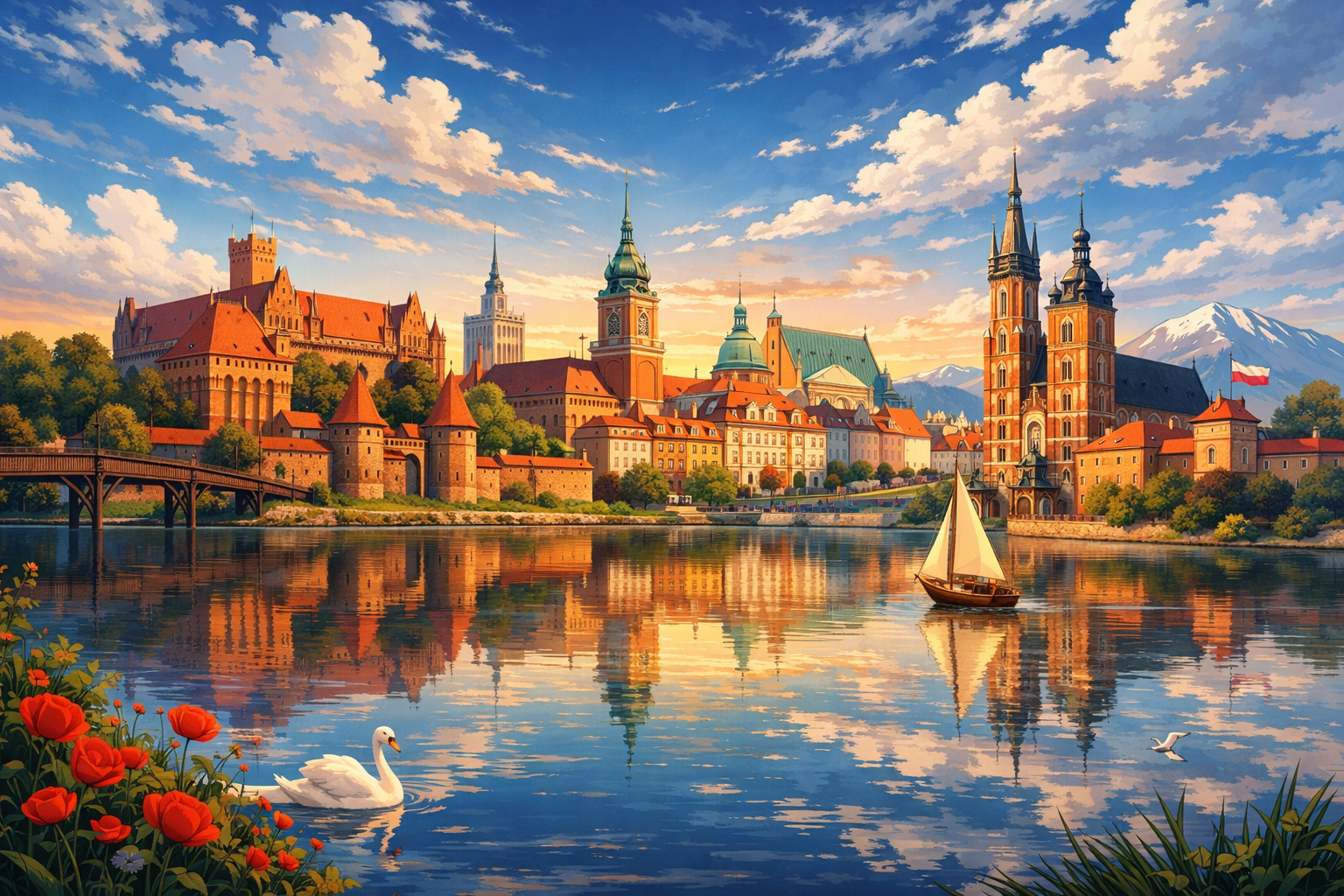
Feel Poland’s energy in Warsaw, then trace medieval echoes in Toruń and maritime grit in Gdańsk before standing beneath Malbork’s red-brick walls. Savor Poznań’s colorful square and Wrocław’s riverside charm en route to Kraków’s regal heart. Pay respects at Auschwitz and step into the glittering depths of the Wieliczka Salt Mine.

🧭 DAY-BY-DAY ROUTE

Ready-made country and city routes with daily plans, sights, transport and accommodation. Buy PDF guides for independent travel.

🧭 DAY-BY-DAY ROUTE


Day 1 — Warsaw: the Old Town and the Royal Route

  • 🚶 Start exploring Warsaw with a loop along the Royal Route: from Castle Square with the glittering Royal Castle and Sigismund’s Column — down Krakowskie Przedmieście, a street woven with legends, to the University of Warsaw, the Church of the Holy Cross (where an urn with Chopin’s heart rests), grand hotel mansions and Baroque- and Neoclassical-era palaces. The Old Town, rebuilt after the war stone by stone, is UNESCO-listed: shady courtyards, the colorful facades of the Market Square and the jagged lines of the Barbican walls create the feeling of a theatrical set. By evening, head to the Vistula riverfront — the promenades, pavilions, and the panorama of Neo-Gothic cathedrals on the opposite bank are beautifully illuminated.


Day 2 — Warsaw: POLIN and Muranów

  • 🚶 The Muranów district is a modern urban fabric that literally grew on the ruins of prewar Jewish Warsaw. Here you’ll find the POLIN Museum: the copper-and-glass waves of its facade seem to “part,” inviting you inside. The exhibition leads from the Middle Ages through the Polish–Lithuanian Commonwealth’s “golden age” to the catastrophe of the 20th century and the rebirth of communities. Walk to the Monument to the Ghetto Heroes, peek into courtyards with art objects, and take a daytime coffee break in the green courtyards near the museum. In the evening — a city view from the terrace of the Palace of Culture and Science.

Day 3 — Warsaw: Łazienki Królewskie

  • 🚶 The Royal Łazienki Park is a “city within a city”: mirror-like ponds, peacocks, classical pavilions, and its main jewel — the Palace on the Isle. In the quiet of the shady alleys, it’s easy to forget that bustling Warsaw is just 10 minutes away. On weekends in season, Chopin is played on the open-air stage, and exhibitions are held in the Orangery. For a perfect day, pair the park with a walk along Ujazdowskie Avenue.

Day 4 — Transfer to Toruń and Copernicus’s medieval city

  • 🚆 Transfer: Warsaw → Toruń (PKP Intercity IC/EIC): ≈ 2h 8m–2h 30m from Warszawa Centralna to Toruń Główny, trains run several times a day.

  • 🚶 Toruń is one of Europe’s best-preserved Gothic cities on the Vistula: red-brick walls, the Town Hall and the “leaning” tower, and the aroma of gingerbread in the streets. The Nicolaus Copernicus House Museum at 15/17 Mikołaja Kopernika Street lets you “peek” into 15th-century daily life and see how a trading city raised the future author of On the Revolutions of the Heavenly Spheres.

Day 5 — Transfer to Gdańsk and the Golden Age of Gdańsk’s Main Town

  • 🚆 Transfer: Toruń → Gdańsk (PKP Intercity/regional): ≈ 2h–2h 20m to Gdańsk Główny.

  • 🚶 Gdańsk stuns with its scale: the Long Market (Długi Targ) with the town hall and Neptune, the Gothic Basilica of St. Mary, the medieval Crane over the Motława. Check in on Granary Island (Wyspa Spichrzów) — here the granite embankments and glass of new buildings make a striking pair with the old. In the evening — sunset on the pedestrian footbridges and lights on the water.

Day 6 — Gdańsk: the Museum of the Second World War and the European Solidarity Centre

  • 🚶 Two museums — two different views of the 20th century. The Museum of the Second World War is a large, dramaturgically structured exhibition in a striking underground-and-aboveground volume. Then — the European Solidarity Centre by the shipyard gate: a steel frame like a ship’s hull and the story of the trade union that changed Europe. Between the two points, it’s easy to walk through the port districts and the ECS viewing terraces.

Day 7 — Day trip to Malbork: the Teutonic Order castle

  • 🚆 Gdańsk ↔ Malbork (POLREGIO/PKP): ≈ 35–60 minutes to Malbork. From the station to the castle is a 10–15 minute walk.

  • 🚶 A gigantic brick castle complex with inner courtyards, galleries, and a monastic garden — the perfect “medieval” picture. Return to Gdańsk for the evening light in the Main Town.

Day 8 — Transfer to Poznań and the Old Market Square

  • 🚆 Transfer: Gdańsk → Poznań (PKP Intercity IC/EIC): ≈ 3h 30m–4h 30m to Poznań Główny.

  • 🚶 In Poznań — the picturesque Old Market Square with colorful townhouses, the town hall, and the “goats” on the pediment (they butt heads at noon). The vibe of a youth-and-university city, beer halls and cafes around the square — a great unhurried evening.

Day 9 — Poznań: Ostrów Tumski and the “croissant museum,” then Wrocław

  • 🚶 In the morning — Ostrów Tumski with the majestic Cathedral of Sts. Peter and Paul: this is where the roots of Polish statehood lie. Then — the interactive Rogalowe Muzeum Poznania on the Old Market Square: the secrets of the legendary St. Martin’s croissant, with a tasting.

  • 🚆 Afternoon transfer: Poznań → Wrocław (PKP Intercity IC/EIC): ≈ 1h 40m–2h to Wrocław Główny.

Day 10 — Wrocław: Market Square and the Racławice Panorama

  • 🚶 Wrocław Market Square is one of the most beautiful squares in Central Europe: the Gothic Town Hall, rows of tenement houses, and nimble bronze “gnomes” all over the center. From here it’s a 10-minute walk to the Racławice Panorama museum—a monumental circular painting (15×114 m) that puts you right in the epicenter of the 1794 battle. Spatial lighting and sound design create a full immersion effect.

Day 11 — Wrocław: Zoo Afrykarium and Hydropolis

  • 🚶 In the morning — Wrocław Zoo with its unique Afrykarium: glass tunnels with sharks and rays, the ecosystems of the Red Sea and the Mozambique Channel. After lunch — Hydropolis, a water science center: multimedia halls, installations, the ocean’s “breathing,” and a drop as a universe. In the warm season, add the Japanese Garden and the fountains by Centennial Hall.

Day 12 — Transfer to Kraków: Wawel and the Old Town

  • 🚆 Transfer: Wrocław → Kraków (PKP Intercity EIP/IC): ≈ 3h 30m–3h 50m to Kraków Główny.

  • 🚶 Kraków is the heart of Polish history and art. Climb Wawel Hill to the royal castle and cathedral, then go down to the Planty Park and the Main Market Square: the Cloth Hall, St. Mary’s Basilica with the famous carved altarpiece by Veit Stoss. Evening — in a café under the vaults of medieval cellars.

Day 13 — Oświęcim: Auschwitz-Birkenau Memorial and Museum

  • 🚆 Kraków ↔ Oświęcim (Koleje Małopolskie/Polregio, SKA3 line): ≈ 1h 20m–1h 40m. Book tickets/time slots in advance on the memorial’s official website.

  • 🚶 Visiting the Memorial is an experience of utmost concentration of memory: barracks, barbed wire, exhibitions in the blocks. Spend the day quietly, leave time for the return, and have dinner without rushing.

Day 14 — Wieliczka: salt underground chambers + Kazimierz

  • 🚆 Kraków ↔ Wieliczka (Koleje Małopolskie SKA1): ≈ 20–25 minutes to the Wieliczka Rynek-Kopalnia station.

  • 🚶 The Wieliczka Salt Mine is an underground “city” with cathedrals, chapels, and sculptures carved in salt, with a damp sheen on the walls and soft lighting. On your way back, spend the evening in Kraków’s Jewish quarter, Kazimierz: narrow streets, tiny synagogues, cozy restaurants, and jazz bars.

Flight tickets

eSIM for travel

Buy PDF guide

Buy PDF guide — 29.99 USD

PDF — 29.99 USD