
Buy PDF guide

Buy PDF guide — 10.71 USD

PDF — 10.71 USD

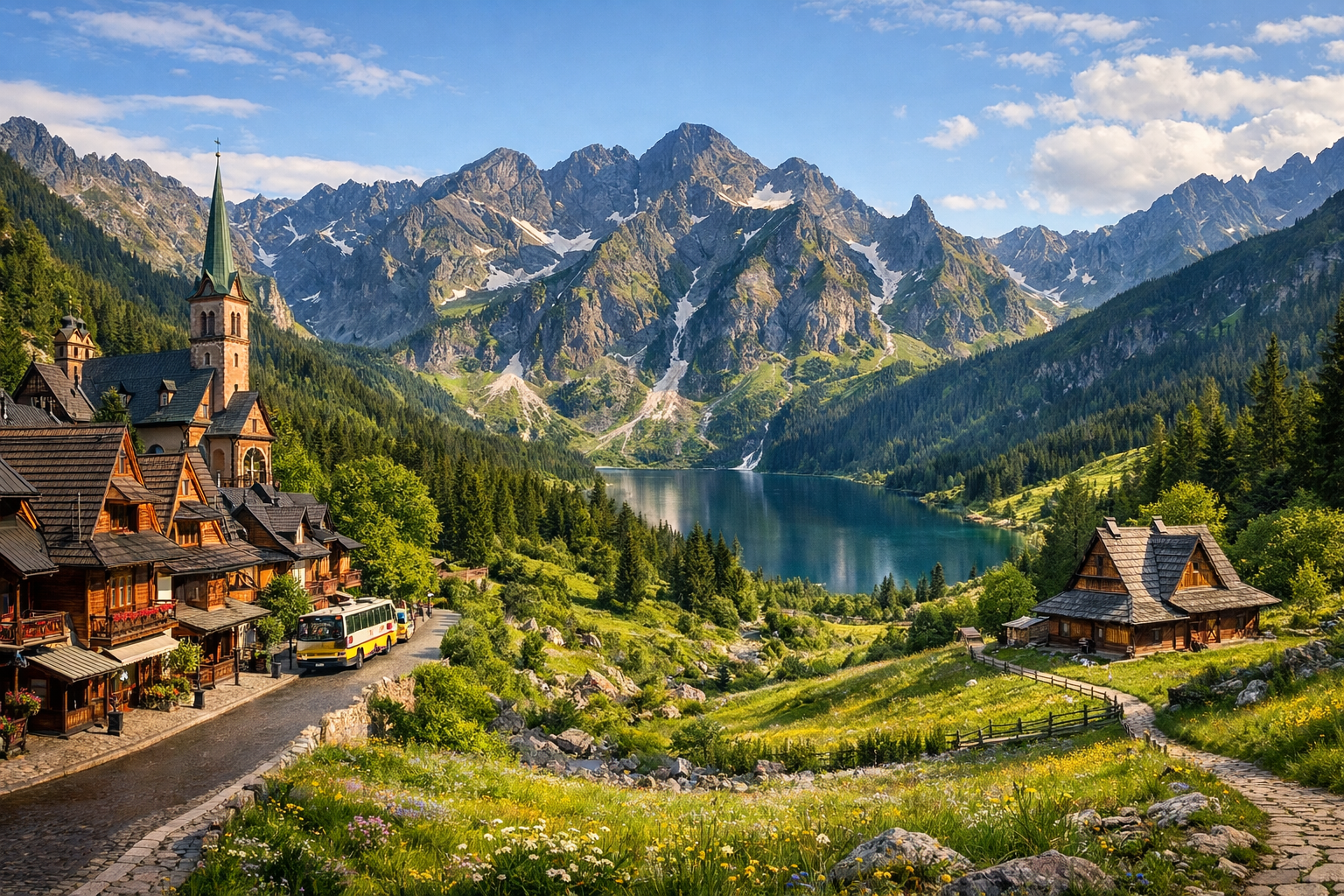
Poland, Zakopane and the Tatras. A budget mountain holiday with accommodation in a guesthouse, walks through the valleys, hikes to the lakes, and trips on local buses. Season: June - September.

Poland, Zakopane and the Tatras. A budget mountain holiday with accommodation in a guesthouse, walks through the valleys, hikes to the lakes, and trips on local buses. Season: June - September.

Escape to Zakopane for a budget-friendly mountain break among the dramatic peaks of the Tatras. Stay in a cosy guesthouse, wander through quiet valleys and alpine lakes, and hop on local buses between Kościelisko, Tatra National Park, and Bukowina-Tatrzańska.

🧭 DAY-BY-DAY ROUTE

Ready-made country and city routes with daily plans, sights, transport and accommodation. Buy PDF guides for independent travel.

🧭 DAY-BY-DAY ROUTE


Day 1 — Zakopane: getting to know the town and the Podhale atmosphere

  • 🚆 If you are arriving via Kraków, the most convenient budget option is to first get from Kraków Airport to the city by train or bus, and then transfer to an intercity bus to Zakopane. In good conditions, the Kraków → Zakopane journey usually takes about 2.5–3 hours, but in summer and on Friday evenings traffic jams are possible, so it is wise to allow up to 3.5–4 hours including transfer and waiting time.

  • 🏡 It is best to plan your stay in a guesthouse or pension in Zakopane or on the border with Kościelisko: this helps keep costs down, gives you a quieter atmosphere, and lets you reach the starting points of popular routes by local buses and private bus services. After the journey, do not overload the first day: this region is beautiful precisely at an unhurried pace, when you can take in the wooden architecture, mountain silhouettes, and the special mix of resort life and highland living.

  • 🚶 Start with a walk through central Zakopane: Krupówki Street is not just a tourist promenade, but a showcase of the whole Podhale region. There are many wooden facades, cheese shops selling oscypek, cafés, pastry shops, stores with wool products, and small venues where live folk music can be heard. Yes, it is quite touristy, but it is exactly the kind of place that quickly helps you feel how Zakopane combines a resort, a mountain base, and local Goral culture.

  • 🚶 Then it is worth turning away from the noisiest axis and walking toward the old streets and quieter neighborhoods. In Zakopane, it is especially interesting to look not only at the mountains, but also at the architecture: the famous “Zakopane style” with its steep roofs, carved wood, decorative details, and the feeling of an almost fairy-tale Alpine village was born right here. Even a short walk along the lanes around the historic villas gives a much deeper impression than the center alone.

  • 🌄 Toward evening, it is nice to head up to one of the nearby viewpoints or simply choose a café with a view of Giewont and the Tatra ridges. In clear weather, the mountains look especially impressive at sunset: the line of the slopes softens, the shadows grow longer, and the town seems to calm down after the daytime flow of tourists. For the first day, this is the ideal balance — a little movement, a little town life, and lots of anticipation before the real trails of the following days.


Day 2 — Kościeliska Valley: an easy mountain day with caves, streams, and meadows

  • 🚌 In the morning, head from Zakopane to Kościelisko by local bus or private bus toward the entrance to Dolina Kościeliska. Depending on where you stay and how long you wait for transport, the trip usually takes about 20–35 minutes. This is one of the most convenient and budget-friendly options for your first full mountain day: there is no need for a long early-morning transfer, and the valley itself is ideal for a calm, rewarding, but not exhausting route.

  • 🚶 Kościeliska Valley is one of the most beautiful and most “accessible-feeling” valleys in the Polish Tatras. There is no harsh stress of high alpine climbing here: the trail gently leads you deeper into the mountains along the water, through forest, past rock walls, grazing areas, and wide meadows. The landscape feels very alive and varied: one moment you walk in the shade of spruces, then emerge into an open section with views of the cliffs, then hear the rush of a stream and almost immediately find yourself back in the cool forest.

  • 🥾 This route is best done in a “walk — look — rest” rhythm. Along the way, you can go as far as the Ornak shelter or simply choose a comfortable turning point for yourself without chasing kilometers. In summer and early autumn, the valley is especially pleasant because you can walk without the constant feeling of storming a summit: instead, your attention shifts to details — the smell of wet wood, the cold air coming off the water, the color of the rocks, bells on the pastures, and the deep silence that appears in pauses between tourist groups.

  • 🕳️ If you like natural features, you can add one of the accessible caves or short side trails, but only if your footwear is comfortable and the weather is stable. It is important not to overload the day: this is a budget mountain slow travel holiday, not a sporting challenge. Better to save your energy for a long walk, lunch at the shelter or a picnic, and a calm return.

  • 🚌 Return to Zakopane by the same local transport. In the evening, it is nice to have dinner in a quieter part of town or by your guesthouse: after a valley walk like this, it is especially pleasant to simply sit on a terrace, look at the sky above the Tatras, and feel that the route is gradually revealing the region without hurry and without unnecessary expenses.

Day 3 — Morskie Oko: a Tatra classic with a long but realistic walk to the lake

  • 🚌 This is the earliest day of the route. In the morning, you need to leave Zakopane by bus or private bus for Palenica Białczańska — the main starting point for Morskie Oko. The transfer itself usually takes about 35–50 minutes, but in summer queues for boarding and heavy demand on this route are quite real, so it is better to leave early. From the parking area, a long walk to the lake still remains.

  • 🚶 The route to Morskie Oko is not a “wild trail” in the usual sense, but a long mountain approach along a paved road through forest and beside the slopes. According to the park, the ascent takes about 4 hours and the descent about 1.5 hours, but for an ordinary traveler it is more reasonable to count the whole day in the 6–8 hour range, including stops, photos, rest, and time at the lake itself. That is exactly why you should not try to combine Morskie Oko with another major activity in the same day.

  • 🏞️ And yet this place did not become legendary by accident. Morskie Oko is one of the most famous lakes in the entire Tatra system — huge, cold, mirror-like, lying in a stone basin beneath severe slopes. When you reach the water after the long approach, a powerful visual effect appears: the space suddenly opens up, the forest retreats, and in front of you is an almost perfect composition of dark green water, gray walls, sky, and reflections. Even with the route’s popularity, this impression truly works.

  • 🍲 At the lake, you can rest, take a break in the mountain shelter, sit calmly on the shore, and not rush back. In good weather, you may want to stay longer to see how the color of the water and clouds changes. But it is important to remember: mountains do not like late starts or overestimating your strength. If you feel tired, it is better not to complicate the route with extra ascents and to dedicate the day to the lake itself.

  • 🚌 Returning to Zakopane usually takes another 35–50 minutes from Palenica Białczańska plus the time for the descent. The evening after Morskie Oko should be made as restorative as possible: an early dinner, a warm shower, and calm sleep. For a budget mountain holiday, this is exactly the kind of day when the impressions are already huge and no extra entertainment is needed.

Day 4 — Bukowina-Tatrzańska and scenic rest: guesthouse, thermal baths, gentle Podhale rhythm

  • 🚌 After the longest trekking day, it makes sense to have a softer day with a move toward Bukowina Tatrzańska or a calm radial trip there from Zakopane. The journey takes about 30–45 minutes depending on transport and connections. This part of Podhale feels a little less urban and more rural: there is a stronger sense of open space, traditional buildings, and life on a mountain slope.

  • 🏡 Bukowina-Tatrzańska is perfect for a budget mountain stay in a guesthouse. There are many guesthouses with views, a more homelike atmosphere, and the feeling that you are not just near a tourist center, but in a real highland settlement. In the morning and evening it is especially beautiful to watch clouds sliding over the hills, ridges appearing on the horizon, and wooden houses, meadows, and roads creating a very cinematic picture of southern Poland.

  • ♨️ If you want to recover, this is a good day for a thermal complex in the Bukowina area. This option is especially good after Morskie Oko: your muscles get a rest, and the day keeps its resort-like feel without a race through attractions. Even if you do not go to the thermal baths, you can spend the day at a relaxed pace: a walk around the village, local food, coffee with a view, a light stroll in the surroundings, and a long evening outdoors.

  • 🚶 Visually, this part of the region is very different from the dense center of Zakopane. Here there is less sense of urban tourist crowds and more of the landscape: hilly roads, front gardens, wooden houses, and distant Tatra panoramas. Days like this are often remembered most strongly, because they let you feel not only the “route points,” but also the fabric of local life itself.

  • 🌙 In the evening, it is nice to arrange an early rest at the guesthouse. This rhythm is especially sensible from June to September: the daylight is long, so there is no need to pack the schedule to the limit. Sometimes the best way to see the Tatras is not another ascent, but a quiet evening with a mountain view and the feeling of a full pause.

Day 5 — Chochołowska Valley or a farewell walk through Zakopane

  • 🚌 For the final day, it is good to choose another beautiful but not extreme natural spot — Dolina Chochołowska. From Zakopane or Kościelisko, the trip by local transport toward Siwa Polana and the entrance to the valley usually takes about 30–45 minutes. It is a fitting end to the route: the valley is spacious, scenic, and gives a very complete, almost pastoral impression of the Western Tatras.

  • 🚶 Chochołowska Valley is famous for its wide, open landscape and its softer, more sweeping character compared with the more dramatic parts of the mountains. The route passes through forest and gradually leads to large meadows, shepherd areas, and views where the mountains read not as a sharp wall, but as an entire horizon. In summer and early autumn, it is especially pleasant to walk here without haste, breathing in the smell of herbs, damp earth, and pine.

  • 🏔️ On this route, it is important not to set yourself the task of “seeing everything.” The final valley is needed more as a beautiful farewell to the region: calmly walk part of the route, sit by the shelter, take the last photos, buy something simple for a snack, and just spend a few more hours in the mountains. This format is much more realistic before departure than trying to squeeze in a difficult high-altitude trek.

  • 🛍️ If the weather is bad or you prefer an easier ending, you can replace Chochołowska with half a day in Zakopane: a museum, an old villa, souvenirs, cheese shops, a calm lunch, and packing. This will not make the route worse — on the contrary, it will give it a gentle ending without the risk of fatigue before the road.

  • 🚆 Next comes departure toward Kraków or the continuation of your journey through Poland. When planning the return, allow extra time: the road between Zakopane and Kraków can be slow on weekends and in high season. It is best to finish the trip without stress, with enough time for the bus, transfer, or road to the airport.

Flight tickets

eSIM for travel

Buy PDF guide

Buy PDF guide — 10.71 USD

PDF — 10.71 USD