
Buy PDF guide

Buy PDF guide — 8.57 USD

PDF — 8.57 USD

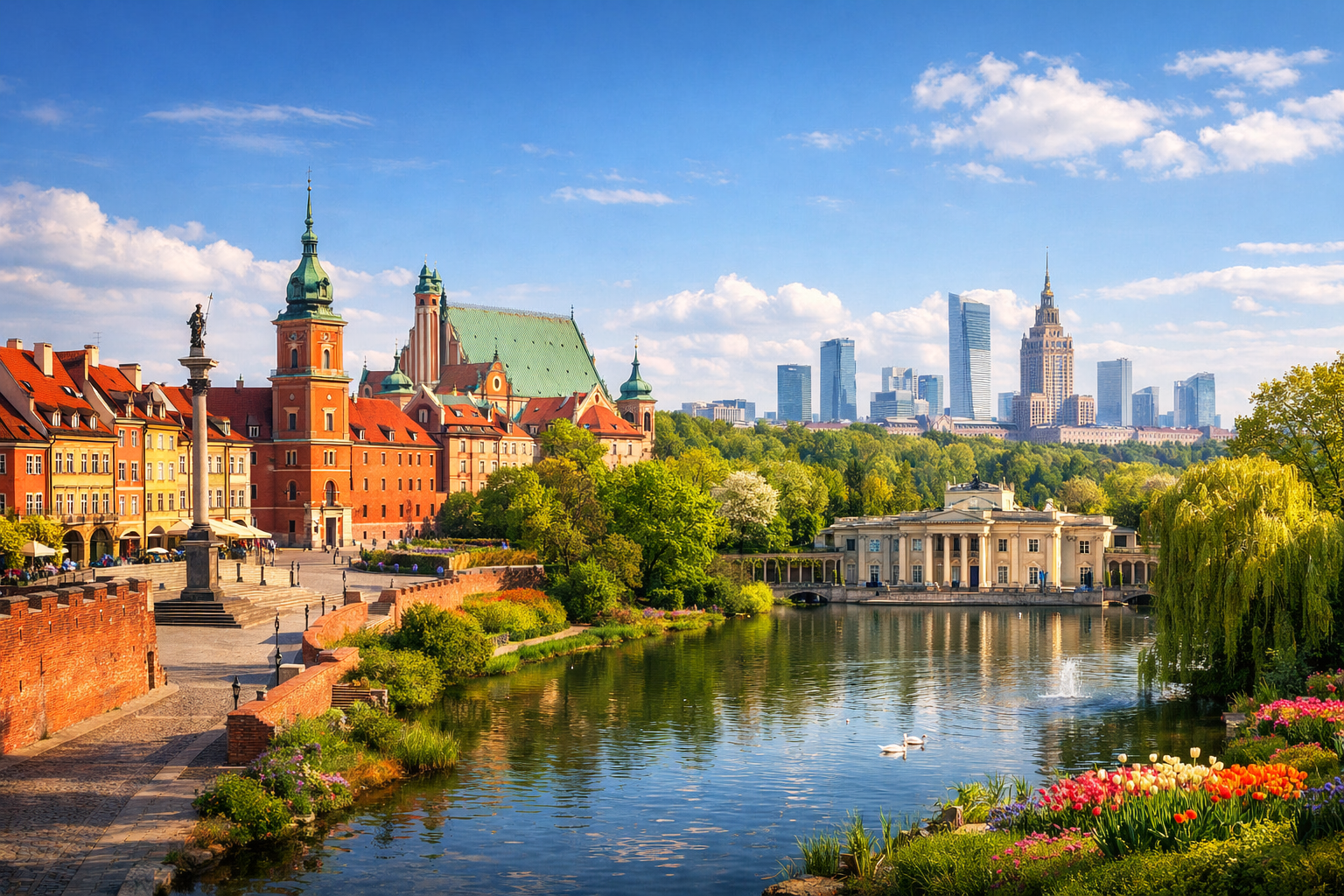
Poland, Warsaw. An affordable trip through the restored Old Town, the Royal Route, parks, museums, and the capital's modern districts. Season: April - October.

Poland, Warsaw. An affordable trip through the restored Old Town, the Royal Route, parks, museums, and the capital's modern districts. Season: April - October.

Discover Warsaw, where the beautifully restored Old Town leads into the elegant Royal Route, leafy parks, and standout museums. From April to October, Poland’s capital is an affordable and rewarding city break, blending historic charm with the energy of its sleek modern districts.

🧭 DAY-BY-DAY ITINERARY

Ready-made country and city routes with daily plans, sights, transport and accommodation. Buy PDF guides for independent travel.

🧭 DAY-BY-DAY ITINERARY


Day 1 — Warsaw: the rebuilt Old Town and Castle Square

  • 🚶 Start your introduction to Warsaw in the Old Town — a place that feels especially moving precisely because its beauty was not simply “given” to the city, but was quite literally brought back to life after the catastrophic destruction of World War II. Today this district looks like a complete historical stage set with narrow streets, colorful facades, church towers, little cafés, and cobbled squares, but behind this picture-postcard view lies an enormous postwar reconstruction effort. A walk here feels like traveling in two dimensions at once: you see an old European capital and, at the same time, a living monument to the city’s resilience. Begin at Castle Square, admire the column of King Sigismund III Vasa, then see the Royal Castle from the outside, continue to the Old Town Market Square, and be sure to notice the Warsaw Mermaid — the symbol of the capital. A good rhythm for the first day is to walk without rushing, making short stops for coffee, photos, and rest on benches: the walking route within the historic core usually takes 3–4 hours at a very comfortable pace.

  • 🏰 If you want to add an interiors visit, stop by the Royal Castle — the former residence of Polish monarchs, linked to some of the country’s most important political events. Even if you do not go in for long, simply being here helps you better understand the scale of Warsaw’s history: from here the Royal Route leads farther south through ceremonial streets and palaces. Inside the castle, the royal apartments, grand halls, and museum atmosphere are especially impressive, while outside it is pleasant simply to linger in the square watching street musicians and tourists. It is reasonable to allow 1.5–2 hours for the interiors, and then take a lunch break in the Old Town area.

  • 🚶 After lunch, continue your walk along the city wall, the Barbican, and the viewpoints over the Vistula. In the evening the Old Town is especially photogenic: soft light on the facades, lively summer terraces, and a sense of intimacy make this area ideal for a calm first evening. If your flight arrived the same day, this route still remains realistic: from Chopin Airport to the center it is usually convenient to get there by city train, bus, or taxi, and then continue on foot without overloading yourself. For travel times within the day, use this as a guide: from central hotels to the Old Town by bus, tram, or taxi it is most often 15–25 minutes, while on foot from Powiśle and Centrum it is about 25–40 minutes.


Day 2 — Warsaw: the Royal Route, Krakowskie Przedmieście, and Łazienki Park

  • 🚶 Dedicate the second day to the capital’s most elegant face — the Royal Route. This is not just one short street, but the city’s historic axis connecting key residences, churches, palaces, and representative public spaces. Start from Castle Square and stroll unhurriedly along Krakowskie Przedmieście and Nowy Świat: on the way you will be accompanied by facades of old mansions, university buildings, churches, bookshop windows, and lively urban scenes. It is here that Warsaw looks not only heroically rebuilt, but truly capital-like — ceremonial, cultured, and very walkable. For the walk itself, with short stops for photos and coffee, it is convenient to allow 2.5–3 hours.

  • 🎼 Along the way, it is easy to include the Fryderyk Chopin Museum, located in a historic palace near Okólnik Street. This is one of Warsaw’s most atmospheric museums: not a dry exhibition “about a great composer,” but a carefully staged journey through the era, the music, letters, salon culture, and Chopin’s personal story. Even those who do not consider themselves knowledgeable about classical music usually remember the museum thanks to the strong spatial storytelling, audio materials, and the overall feeling of closeness to one of the key figures of Polish culture. It is worth setting aside about 1.5 hours for the visit.

  • 🌿 In the second half of the day, head to Royal Łazienki — a vast palace-and-park ensemble that served as the summer residence of King Stanisław August. It is one of the most beautiful places in Warsaw during the season from April to October: water, green alleys, peacocks, classical pavilions, the amphitheater, and the famous Palace on the Isle create the feeling that you have suddenly left the capital and found yourself in an idealized park of the Enlightenment era. Here it is better not to try to see everything at a gallop; it is much more pleasant to choose a slower rhythm: a walk along the alleys, a short rest by the water, a visit to the Palace on the Isle or the Old Orangery, and a coffee break. For the transfer from the Nowy Świat area to Łazienki, allow about 15–25 minutes by bus or taxi, and for the park itself at least 3 hours, preferably 4.

  • 💡 From May to September, the route is especially good thanks to the long daylight hours and lush greenery. In the warm season it is often particularly pleasant to end the day here without a rigid schedule: simply wander the paths, watch the reflections in the water, and feel how Warsaw becomes softer, calmer, and more romantic than you would expect from a major capital.

Day 3 — Warsaw: museums of memory and modern urban history

  • 🏛️ It makes sense to devote the third day to the Warsaw that cannot be understood without its dramatic 20th-century history. Start with the Warsaw Uprising Museum — one of the city’s most powerful museums and perhaps one of the most emotionally intense in Central Europe. This is not just a collection of documents and objects, but an immersion into the atmosphere of 1944: sound, light, archives, personal stories, photographs, a map of the destroyed city, and a sense of the ultimate price Warsaw paid for its freedom. The exhibition often leaves a deep impression even on those who do not usually like “heavy” museums. It is important not to rush here: it is best to allow 2.5–3 hours for the visit and be sure to take a break afterward.

  • 🚋 After the museum, head to the Muranów district to the POLIN Museum. The journey between these points usually takes about 20–30 minutes by public transport or taxi, depending on traffic. POLIN has a different tone: not only tragedy, but a thousand years of the history of Polish Jews, told through culture, everyday life, religion, ideas, language, migration, and memory. The museum building itself is considered one of the striking examples of modern architecture in Warsaw, and the exhibition inside is arranged very intelligently and coherently. As a result, the day becomes multilayered: in the morning — the uprising and the destruction of the city, during the day — a broader history of society, memory, and the coexistence of cultures. It is reasonable to leave no less than 2–3 hours for POLIN.

  • 🌆 In the evening, you can catch your breath a little and walk along the modern streets of the center or toward Plac Grzybowski to feel how Warsaw combines memory and everyday life. The character of the city is especially noticeable here: it does not try to be only “historic” or only “new,” but builds its identity from surviving fragments, reconstruction, modernism, glass office towers, parks, and a very lively urban energy. This day is emotionally heavier, so it is good to leave time in advance for an early dinner and a calm return to the hotel.

Day 4 — Warsaw: the modern capital, Vistula boulevards, and a final walk

  • 🌉 Dedicate the last day to a lighter and more modern Warsaw. A great idea is to start in Powiśle and on the Vistula boulevards. In the warm season, this is one of the most pleasant parts of the city: wide walking areas, steps down to the water, cyclists, cafés, views of bridges, and a sense of open space that you do not expect after the intimate Old Town. It is a good place simply to walk without a strict goal, catching the rhythm of the capital. From the area near the Chopin Museum to the boulevards is just a few minutes on foot, and from central hotels to Powiśle it is usually 10–20 minutes.

  • 🏙️ Then move to the central modern districts around the Palace of Culture and Science, Śródmieście, and the business part of the city. This is a different Warsaw — vertical, energetic, and full of contrasts. Here socialist monumentality, shopping galleries, glass towers, broad avenues, and cozy urban courtyards can stand side by side. For a budget trip this is especially convenient: the area is well connected by transport, full of affordable cafés, easy to navigate, and allows you to combine walks with some last shopping or rest before your flight.

  • 🌳 If you still have energy and the weather is good, finish the tour with a walk through the Saxon Garden or a calm return to the Royal Route — that way the itinerary closes beautifully, connecting historic Warsaw with the modern city. In terms of timing, this day is easy to adapt to your departure: you can do a short 4–5 hour version or a full-day one. To Chopin Airport from the center, people usually allow about 20–30 minutes by taxi without major traffic and about 25–40 minutes by train or bus including waiting time.

Flight tickets

eSIM for travel

Buy PDF guide

Buy PDF guide — 8.57 USD

PDF — 8.57 USD