
Buy PDF guide

Buy PDF guide — 10.71 USD

PDF — 10.71 USD

Poland, Lublin and Zamość. An affordable route through the less touristy cities of eastern Poland, with Renaissance squares, fortresses, and traditional cuisine. Season: May - September.

Poland, Lublin and Zamość. An affordable route through the less touristy cities of eastern Poland, with Renaissance squares, fortresses, and traditional cuisine. Season: May - September.

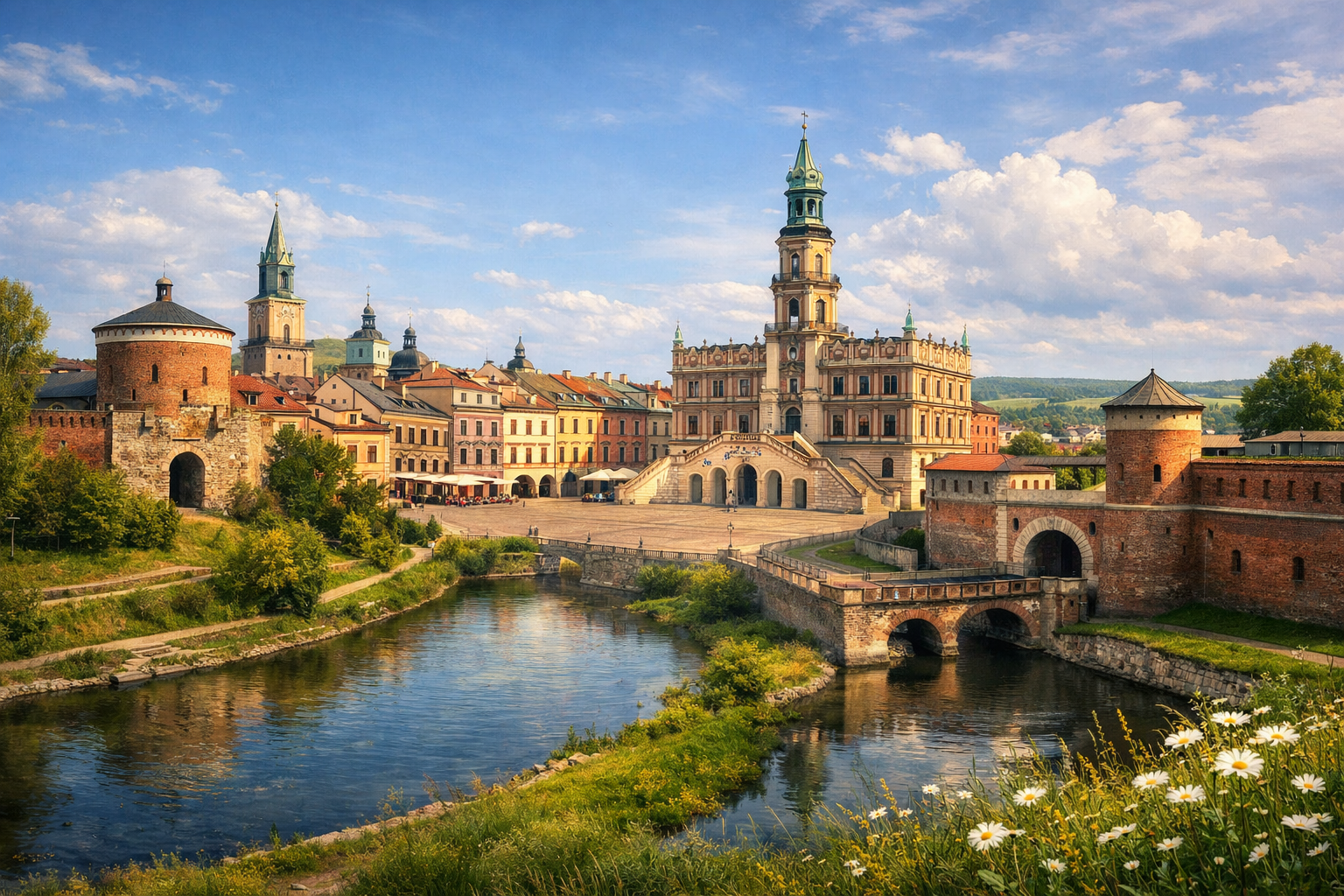
Discover a quieter side of Poland on an affordable journey through Lublin and Zamość, where grand Renaissance squares, old fortresses, and atmospheric old towns feel refreshingly uncrowded. Between May and September, eastern Poland is at its best for wandering sunlit streets and lingering over hearty traditional cuisine.

🧭 DAY-BY-DAY ITINERARY

Ready-made country and city routes with daily plans, sights, transport and accommodation. Buy PDF guides for independent travel.

🧭 DAY-BY-DAY ITINERARY


Day 1 — Lublin: Old Town, Kraków Gate, and the Tribunal

  • 🚶 Start your journey in Lublin — the largest city in eastern Poland and one of the country’s most atmospheric historic centers. Its Old Town does not look unnaturally “polished like a postcard”: instead, it has a pleasant sense of real urban life, where the medieval layout, Renaissance facades, arches, quiet passages, and old stone stairways come together into a very cohesive and warm scene. An unusually large amount of authentic historic buildings has survived within the old walls, and a walk through the winding streets gives exactly that feeling of Eastern Poland that draws people here in the first place: fewer crowds, more space, more local everyday life.

  • 🚶 The heart of today’s route is Rynek and the Crown Tribunal building at Rynek 1. This is where the Lublin Renaissance reveals itself especially beautifully: the old town hall dominates the space, surrounded by elegant townhouses with decorative attics and facade details, while the square itself feels intimate and highly photogenic. The Crown Tribunal, one of the most important judicial institutions of the Polish–Lithuanian Commonwealth, once met here, so Lublin was seen not merely as a provincial town but as a politically significant center. The best approach is not to rush: pass through Kraków Gate, make a loop around the market square, peek into the inner courtyards, and give yourself time for a coffee overlooking the facades.

  • 🍽️ In the evening, devote time to the traditional cuisine of the Lublin region. Look for dishes such as pierogi, cebularz lubelski, żurek, bigos, potato and mushroom dishes, as well as simple seasonal desserts. May through September are especially pleasant because tables on the streets and squares let you quite literally dine inside a historic setting. It’s best to keep this day light: no overload of museums, with an early check-in and an easy rhythm after the journey.


Day 2 — Lublin: the castle, the donjon, and city panoramas

  • 🚶 Dedicate your second day to Castle Hill — one of Lublin’s key symbols and the best way to understand how layered the city’s history is. Lublin Castle is located at Zamkowa 9 and is connected not only with defensive history but also with major events of the Polish–Lithuanian era. The climb here is especially pleasant in the morning: soft light falls beautifully on the walls, and from below there is an expressive perspective toward the Old Town.

  • 🚶 Special attention should be paid to the castle donjon tower — one of the oldest elements of the whole complex. This massive Romanesque structure with thick walls makes a strong impression precisely because of its severity: against the backdrop of the more decorative center, it reminds you that Lublin was not only a trading and judicial city, but also a borderland and strategic one. The viewing platform at the top offers one of the best views of the red roofs, towers, and undulating silhouette of old Lublin. It is the ideal point to see how compactly and harmoniously the historic center is woven into the terrain.

  • 🚶 After the castle, continue the day with a walk through the neighboring streets and an unhurried exploration of the city’s cultural layers: Catholic churches, traces of its multinational past, old gates, and fragments of defensive lines can all be felt here almost effortlessly, literally within walking distance. If you want a calmer pace, leave the second half of the day for a long lunch and free time in the center. This rhythm is especially suitable for a budget route: fewer unnecessary transfers, more meaningful immersion.

Day 3 — Transfer to Zamość: the Great Market Square and an ideal Renaissance city

  • 🚆 Transfer: Lublin → Zamość, regional POLREGIO train on the Lublin Główny → Zamość / Zamość Wschód line. In season and with normal connections, the journey usually takes about 1 hr 45 min to 2 hr 15 min. This is a realistic and convenient transfer without an exhausting day on the road: you can have a relaxed breakfast in Lublin in the morning and be inside one of Poland’s most beautiful historic ensembles by noon.

  • 🚶 Zamość is a rare city that impresses not by the number of sights, but by the unity of its concept. It is often seen as an “ideal Renaissance city,” and that is very palpable on site: everything is built according to a clear compositional logic, the facades look ceremonial but not heavy, and the Old Town space feels assembled almost like a theatrical stage. The main point is Rynek Wielki, a huge and astonishingly harmonious square with the town hall, arcades, and the famous Armenian townhouses. This is where it becomes especially clear why a route through the less touristy cities of eastern Poland can leave a stronger emotional impression than many more hyped destinations.

  • 🚶 After check-in, take a long walk without rushing: the Great Market Square, the town hall, the surrounding quarters, quiet side streets, viewpoints toward the fortifications, and the golden evening light on the facades. Zamość is especially rewarding in the second half of the day, when there are fewer tour groups and the city begins to sound quieter. Dedicate dinner to regional Polish cuisine: choose simple meat dishes, soups, pierogi, local infusions, and seasonal vegetables. In small towns, this is often both tastier and noticeably more affordable.

Day 4 — Zamość: fortress, Arsenal, and museum day

  • 🚶 Today is built around the fortress history of Zamość. This is not only a beautiful Renaissance center, but also an important fortification ensemble, thanks to which the city is perceived as a carefully planned residence-fortress. Start with a walk along the defensive lines and bastion sections to feel the scale of the idea: here it becomes especially clear how Renaissance aesthetics were combined with military engineering.

  • 🏛️ The day’s main museum site is Muzeum Fortyfikacji i Broni Arsenał, ul. Zamkowa 2. The Arsenal helps “assemble” the historical picture into a whole: from the very concept of a fortress city to the local military history of the region. Even for those who do not consider themselves fans of weapons or military matters, the space is usually interesting precisely as part of the overall image of Zamość — strict, rational, and at the same time very beautiful.

  • 🏛️ Then it is worth visiting Muzeum Zamojskie, ul. Ormiańska 30, to complete the impression with the city’s history, its multiethnic environment, and the culture of the former Zamoyski entail. If you still have energy, add the city’s academic trace — the area of the former Zamoyski Academy, where the founder’s intellectual ambition is especially tangible. Leave the evening once again for the square: in Zamość it is important to see the center at least twice in different light — by day and at sunset. Then the Renaissance geometry begins to reveal itself in a completely different way.

Day 5 — Return to Lublin: Village Museum or Majdanek, flight/departure

  • 🚆 Transfer: Zamość → Lublin, regional POLREGIO train. The trip takes about 2 hours on average, so the day can be planned gently: an early departure from Zamość, arrival in Lublin in the first half of the day, and then one meaningful location before heading home.

  • 🌳 If you want to end the journey on a bright, ethnographic, and very “Polish” note, choose the Lublin Village Museum — Muzeum Wsi Lubelskiej. It is an excellent finale for a route about less touristy Poland: wooden architecture, rural buildings, gardens, paths, and a sense of slowed-down time help you see the region not only through cities and squares, but also through everyday culture. In the warm season, from May to September, this is an especially good option.

  • 🕯️ If, however, historical depth and remembrance matter more to you, you can choose the State Museum at Majdanek at Droga Męczenników Majdanka 67. This place requires a calm pace, a respectful mindset, and emotional capacity, but it gives very important historical context to the entire region. After the visit, it is best not to overload the day: leave time for the transfer, a late lunch, and the road to the airport or railway station. This ending makes the route feel complete — from Renaissance beauty and regional cuisine to the complex history of Eastern Poland.

Flight tickets

eSIM for travel

Buy PDF guide

Buy PDF guide — 10.71 USD

PDF — 10.71 USD