
Buy PDF guide

Buy PDF guide — 8.57 USD

PDF — 8.57 USD

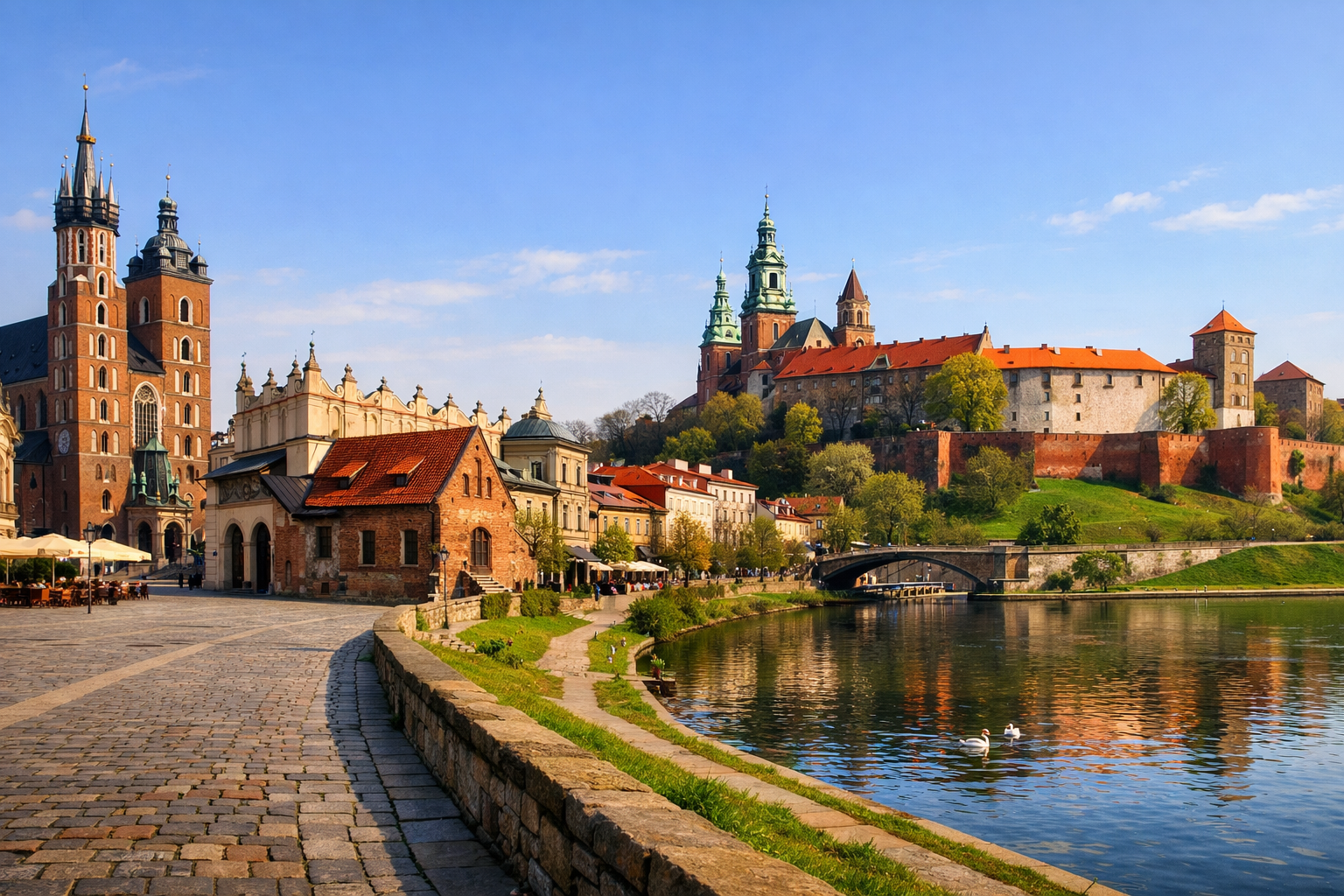
Poland, Krakow. An inexpensive city tour of the Main Market Square, Kazimierz, Wawel, free museums, and local milk bars. Season: March — November.

Poland, Krakow. An inexpensive city tour of the Main Market Square, Kazimierz, Wawel, free museums, and local milk bars. Season: March — November.

Discover Krakow on a budget, from the grand Main Market Square to the historic streets of Kazimierz and the hilltop charm of Wawel. Between March and November, you can mix free museums with hearty, low-cost meals in traditional milk bars for an easy, atmospheric city break.

🧭 DAY-BY-DAY ROUTE

Ready-made country and city routes with daily plans, sights, transport and accommodation. Buy PDF guides for independent travel.

🧭 DAY-BY-DAY ROUTE


Day 1 — Krakow: Main Market Square, Floriańska Street, and an evening in the Old Town

  • 🚆 If you arrive at Krakow Airport, the most convenient and budget-friendly start is the SKA1 train to Kraków Główny. The trip takes about 20 minutes, the station is right by the terminal, and you can buy a ticket from a machine or on the train. From the main station to the Old Town and most central hotels it is roughly a 10–20 minute walk, so you can plan your first day with almost no unnecessary transfers.

  • 🚶 Start getting to know Krakow at the Main Market Square — one of the largest medieval squares in Europe and the absolute heart of the city. Here Krakow reveals itself in full force right away: the Gothic towers of St. Mary's Basilica, the rhythm of the city bugle call, old townhouse facades, street musicians, café terraces, and the slow, slightly theatrical movement of people across the cobblestones. This place is not just the "main point," but a real urban stage where you can feel the many centuries of history of Poland’s former royal capital. By day the square looks grand and bright, and by evening it becomes especially beautiful: in the soft glow of the lanterns, Krakow feels almost cinematic.

  • 🏛 In the center of the square stands the Cloth Hall — the famous Sukiennice, where trade bustled for centuries. Today it is one of the city’s symbols: under the arcades you can hide from the rain, browse souvenir stalls, and feel how medieval commercial Krakow was woven into the wider European world. If you want to add impressions without overloading the day, you can go down into the Rynek Underground museum beneath the square: it is a powerful, modern exhibition about the medieval city, archaeology, crafts, and everyday life in Krakow beneath the layers of time.

  • 🚶 After the square, walk along Floriańska Street to St. Florian's Gate and the Barbican. This route is short but full of atmosphere: along the way are old houses, shop windows, churches, a university spirit, and the constant feeling that the city here grew not like a museum under glass, but like a living organism. The Barbican and the remains of the fortifications are especially good for sensing Krakow not only as a beautiful tourist center, but also as a fortified medieval city with a strong political and trading role.

  • 🍽 For lunch or an early dinner, it is worth stopping by one of the local milk bars — this is an important part of Polish urban culture, not just a way to save money. In a good bar mleczny you can eat inexpensive homemade Polish food: żurek, tomato soup, pierogi, stuffed cabbage rolls, cutlets, potatoes, compote, and simple desserts. For the first day this is the ideal format: quick, budget-friendly, and very local.

  • 🌆 It is best to leave the evening for an unhurried walk through Planty — the green park ring that surrounds the Old Town where the city walls once stood. It is one of the most pleasant routes for unwinding after the journey: you can simply walk without a goal, listen to the city noise from a distance, look at the illuminated facades, and gradually settle into Krakow’s rhythm. For the night, it makes sense to stay in the Stare Miasto area or near the station so the whole route remains compact and saves energy.


Day 2 — Krakow: Wawel, the Royal Route, and the Vistula embankments

  • 🚶 Dedicate the second day to Wawel — a place without which it is impossible to understand Krakow and Polish history as a whole. From the Main Market Square it usually takes about 15–20 minutes to walk here through old streets and canonical courtyards. The climb up Wawel Hill itself is not difficult, but it is better to allow time and go calmly: here you do not want to rush, but to look around, because every view seems specially made for a postcard.

  • 🏰 Wawel Royal Castle and the cathedral are a concentration of Polish statehood, memory, and visual beauty. Romanesque, Gothic, Renaissance, and later layers come together here, and the hill itself rises above the Vistula so that the whole ensemble looks almost legendary. Even if you do not take many paid exhibitions, a walk around the grounds already gives a powerful impression: inner courtyards, walls, towers, river panoramas, and the feeling that for centuries kings, clergy, and chroniclers looked out over the country from here.

  • 💡 For a budget trip, it is especially useful to remember that Wawel sometimes offers free entry to certain exhibitions on Mondays, but the number of such tickets is limited and they must be collected at the ticket office. That is why it is better to start this day earlier. If the free slots are gone, it is still worth staying on the hill, walking through the courtyards, going to the viewpoints, and visiting the Royal Gardens if they are included with your ticket format.

  • 🚶 After Wawel, go down to the Vistula and walk along the boulevards. It is a pleasant change of rhythm after monumental architecture: here the city breathes more freely, with more sky, water, and space. The view of the castle from below is especially beautiful — from the river Wawel seems even more powerful and theatrical. On such a walk it is convenient to pause for coffee, a snack, or simply a rest on a bench, without trying to fill every minute with sights.

  • 🏛 In the second half of the day, you can add one of the free museum highlights. A good option is the branches of the National Museum in Krakow, where permanent exhibitions are free on Tuesdays. If your day falls on a Tuesday, you can choose MNK Main Building or another venue that works conveniently with your route. This makes it possible to combine royal and artistic Krakow without hitting your budget.

  • 🍽 In the evening, a simple dinner in a milk bar or an inexpensive local canteen in the center is again appropriate. After a packed day, the best scenario is not to overload yourself with long rides, but to end the evening within the Old Town so that the hotel is just a 10–20 minute walk away.

Day 3 — Krakow: Kazimierz, Jewish heritage, and atmospheric streets

  • 🚶 The third day is ideal for Kazimierz — a district that is completely unlike the formal Old Town, yet in many ways remains even more memorable. From the center it is easy to walk here in about 20–30 minutes, or take a tram in 10–15 minutes if you want to save energy. Kazimierz reveals itself not through facade beauty, but through layers of memory, the texture of streets, courtyards, signs, synagogues, and a special mix of the old, the sad, the living, and the fashionable.

  • 🕍 Start with Szeroka Street and the Old Synagogue — one of the district’s most important historical points. Here it is especially easy to feel that Kazimierz was once a separate town and for centuries remained the center of Jewish life in Krakow. The space of Szeroka does not resemble a typical European tourist quarter: it is wider, more contemplative, with its own rhythm and memory. Even a simple walk between synagogues and old houses already works as a historical immersion.

  • 🏛 If you want a museum component, Old Synagogue and Galicia Jewish Museum are very fitting choices. The first helps you better understand the history and culture of Krakow’s Jews, while the second approaches the subject through a more modern and emotional view of memory, identity, and the traces of a vanished world. Both places complement a walk around the district well and make Kazimierz not just a beautiful backdrop, but a living space for reflection.

  • 🚶 After the museums, it is worth walking toward Wolnica Square and in the direction of the Ethnographic Museum. This part of Kazimierz is calmer, a little less touristy, and very pleasant for a slow pace. It is especially good here to notice the details: old signs, tram lines, courtyard wells, local cafés, bookshops, walls with the patina of time. Kazimierz does not demand haste — it should be experienced, not simply "checked off."

  • 🍽 This is exactly the day when the theme of milk bars and simple Polish cuisine works especially well. An inexpensive lunch in Kazimierz or on the way there fits naturally into the route: soup, a main course, salad, and compote usually provide a break and the feeling of a very grounded, real journey without tourist pomp. In the evening, if you wish, you can stay in the area longer: Kazimierz is known for its bars and nightlife, but even if you choose only a walk, its evening atmosphere with soft light and the hum of conversation is very memorable.

  • ⚠️ Poland as a whole is considered a safe country for travel, and Krakow is comfortable for independent walks, but in tourist areas, on public transport, near stations, and in nightlife venues, it is worth taking normal precautions: keep an eye on your bag, do not leave your phone unattended on the table, and do not accept pushy offers from random strangers.

Day 4 — Krakow: free museums, a calm finale, and departure

  • 🏛 It is best to make the final day lighter and more flexible so it works both for a late departure and for heading back to the airport. A good idea is to dedicate it to free museums and places that are easy to combine without rushing. If it is Tuesday, use the free entry to the permanent exhibitions of the National Museum in Krakow. Main Building or Sukiennice are especially convenient if you want to end the trip with a beautiful artistic highlight while staying within the center.

  • 🚶 If you did not have time earlier, you can add the Archaeological Museum or return once more to the Main Market Square in a slower mode — no longer as a "must-see site," but as a place that in a few days has become familiar and almost your own. That is the strength of a short trip to Krakow: the city does not overwhelm with scale, but gradually draws you in, and by the fourth day even the usual route through the center starts to feel personal.

  • 🌿 The second half of the day is perfect for Planty, a short pause by the Vistula, or an unhurried walk around the area of Grodzka, Kanonicza, and Senacka streets. This is a very beautiful part of Krakow, where it is easy to feel the city’s university, church, and aristocratic character. There is no need to rush here: it is better to leave time for coffee, photos, buying small local souvenirs, or simply contemplating.

  • 🍽 Before departure, you can arrange one last budget lunch in a milk bar. For a short city trip, this is almost the ideal ending: no unnecessary expenses, but with the real taste of the place. Homemade Polish food in this format helps end the trip not with banal fast food on the road, but with something genuinely local.

  • 🚆 The most convenient way back to the airport is again by train from Kraków Główny: on average about 20 minutes on the way, and the station at the airport is connected to the terminal by a covered passage. If your flight is early or very late, you can use bus lines 209, 300, or the night 902, as well as the official airport taxi service. It is sensible to allow extra time for the trip to the airport, especially in the high season from March to November.

Flight tickets

eSIM for travel

Buy PDF guide

Buy PDF guide — 8.57 USD

PDF — 8.57 USD