
Buy PDF guide

Buy PDF guide — 10.71 USD

PDF — 10.71 USD

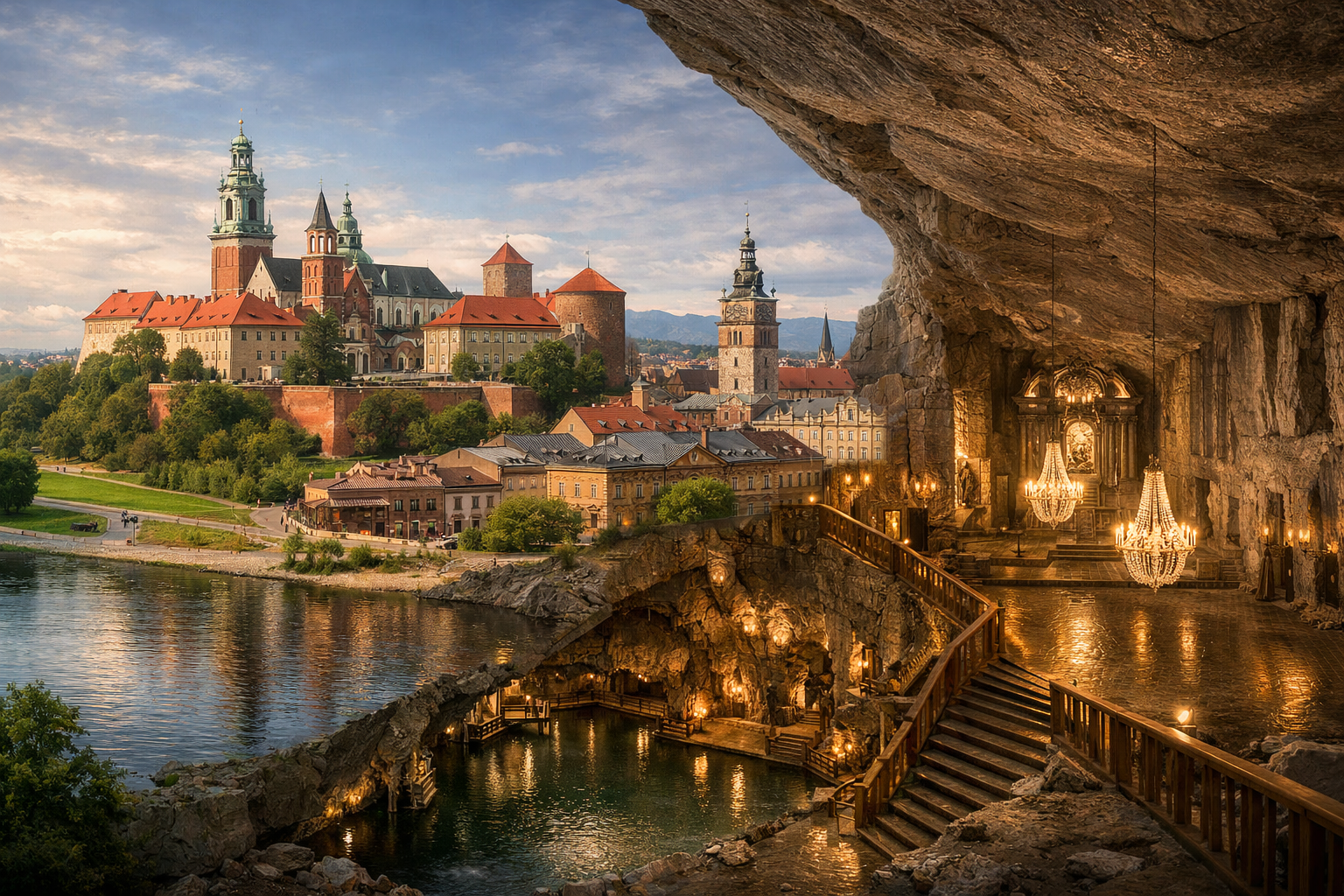
Poland, Krakow and the Wieliczka Salt Mine. A budget trip through historic Krakow with a one-day excursion to the underground halls and chapels of Wieliczka. Season: year-round.

Poland, Krakow and the Wieliczka Salt Mine. A budget trip through historic Krakow with a one-day excursion to the underground halls and chapels of Wieliczka. Season: year-round.

Discover Krakow’s storybook streets, grand squares, and cozy cafés on a budget-friendly escape that feels rich in history. Then slip beneath the surface for a day in the extraordinary Wieliczka Salt Mine, where vast chambers and chapels carved from salt create one of Poland’s most unforgettable sights.

🧭 DAY-BY-DAY ITINERARY

Ready-made country and city routes with daily plans, sights, transport and accommodation. Buy PDF guides for independent travel.

🧭 DAY-BY-DAY ITINERARY


Day 1 — Krakow: arrival, the Old Town, and an evening on the Main Market Square

  • 🚆 If you arrive at Krakow Airport, the most convenient budget way to get to the center is the SKA1 train. The station is located right by the terminal, with access via a covered pedestrian bridge. The trip to Kraków Główny usually takes about 20 minutes, and if you are heading toward Wieliczka on another day, it is useful to remember that this same line connects the airport, the main station, and Wieliczka Rynek-Kopalnia station. After arriving at the main station, allow another 10–15 minutes to exit, get your bearings, and walk to your hotel near the Old Town.

  • 🚶 It is best to make the first day as gentle and walkable as possible. After checking in, head to the Old Town — one of the most complete and beautiful historic centers in Central Europe. The heart of Krakow is Rynek Główny, a huge medieval square where Gothic, Renaissance, and Baroque come together in a remarkably harmonious scene. Here it is easy to feel that rare urban rhythm in which tourist energy does not destroy history but only highlights it: the sounds of street musicians, the silhouette of St. Mary's Basilica, the arcades of the Cloth Hall, horse-drawn carriages, and the steady flow of people along the cobbled streets create the feeling of a grand European theater under the open sky. Give yourself time not just to “see the square,” but to live it — sit by the facades of old townhouses, walk a full circle around it, look into the arches, small courtyards, and side streets where Krakow instantly becomes quieter and more local.

  • 🚶 Then walk to Florian Gate and the Barbican — powerful remnants of the city’s old defensive system. This section is especially good for a first introduction to the city because it clearly shows how Krakow entered the modern era without destroying its own medieval framework. From here it is convenient to reach Planty — the green park ring that encircles the Old Town on the site of the former city walls. In the evening, Planty offers an especially pleasant pause after the journey: the shade of old trees, benches, soft city light, and the feeling that you are walking along an invisible historical boundary between old royal Krakow and the later city.

  • 💤 On the first evening, do not overload the program with museums. It is better to save your energy for the following days and end the day with an early dinner near the station or the Main Market Square. If your flight arrives late, a short walk of 1.5–2 hours is enough. If you arrive early, allow 4–5 hours with breaks for a relaxed introduction to the Old Town, Planty, and dinner.


Day 2 — Krakow: Wawel, the Royal Route, and Kazimierz

  • 🚶 Dedicate the morning to Wawel Hill — a place where the historical symbolism of Poland is felt especially strongly. Wawel is not just a castle and not just a beautiful panorama above the Vistula. It is a space where power, ceremony, religion, and the idea of Polish statehood were concentrated for centuries. As you climb the hill, it feels as though you are entering not a separate museum site, but a major historical node of the country. Today the castle functions as one of Poland’s most important art museums, while the entire Wawel complex remains one of the nation’s главных святынь. Even if you are not planning to buy many interior exhibitions, it is absolutely worth coming here for the atmosphere of the courtyards, the views over the Vistula, the stone walls, the royal facades, and that special sense of scale that photographs rarely convey.

  • 🚶 After Wawel, it makes sense to walk down to Grodzka Street and continue along the Royal Route — the old axis by which monarchs, ambassadors, and ceremonial processions entered the city. This route is good because the architecture here forms not a set of postcards, but a coherent narrative: from the royal summit through church facades, the university milieu, and townhouses back to the Main Market Square. Along the way, it is convenient to make short stops for coffee and rest every 45–60 minutes, because although the route is compact, it is emotionally rich and visually dense.

  • 🚶 In the second half of the day, head to Kazimierz — once a separate town, and today one of Krakow’s most atmospheric districts. Here the urban landscape becomes less ceremonial and more layered: Catholic and Jewish traces of history, inner courtyards, old signs, intimate squares, cafés, and bookshops create the feeling of a district that was not “assembled” for tourists, but grew naturally and in places even a bit rough around the edges. A walk through Kazimierz is especially valuable because it takes the trip beyond the classic set of “market square — castle — cathedral” and lets you feel Krakow as a living city of memory.

  • 🚶 Toward evening, you can walk to the Vistula embankments or stay around plac Nowy, where it is easy to have an inexpensive dinner. Walking time between the main points of this day is usually short: Wawel and the Old Town are linked by 10–15 minutes on foot, and from the Market Square to Kazimierz it is about 20–25 minutes at a relaxed pace. It is best to plan the whole day without rushing, with a total walking distance of about 8–10 km.

Day 3 — Wieliczka: the salt mine and the underground world

  • 🚆 Transfer: Kraków Główny → Wieliczka Rynek-Kopalnia on the SKA1 line. Allow about 25–30 minutes for the train ride itself, plus 10–15 minutes for waiting for the train and about another 10 minutes for the walk from the station to the entrance area of the complex. From central Krakow, this is a realistic and convenient day trip without changing your base.

  • 🚶 A trip to “Wieliczka” is the climax of the route and one of those places that truly justify world must-see status. The salt mine is perceived not as an ordinary museum and not as a short underground excursion, but as an entire hidden city beneath the earth with its own logic, acoustics, climate, and an almost theatrical sense of unreality. When you descend, Krakow and the everyday world above seem to recede sharply, and in their place appear long salt corridors, underground chambers, traces of miners’ labor, carved reliefs, and spaces where utilitarian industrial history gradually turns into art. The tourist route of the mine stretches through a system of workings and halls at depth, where the salt-carved chapels, vast chambers, and the play of light on the gray-green walls are especially impressive. The visit makes such a strong impression precisely because of the contrast: harsh mining labor, religious imagination, engineering, and aesthetics come together here in a single experience.

  • 🚶 The main emotional high point for many is St. Kinga’s Chapel, one of the most famous underground sacred interiors in Europe. This space amazes not only by its size, but by the fact that it seems almost impossible: chandeliers, reliefs, altar forms, and the overall grandeur of the hall appear not in marble and not in wood, but in salt. Even if you have seen photos in advance, in person everything feels far more powerful because of the scale, the humid air, the subdued light, and the awareness that you are deep underground. For the entire visit, including entry, waiting for the group, completing the route, a souvenir break, and returning to the surface, it is reasonable to allow 4–5 hours. If you buy a ticket in advance for a specific slot, the day goes much more smoothly.

  • 💤 After the tour, do not try to cram half of Krakow into the program as well. It is better to have a late lunch or early dinner in Wieliczka or after returning to the city, and leave the rest of the evening free. The return on the same SKA1 train usually takes a comparable amount of time, so including the round-trip travel, transfers, and the mine itself, this day is a full but not exhausting excursion program.

Day 4 — Krakow: Rynek Underground, the Czartoryski, and the evening Old Town

  • 🚶 After the intense trip to Wieliczka, it makes sense to return to a more intimate urban day. Start with Rynek Underground — one of Krakow’s most interesting museum spaces, located directly beneath the Main Market Square. This is not just an archaeological exhibition, but a well-staged story about the birth of the medieval city, its trade, everyday life, disasters, rebuilding, and hidden layers of time. The visit is especially valuable after the first days of walking above ground: you already know the squares and streets above, and here you begin to literally see what lies beneath them. Krakow reveals itself as a city-palimpstest, in which present-day beauty rests on deep historical layers that are almost physically tangible.

  • 🚶 Then head to the Czartoryski Museum — one of the city’s key art destinations. It is a good choice for the route because it adds not only urbanism and a historic setting to the journey, but also an encounter with museum-level European art. The complex itself is linked to one of Poland’s most significant aristocratic collections and feels like a quieter, more concentrated part of Krakow — without the bustle of the square, but with strong cultural depth. For both museums together, including a coffee break, it is convenient to allow 4–5 hours.

  • 🚶 In the second half of the day, leave time for a slow walk without a strict goal: return to the Cloth Hall, stroll through the streets around ul. Sławkowska, św. Jana, or Grodzka, and peek into courtyards and passages. This day is especially good because of its balance — after the underground monumentality of Wieliczka, a different kind of pleasure arrives here: not a grand effect, but a gradual saturation with details, facades, shop windows, church portals, the ringing of trams, and that rare type of European urban beauty that reveals itself only on repeated unhurried walks.

  • 💤 The evening can end with an early rest at the hotel or a short outing to the illuminated Main Market Square. Krakow at night is especially beautiful outside peak hours: the facades of the townhouses soften, the crowds thin out, and the square itself begins to function not as a tourist stage, but as a great historical space where you can finally hear the air.

Day 5 — Krakow: Schindler, Podgórze, farewell city, and departure

  • 🚶 It is best to devote the final day to a more serious and historically complex layer of the city — the Zabłocie district and Oskar Schindler’s Enamel Factory. The exhibition here is dedicated to Krakow during the Nazi occupation of 1939–1945 and usually leaves a strong impression not only because of the subject, but also because of the way it presents urban life in an extreme era. This is a museum that changes the tone of the trip: after the royal, medieval, and romantically beautiful Krakow, it forces you to see the city as a space of trauma, resistance, and memory. It is worth setting aside at least 2–3 hours for the visit, especially if you prefer reading the materials rather than moving through the halls quickly.

  • 🚶 After the museum, it is useful to walk around Podgórze and along the Vistula. This part of Krakow is less ceremonial, but that is exactly why it is especially valuable at the end: it helps you feel the scale of the city beyond the tourist core. Here Krakow looks more modern, calmer, and more everyday. If there is time left, you can briefly return to Kazimierz or visit the Galicia Jewish Museum to complete the route with a more holistic understanding of the district’s cultural and historical layers.

  • 🚆 If you are heading to the airport, plan your departure with a time buffer. The SKA1 train from Kraków Główny to the airport takes about 20 minutes, but you also need to add the trip to the station, waiting time, and time to get through to the terminal. Realistically, allow about 60–90 minutes from your hotel door to the airport entrance. A taxi usually takes about 25 minutes, but the time depends heavily on traffic.

  • 💤 This route is intentionally designed as a compact budget trip without unnecessary transfers: one main base in Krakow, a logical one-day trip to Wieliczka, a moderate daily load, and time to rest. It works in any season: in winter Krakow is especially atmospheric and intimate, in spring and autumn it is ideal for long walks, and in summer it is easy to combine museums with evening outings and the Vistula embankments.

Flight tickets

eSIM for travel

Buy PDF guide

Buy PDF guide — 10.71 USD

PDF — 10.71 USD