
Buy PDF guide

Buy PDF guide — 12.85 USD

PDF — 12.85 USD

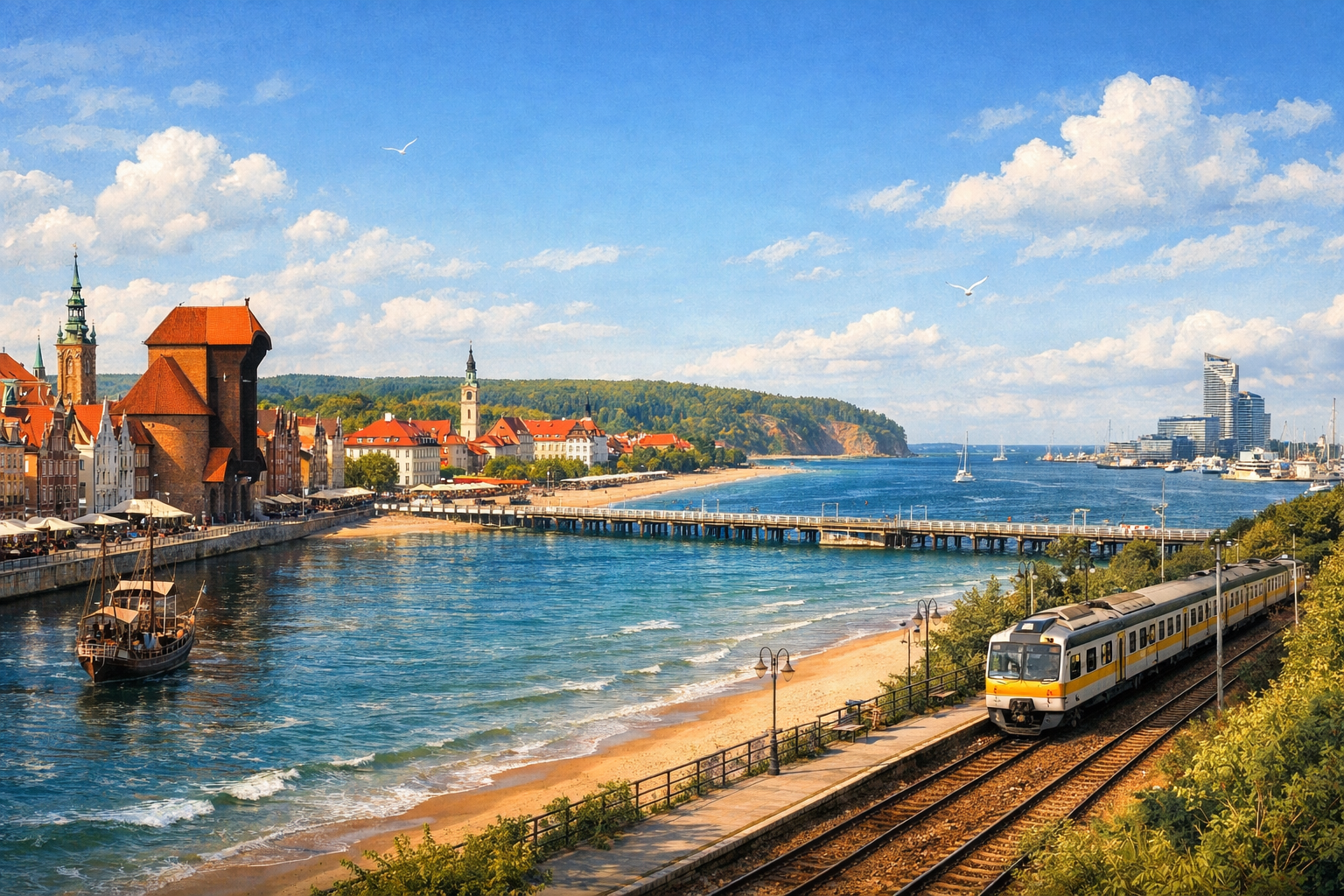
Poland, Gdańsk, Sopot, and Gdynia. A budget itinerary through the cities of the Baltic coast with beaches, historic architecture, and trips on the suburban train. Season: May - September.

Poland, Gdańsk, Sopot, and Gdynia. A budget itinerary through the cities of the Baltic coast with beaches, historic architecture, and trips on the suburban train. Season: May - September.

Discover Poland’s Baltic coast on a budget, hopping by suburban train from the historic streets of Gdańsk to the sandy beaches of Sopot and the modern waterfront of Gdynia. Between seaside walks, grand architecture, and easy day trips to Oliwa and Orłowo, this summer route is perfect from May to September.

🧭 DAY-BY-DAY ROUTE

Ready-made country and city routes with daily plans, sights, transport and accommodation. Buy PDF guides for independent travel.

🧭 DAY-BY-DAY ROUTE


Day 1 — Gdańsk: Main Town, Długi Targ and the Motława waterfront

  • 🚆 If you arrive at Gdańsk Airport, the most budget-friendly and convenient way to start the trip is by train via Gdańsk Wrzeszcz station with a transfer to the SKM toward the center. On average, the trip to Gdańsk Główny or Gdańsk Śródmieście takes about 35–50 minutes including the transfer and waiting time, and the airport station is located right by the terminal. After check-in, leave your things and plan a calm day without overloading yourself: old Gdańsk reveals itself best on an unhurried walk.

  • 🚶 Gdańsk’s Main Town is a rare place where historic architecture, maritime history, and the almost theatrical beauty of the facades feel not like a museum set, but like a living urban landscape. It is convenient to start your walk at the Golden Gate and slowly go along Długa Street to Długi Targ, admiring the narrow tall houses with richly decorated gables, stone portals, carved details, and facade colors that look especially beautiful in the soft light of late afternoon. This is one of those places where it is easy to spend several hours without a clear goal: stepping into courtyards, stopping by fountains, climbing viewpoints, and simply absorbing the atmosphere of the old Hanseatic city. On Długi Targ you are greeted by the city’s symbols — the Main Town Hall, Artus Court, and Neptune Fountain, and a little farther on begins the Motława waterfront with views of the famous Crane, old gates, and moored vessels.

  • 🌆 In the evening, be sure to return to the river. After the daytime bustle, the Motława becomes especially photogenic: illuminated facades, reflections on the water, wooden restaurant terraces, ships, and the silhouettes of old warehouses create a very cinematic mood. If you want a budget dinner, it is better to look for places not on the first line but on nearby streets away from the most touristy storefronts — prices are often noticeably nicer. For the first day, the ideal format is: 2–3 hours of walking, an early dinner, a bit of rest, and a short evening outing to the river.


Day 2 — Gdańsk: Museum of the Second World War, European Solidarity Centre and Westerplatte

  • 🚶 This day is best devoted to the modern history of Gdańsk, because here the city reveals itself not only as a beautiful seaside resort region, but also as a place of enormous historical weight. In the morning, start with the Museum of the Second World War — it is one of the strongest and most emotionally intense museums in Poland. The huge modern building near the historic center stands out immediately for its architecture, and the exhibition is designed to show the war through human destinies, everyday life, the destruction of cities, occupation, resistance, and the complex memory of the 20th century. It is reasonable to allow at least 2.5–3 hours for the visit, and longer if you love museums.

  • 🚋 After the museum, it is convenient to return to the former shipyard area and continue to the European Solidarity Centre. This is a very important place for understanding modern Poland: it tells the story of the Solidarity movement, workers’ protests, the country’s transformation, and Gdańsk’s role in the history of the fall of the communist bloc in Europe. Besides the exhibition itself, the surrounding space is also impressive — industrial architecture, shipyard scale, broad squares, and the monumentality of the area.

  • 🚌 If you still have energy and want to add a historical accent, in the second half of the day you can go to the Westerplatte area. This is a calmer, more open, and windier location by the water, connected with the beginning of the Second World War. It is worth coming here not for a dense museum program, but for the feeling of the place itself: the peninsula, memorials, proximity to the port, Baltic air, and a very focused, serious atmosphere. It is important not to overload the day: after a full visit to the two main museums, Westerplatte is best kept as a short 1.5–2 hour outing.

Day 3 — Sopot: beach, pier, resort architecture and a slow day by the sea

  • 🚆 The transfer from Gdańsk to Sopot on the SKM suburban train is one of the most pleasant and easiest parts of this route. From Gdańsk Główny to Sopot it takes about 20–25 minutes, trains run frequently, and the trip itself is convenient even with light luggage. This format is exactly what makes the Tricity an ideal budget route: you stay in one base or change hotels if you like, while the cities are literally strung along one railway line on the coast.

  • 🏖️ Sopot has a completely different tone compared with Gdańsk. If Gdańsk impresses with history and urban scale, Sopot works through lightness, resort rhythm, and the atmosphere of a Baltic holiday. The main idea of the day is not to rush. From the station, walk toward Bohaterów Monte Cassino Street, then to the pier and the beach. Along the way, you get the feeling of a classic European seaside resort: neat villas, hotels, green streets, cafés, flowerbeds, and a very pleasant human scale. Sopot’s pier itself is one of the symbols of the Polish coast: a long wooden pier stretches out into the sea, and even a simple walk along it gives that exact vacation feeling people come here for in summer.

  • 🌊 After walking through the center, give yourself time for the beach. In May and September, it may be a day for a long walk along the water’s edge and photos, while in the warm summer weeks it can be a full seaside rest day. The beaches here are sandy, wide, and very photogenic, and the light over the Baltic often changes literally every half hour: silver, amber, then almost northern. In the evening, it is nice to stroll again through the resort center, look at the illuminated buildings, and sit in an inexpensive café a little farther from the very first line.

Day 4 — Oliwa and Sopot: park, cathedral, suburban rail line and a second evening by the sea

  • 🚆 In the morning, take a short trip to the Oliwa district, which lies between Gdańsk and Sopot and fits perfectly into the route thanks to the suburban train. It is quick to reach from Sopot or from central Gdańsk stations, usually within 10–20 minutes depending on your starting point and the specific train. This is a good day to exhale a little after the intense history and switch to a greener, more intimate format.

  • 🌿 Oliwa Park is one of the most pleasant places in the whole region for a calm walk. There is no loud tourist pressure here, but there are old trees, alleys, ponds, manicured lawns, and a very soft, almost aristocratic atmosphere. Nearby is Oliwa Cathedral, known for its long past and organ tradition. Even if you are not planning a long look at the interiors, the ensemble of the district itself makes a strong impression: old monastic motifs, greenery, silence, and the feeling that you have stepped out of the rhythm of the coast for a few hours.

  • 🌆 After Oliwa, return to Sopot for a second evening by the sea. Repeating it here is justified: Sopot has very different daytime and evening faces. By day it is a beach town, and by night a resort with soft light, music, strolling crowds, and that vacation feeling that is especially pleasant in the May-to-September season. If the weather allows, watch the sunset by the water, then return by train or stay overnight in Sopot if you want to make the route more relaxed.

Day 5 — Gdynia: maritime modernism, waterfront, museum ships and city beach

  • 🚆 From Sopot to Gdynia on the SKM takes very little time — usually about 10–15 minutes to Gdynia Główna, and then you can walk or use city transport to reach the waterfront. This is another advantage of the route: all three cities are connected so closely that transfers do not eat up the day and do not create the fatigue typical of big intercity trips.

  • ⚓ Gdynia is noticeably different from both Gdańsk and Sopot. It is a younger, more maritime, functional, and modernist-in-spirit part of the Tricity. There is less “storybook” antiquity here, but the themes of the port, navy, ocean travel, and a city that grew in the 20th century as Poland’s modern window to the sea are felt more strongly. It is best to start from the Southern Pier area and the waterfront: this is where museum ships, sea views, open spaces, and a pleasant promenade zone with wind, seagulls, and horizons are concentrated.

  • 🚢 If you like maritime themes, definitely look into Gdynia’s maritime museum context: the navy museum and historic ships make the city especially interesting not only for a walk, but also for a substantial day out. After that, head to the city beach or the boulevard — it is very pleasant here simply to walk along the sea without a strict plan. Gdynia is less resort-like than Sopot, but that is exactly why many people like it even more: it feels honest, spacious, and fresh. On a warm day, you can easily combine a museum, a walk along the waterfront, the beach, and dinner by the water.

Day 6 — Gdynia Orłowo and the final day on the Baltic

  • 🚆 Dedicate the final day to Orłowo — one of the most beautiful and atmospheric seaside districts in the region. It is easy to get here from central Gdynia by local train or bus, and then walk down to the sea. This is an ideal point to end the six-day route: no rush, no long museums, with the emphasis on landscape, air, and the last hours by the Baltic.

  • 🌅 Orłowo is loved for its combination of sea, beach, wooden pier, and the coastal cliff of Kępa Redłowska. Here the northern character of the coast is felt especially strongly: pale sands, cool water, pines, wind, and a beautiful escarpment that makes the landscape not just resort-like, but truly expressive. A walk along the water, going out onto the pier, climbing to viewpoints, and lingering on the beach create the feeling of a very right ending — not loud, but deep and memorable.

  • 🧳 In the second half of the day, leave a time buffer for the return trip to the airport or departure station. If you are leaving via Gdańsk Airport, allow about 60–90 minutes from Gdynia or Sopot, including transfers, waiting time, and a possible change at Gdańsk Wrzeszcz. For a budget route, this is more sensible and calmer than traveling at the last minute. Poland is generally considered a safe country for travel, but as in any popular urban agglomeration, it is worth following normal caution on public transport, at stations, in tourist areas, and in nightlife venues.

Flight tickets

eSIM for travel

Buy PDF guide

Buy PDF guide — 12.85 USD

PDF — 12.85 USD