Buy PDF guide

Buy PDF guide — 6.43 USD

PDF — 6.43 USD

Plovdiv - the Old Town and the creative Kapana district

Plovdiv - the Old Town and the creative Kapana district

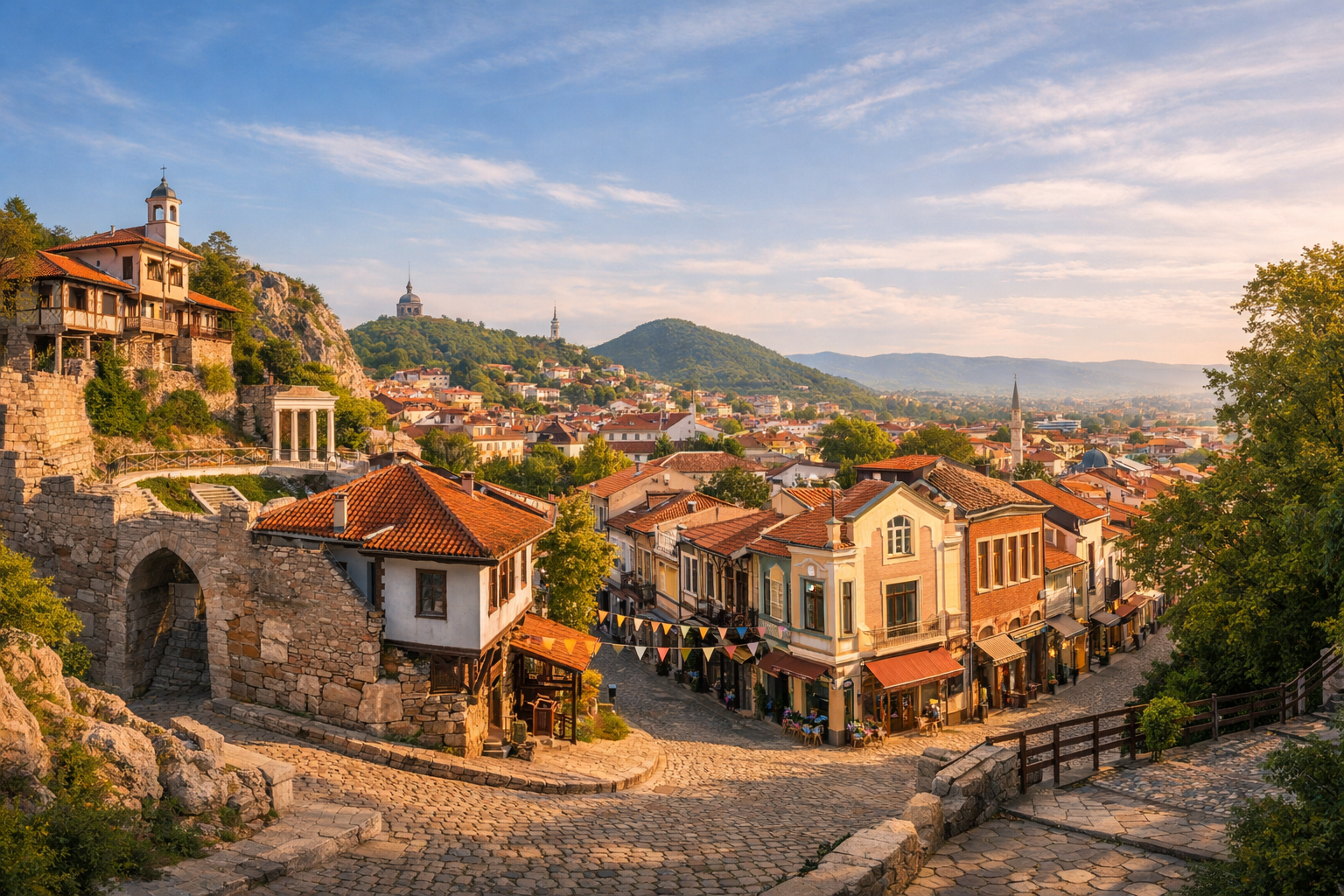
Plovdiv charms with its cobbled Old Town, where colorful 19th-century houses stand above one of Europe’s oldest cities. Just below, the creative Kapana district buzzes with galleries, cafés, and street life, blending ancient heritage with the city’s vibrant center.

🧭 DAY-BY-DAY ITINERARY

Ready-made country and city routes with daily plans, sights, transport and accommodation. Buy PDF guides for independent travel.

🧭 DAY-BY-DAY ITINERARY


Day 1 — Plovdiv: Old Town, Ancient Theatre, and Revival-era houses

  • 🚶 It is best to devote the first day to Plovdiv’s Old Town — one of the most beautiful and atmospheric historic ensembles in Bulgaria. Start the morning without rushing: walk up the cobbled streets through the Saborna area, where every turn reveals either a carved wooden balcony, a facade in soft ochre tones, or a view of the hills and modern neighborhoods below. Allow at least 4–5 hours with breaks to get to know the Old Town: here it is important not just to “tick off the sights,” but to give yourself time for the rhythm of the place. The main visual highlight of the day is the Ancient Theatre of Plovdiv, one of the best-preserved Roman stages in the world. It is best to come here in the first half of the day or closer to golden hour: the marble rows, the city panorama, and the sense of layered history are especially powerful here.

  • 🏛️ After the theatre, it makes sense to explore the “interior” layer of the Old Town: visit the Regional Ethnographic Museum, located in the famous Argir Kuyumdzhioglu House. This is one of those museums where the value lies not only in the collection, but in the building itself — rich, almost theatrical, with the characteristic layout of Plovdiv’s Revival period. Then continue your route through the house museums: Balabanov House and Hindliyan House give a good sense of what the urban elite of the 19th century looked like — with murals, decorative ceilings, reception salons, and a subtle mix of Balkan, Eastern, and European influences. Allow a bit of time for moving between these points, but do not underestimate the climbs and uneven stone underfoot: comfortable shoes are essential, and the pace should be relaxed.

  • ☕ In the second half of the day, take a deliberate break for coffee or a late lunch right in the Old Town or along its lower edge, so you do not burn out from the number of impressions. After resting, you can walk to Hisar Kapia and simply wander without a strict plan: it is in this part of Plovdiv that the city is especially good as a feeling, not just as a set of attractions. In the evening, head down to the central pedestrian zone. If you still have energy, end the day with a short walk by the Roman Stadium and Dzhumaya Square — this way you will see how the ancient layer, Ottoman heritage, and modern urban life in Plovdiv literally overlap each other. The overall walking load for the day will be moderately high, so after 19:00 it is better to leave free time without adding new museums.


Day 2 — Plovdiv: the creative Kapana district, Main Street, and the city rhythm

  • 🚶 Dedicate the second day to Kapana — Plovdiv’s creative district, which is best experienced not as a “sight,” but as a living urban environment. Historically this was an artisans’ area, and today it is a quarter of small streets, workshops, design spaces, bars, galleries, and cafés. Come here early in the morning, while the area is not yet crowded: at this time it is easier to feel the scale of the district, notice street names connected with crafts, and catch details that get lost in the evening noise. For a relaxed walk through Kapana with stops for coffee, shop windows, local stores, and small art spaces, it is worth allowing 2–3 hours.

  • 🎨 After Kapana, it is natural to move on to the Main pedestrian street and the Roman Stadium. This is a convenient pairing: from the intimate lanes of the district, you emerge into a more “ceremonial” urban scale. The Roman Stadium is especially interesting here precisely because of its context — it is not isolated like a museum object, but woven into the everyday fabric of the center. Nearby stands Dzhumaya Mosque, one of the notable Ottoman landmarks in central Plovdiv; around it you can clearly feel just how historically layered the city is. This part of the route is a good place for a long lunch or late meal: the day should not feel overloaded with museums, but rather “flavorful” and visually varied.

  • 🌆 In the second half of the day, leave room for a freer rhythm: return to Kapana if you want more atmosphere, or walk to Tsar Simeon Garden. This park works well as a change of pace after the dense center: greenery, alleys, open spaces, and the chance to simply sit without a plan. In the warm season, it is convenient to end the evening at the Singing Fountains, but it is best to check the schedule of the light-and-music shows closer to your trip. The point of the second day is not to “see the maximum,” but to live inside central Plovdiv: in the morning — Kapana’s creative texture, during the day — history woven into the urban fabric, and in the evening — a soft, highly walkable center.

Day 3 — Plovdiv: basilicas, archaeology, and a panoramic finale

  • 🏛️ The third day is best built around Plovdiv’s early Christian and archaeological layers. Start with the Bishop’s Basilica of Philippopolis — one of the city’s key modern museum spaces, where ancient mosaics are experienced not as a fragment, but as a large spatial narrative. Then you can walk to the Small Early Christian Basilica: it is more compact, but very expressive and complements the late antique theme well. Allow at least 2–2.5 hours to visit both basilicas, including the walk between them and a short rest. After that, it makes sense to continue to the Regional Archaeological Museum to gather a broader historical context — from ancient Philippopolis to finds from the region.

  • 🗺️ After such an intense first half of the day, be sure to take a long break for lunch and rest in the center. The third day often turns out to be the most “information-dense,” so without a pause the impressions begin to blur together. In the second half of the day, return to a walking format: you can head toward the Old Town once again, but without mandatory entries, or choose the panoramic point at Nebet Tepe. It is here that you feel especially clearly the character of Plovdiv as a city on hills, where ancient history is not separated from modern life, but quite literally lies beneath its feet.

  • 🌇 It is best to make the finale of the route calm and beautiful: a light walk, scenic views, an early dinner, and a little free time in your favorite part of the center — Kapana, Saborna, or the surroundings of the Ancient Theatre. Plovdiv reveals itself through repeated walks: when everything feels dense and new on the first day, by the third you begin to sense an internal map of the city. So the last evening should not be packed with new mandatory sights — let it become a soft ending with views of rooftops, hills, and layers of history that are preserved here with remarkable naturalness.

Flight tickets

eSIM for travel

Buy PDF guide

Buy PDF guide — 6.43 USD

PDF — 6.43 USD