
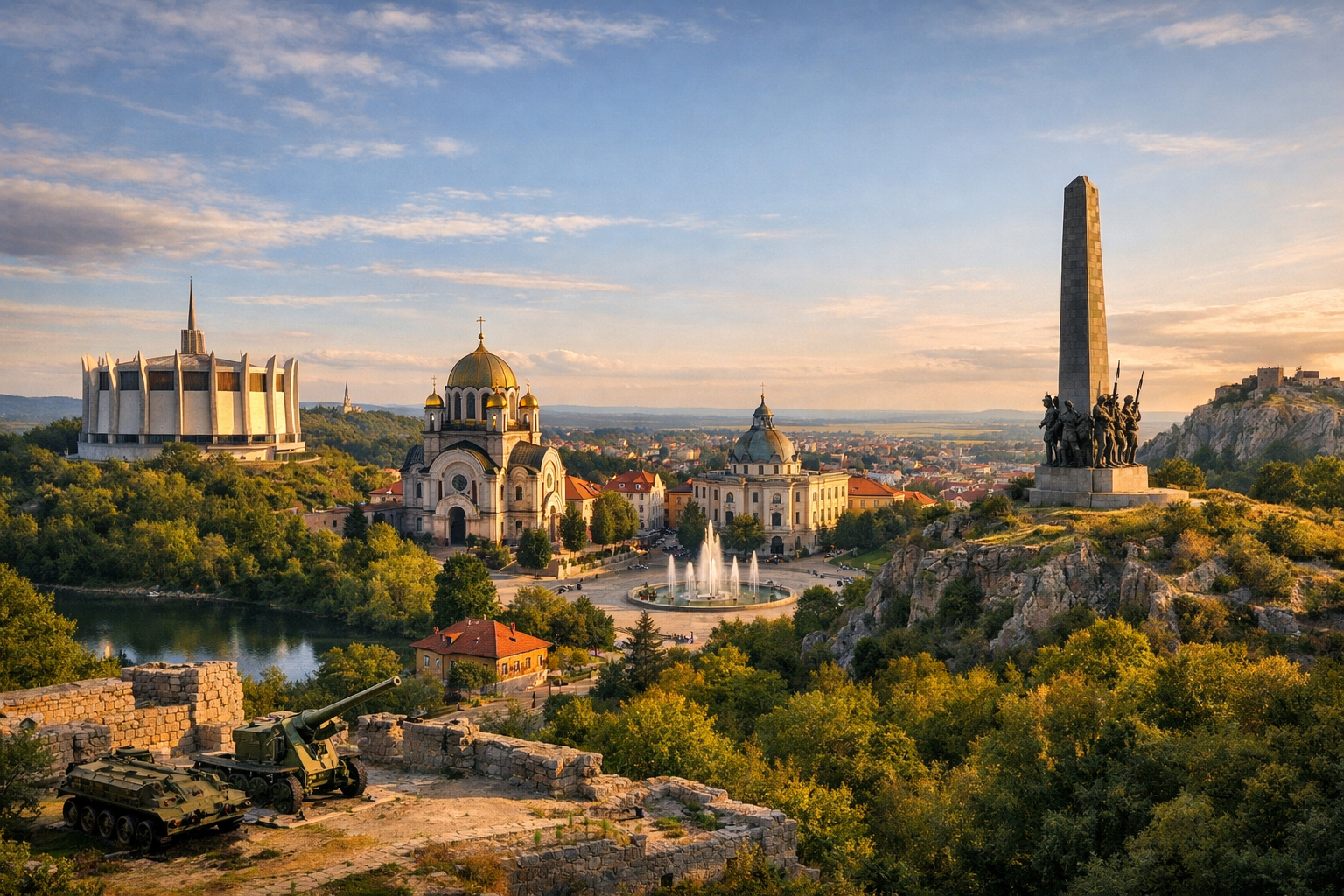
Day 1 — Pleven: city center, memorials, and the Panorama
🚶 It’s best to build the first day around Pleven’s military history, but without rushing and with proper breaks. Start the morning in the central part of the city, where it is easiest to feel that Pleven is not just a provincial Bulgarian town, but a place of European memory connected with the war of 1877–1878. From the pedestrian streets and the rhythm of the city, head to the St. George the Conqueror Chapel-Mausoleum: this is one of the city’s strongest memorial points, austere and solemn, with exactly the right mood for entering the historical context. After a short stop and a look inside, take a coffee break or an early lunch in the center so you don’t overload the day from the very beginning.
🏛️ After the break, continue to Skobelev Park and the Pleven Epopee 1877 Panorama. It is convenient to allow about 10–15 minutes by taxi or roughly 25–35 minutes on foot at an easy pace between the city center and the memorial complex. The park itself is not just a green area, but a historical field of memory: here the cost of the third assault on Pleven is especially tangible, and the space works not as a “setting” but as a continuation of the events themselves. For the park, the mass graves, the redoubts, and the outer grounds, it is sensible to allow at least 45–60 minutes.
🖼️ Then devote 1.5–2 hours to the Panorama itself. This is the main point of the route and the place many people come to Pleven for in the first place. The exhibition is arranged to gradually lead you from a historical introduction to the climax of the siege: the large-scale painted canvas, the object foreground, the lighting, the dramatic sequence of the halls, and the transition to the diorama make the impression almost theatrical, yet carefully documented. A slow pace works especially well here: don’t rush through the halls, but give yourself time to follow the logic of the events — from the assaults to the capitulation of Osman Pasha.
🌆 In the evening, return to central Pleven. After a heavy historical day, it is better to choose a calm ending: a walk along the pedestrian zone, an early dinner, and a brief “second look” at the city without the concentration of museum visits. It is precisely at this moment that Pleven begins to feel more layered: not only as a place of battle, but also as a city that lives on top of its memory. It’s best not to plan long transfers for the night — this day is already full and emotionally dense on its own.