Buy PDF guide

Buy PDF guide — 29.99 USD

PDF — 29.99 USD

PISA • PIAZZA DEI MIRACOLI

PISA • PIAZZA DEI MIRACOLI

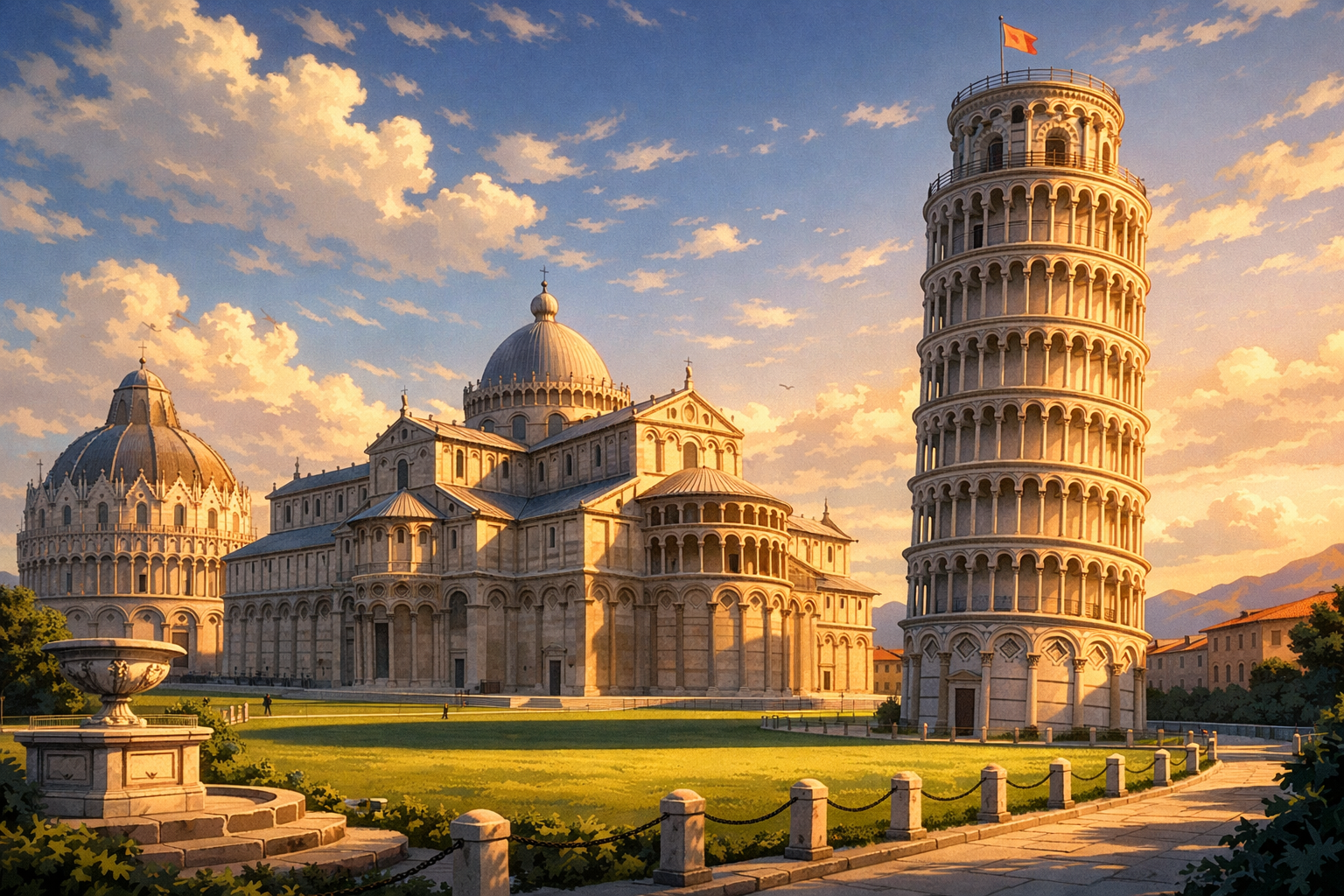
Begin at Pisa’s Piazza dei Miracoli, where the Leaning Tower rises above marble monuments and emerald lawns, then wander the Lungarno riverbanks to the Medici Arsenals and the quiet pines of San Rossore. From here, Tuscany unfolds—medieval Lucca, seaside Viareggio, portside Livorno, and art-soaked Florence all within easy reach.

🧭 DAY-BY-DAY ITINERARY

Ready-made country and city routes with daily plans, sights, transport and accommodation. Buy PDF guides for independent travel.

🧭 DAY-BY-DAY ITINERARY


Day 1 — Pisa: first introduction to the Piazza dei Miracoli

  • 🚶 Arrival at Pisa Galileo Galilei Airport and a quick ride on the PisaMover (≈ 5 min) to Pisa Centrale station. Check in and take an unhurried walk to Piazza dei Miracoli (Piazza del Duomo) — a green lawn where, laid out as if in the palm of your hand, are the Baptistery, the Duomo, the Camposanto, and the leaning tower. It’s ideal to come closer to sunset: the marble warms up, locals rest peacefully on the grass, and the shadows from the arcades gently “draw” the perspective. Focus on the feeling of space and the scale of the ensemble; don’t rush inside — everything essential will be tomorrow.


Day 2 — Piazza dei Miracoli in depth: tower, cathedral, baptistery, Camposanto

  • ⏱ Plan 3.5–5 hours of pure sightseeing + breaks for rest and coffee. Start by climbing the Tower (timed entry; ascent/descent ≈ 30–40 min), then the Duomo (≈ 45–60 min) — twisting carvings, inlays, the shimmer of mosaics. Linger in the Baptistery to hear the famous acoustics (declaimers sometimes demonstrate the dome’s “polyphonic” effect; visit ≈ 20–30 min). Finish with the Camposanto Monumentale (≈ 60–90 min): long Gothic galleries, a cycle of frescoes, and a rare concentration of silence in the middle of a tourist hub. Take breaks on the grass or in the shady wall openings — that way you’ll keep your energy through the evening.

Day 3 — Square museums: sinopie and cathedral treasures + the Botanical Garden

  • 🏛 In the morning — Museo delle Sinopie (≈ 45–60 min): preparatory drawings for the Camposanto frescoes offer a rare look “inside” 14th-century workshops. Then — Museo dell’Opera del Duomo (≈ 60–90 min): sculptures by Nicola and Giovanni Pisano, the bronze “Pisan Griffin,” original doors, and artifacts from the whole square. After the museums — a 10-minute walk to the Orto e Museo Botanico: one of the oldest university gardens in Europe, ideal for a “reset” after stone and marble (≈ 45–60 min, depending on your energy). In the evening — dinner on Via Santa Maria or in the neighborhoods toward the Lungarno.

Day 4 — Above the city: a walk along the Mura di Pisa + the Lungarno embankments

  • 🚶 Go up onto the medieval walls (entrance by the Santa Maria tower behind the Camposanto): from above you can see Pisa’s “signature” — a succession of rooftops, courtyards, the Baptistery dome and the garden, all the way to the bends of the Arno. Allow 60–90 min for the wall route. In the afternoon, head down to the river: Santa Maria della Spina — a tiny “jewel box” on the water; Palazzo Blu — a modern exhibition center in a historic palazzo (go inside or at least see the façade and courtyard). Sunset — on the Ponte di Mezzo bridge: from here the Lungarno opens up in both directions.

Day 5 — Medici Arsenals and “New antiquities”: the museum of ancient ships

  • 🏺 In the Medici Arsenals on Lungarno Ranieri Simonelli — Museo delle Navi Antiche di Pisa (≈ 90–120 min). In the halls of former shipbuilding sheds — remarkably well-preserved Roman-era vessels, cargo fragments, navigation by the stars, and a panorama of Mediterranean trade. This is an unusual, “maritime” Pisa — the one that explains the city’s wealth before the university era. After the museum — lunch by the river, then an unhurried loop along the Lungarno (photos of bridges, reflections in the water, cafés).

Day 6 — Tuscan nature: Tenuta di San Rossore

  • 🌿 Half a day in the Migliarino–San Rossore–Massaciuccoli regional park. It’s convenient to reach the “Cascine Vecchie” entrance by bus/taxi (from the center ≈ 20–30 min). Then — on foot or by bike: centuries-old pines, dunes, the smell of the sea, and the light so beloved by Tuscan painters. Bring water/snacks and move unhurriedly, with pauses for shade and photos; if you like, join an organized walk from the visitor center. In the evening, return to the city for dinner.

Day 7 — Lucca: walls, towers, winding streets

  • 🚆 A half-day excursion to Lucca: regional train ≈ 25–35 min, trains run about every 30 min. Plan: a loop on the city ramparts (you can rent a bike), Duomo di San Martino, Piazza dell’Anfiteatro, the Guinigi Tower with trees on top. Return to Pisa for dinner. Allow 6–7 hours total for travel and breaks, of which the round trip is ≈ 1 hour.

Day 8 — Viareggio: sea and Art Deco on the waterfront

  • 🌊 The regional train from Pisa Centrale to Viareggio takes ≈ 20–30 min. Morning — promenades and the beach, midday — cafés and seafood, then — Liberty-style architecture along the Passeggiata Margherita. Return to Pisa before sunset. A day with an emphasis on “sea air” between dense museum blocks.

Day 9 — Livorno: the Venezia Nuova canals and salty winds

  • ⛵ Train to Livorno Centrale ≈ 15–25 min. Route: the Venezia Nuova district (canals, little bridges and boats), Mercato Centrale, the seafront by the Terrazza Mascagni. Lunch with cacciucco (fish stew) — and back to Pisa. Time-wise — 5–6 hours including travel + coffee/photo breaks. In the evening — a light walk along Borgo Stretto and Piazza delle Vettovaglie.

Day 10 — Florence “lite” from Pisa

  • 🎨 The regional train to Firenze S.M.N. usually takes 50–80 min. “Overview” route: the Duomo and Brunelleschi’s dome from the outside, Piazza della Signoria, Ponte Vecchio, Santa Croce — without overloading on museums. Return on an evening train (check the timetable in advance), leaving a buffer for boarding and possible delays. Useful: no-heel shoes, water, and a light cover-up from the sun.

Day 11 — Pisa at an easy pace: markets, inner courtyards, Borgo Stretto

  • 🧺 No trips: the morning market at Piazza delle Vettovaglie, the arcades of Borgo Stretto, bookshops and cafés. After midday — Museo della Grafica in Palazzo Lanfranchi (a wonderful collection of drawings and prints) or simply a “lazy” walk along the embankments. End the day — your favorite spot on the Lungarno for sunset.

Day 12 — A museum duet on the Lungarno: San Matteo and the Royal Palace

  • 🏛 Morning — Museo Nazionale di San Matteo (≈ 60–90 min): 13th–15th century painting and sculpture, from Giunta Pisano to the early Renaissance. Afternoon — Museo Nazionale di Palazzo Reale (≈ 60 min): interiors of dynastic eras, the Gioco del Ponte armory, portraits of the Medici and the House of Lorraine. Between the museums — lunch and a short break by the river.

Day 13 — Buffer day and favorites: go back to what you loved

  • 🔁 A backup day: catch up on what you didn’t manage (for example, revisit the Mura di Pisa under different weather, stop by Palazzo Blu for the current exhibition, or walk through the Camposanto again during “quiet” hours). In the evening — souvenirs (art posters, ceramics, books) and a final gelato on Borgo.

Day 14 — Finale: morning on the Piazza dei Miracoli and a farewell loop through the center

  • 🌅 Get up early and head to Piazza dei Miracoli when there’s almost no one here: the light is soft, and the sound of bells sets the city’s rhythm. A short loop around your favorite spots (the Lungarno, courtyards, bookshops), lunch — and departure. If you’re heading to the airport, keep the PisaMover timetable in mind and allow extra time for security.

Flight tickets

eSIM for travel

Buy PDF guide

Buy PDF guide — 29.99 USD

PDF — 29.99 USD