
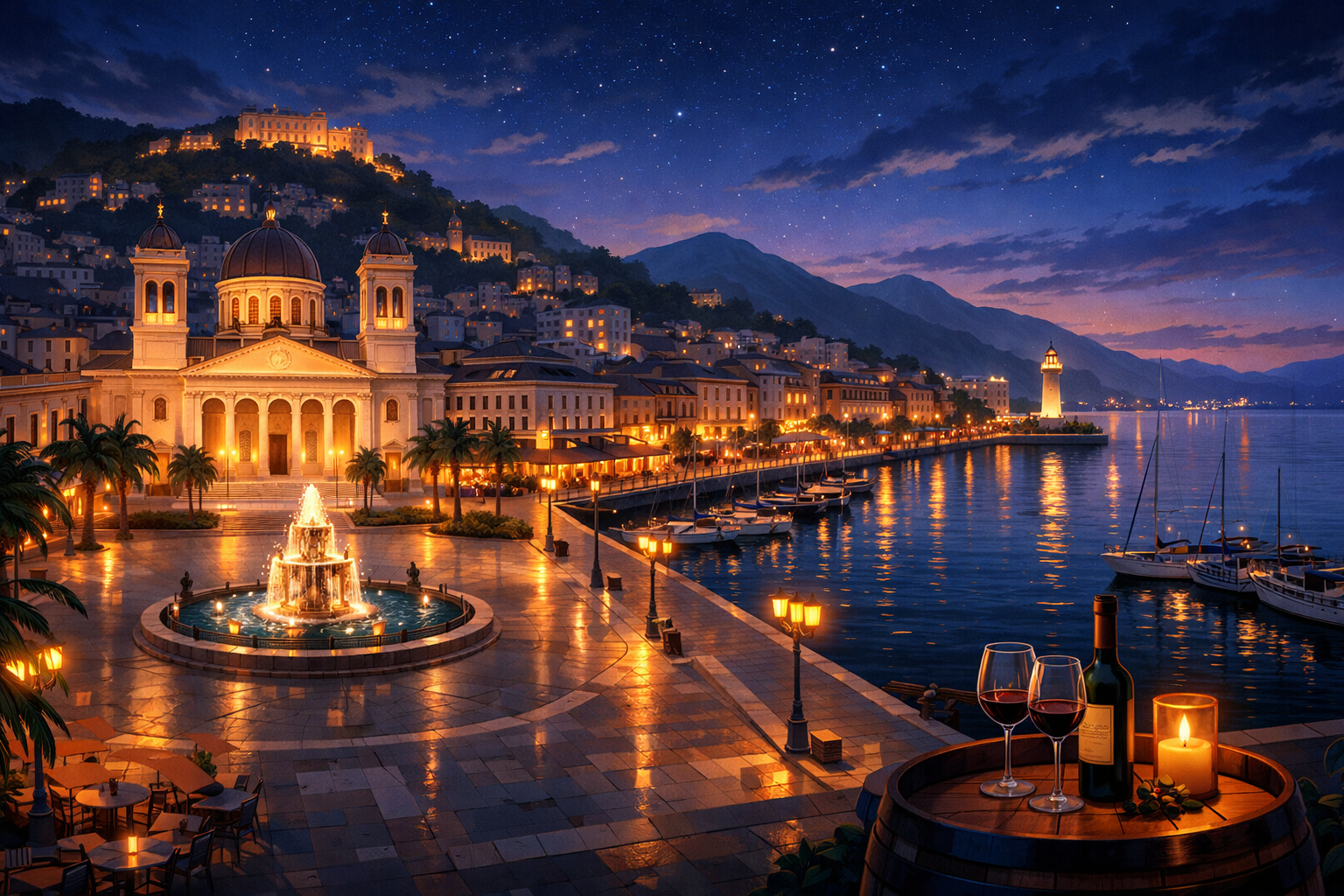
Day 1 — Patras: port, Georgiou Square and an evening on the waterfront
🚶 Patras is not just the third most important city in Greece, but a true maritime hub of Western Greece, historically oriented toward the water and still perceived as the "Greek gateway to the West." The city’s port character is especially tangible here: ferries, a long shoreline, spacious seaside avenues, wind from the Gulf of Patras, and a constant sense of movement. It makes sense to begin your introduction in the lower town, where broad streets, neoclassical facades, and urban rhythm blend with a maritime atmosphere. This is exactly where Patras reveals itself as a city for walking: bright, energetic, and businesslike by day, then soft, wine-toned, slightly theatrical, and very lively by evening.
🚶 Georgiou I Square is one of the city’s main public spaces and the best place to feel its urban temperament. It is Patras’s ceremonial square, with historic buildings, cafés, meeting spots, and a subtle capital-city tone that unexpectedly combines with the relaxed Peloponnesian rhythm. From here, it is easy to plan the whole day: shopping streets, access to the seaside part of the center, and important cultural sites are all nearby. The square is especially pleasant in the morning or closer to sunset, when the facades take on a warm honey shade and the usual Greek scene begins at the tables — coffee, conversation, aperitifs, and unhurried observation of city life.
🚶 Be sure to walk up to the Municipal Theatre Apollo, which stands on the square and is considered one of Patras’s architectural calling cards. This elegant 19th-century building, tied to the city’s cultural history, adds aristocratic depth to the square: alongside the port and commercial character of Patras, there has always also been a strong theatrical, musical, and social dimension. Even if you do not go inside for a performance, the exterior of the theatre, the proportions of its facade, and the atmosphere of the historic center make this stop an important part of the route.
🚶 After the center, head toward the city’s seafront — the waterfront and the area near the port. Walking from Georgiou Square to the coastal zone usually takes about 10–15 minutes at a relaxed pace. This stretch should not be seen as just a transition: along the way, you can clearly see how Patras lives on the contrast between upper and lower town, between the administrative center and the open maritime horizon. By the water, the space opens up, the air becomes saltier, and city noise gives way to the rhythm of a stroll. This is a good place for a long unhurried pause: walk along the shore, sit on a bench overlooking the gulf, watch the port logistics, and feel that rare state in which a city seems both industrious and romantic at the same time.
🍷 In the second half of the day, allow 1.5–2 hours for the wine part of the route: Patras is closely connected with the wine culture of the Achaia region, and the main symbol here is considered to be Mavrodaphne. In the city itself, it is pleasant to choose a wine bar, a restaurant with a local wine list, or a stylish hotel bar by the sea and arrange a tasting evening without overloading the schedule. The idea of this day is not a formal tour, but atmosphere: a glass of local wine, a view of the port line, the slow transition from daytime heat to evening freshness, and the feeling that Patras truly opens up after sunset. Not only red and fortified local wines are appropriate here, but also light white or rosé options from the region, especially if you want to pair your walk with seafood.
🌃 Dedicate the evening to the nightlife atmosphere of Patras. The city is known for its lively student and bar scene, so after 20:00 the central quarters and the waterfront area become noticeably more animated. It is better not to try to cover everything at once: choose a sequence like "aperitif by the water → dinner → one or two bars." This pace is realistic, not tiring, and leaves room for a genuine impression. Nighttime Patras is not about glamorous staging, but about a living mix of sea, conversation, music, wine, and the feeling of a large port that never fully falls asleep.
💤 Plan to return to the hotel no earlier than 23:00–00:30, especially if you want to experience the city’s evening rhythm without rushing. If you are staying in the center or by the coast, many parts of the route are easy to cover on foot, while for late evening it is wise to leave a taxi as the comfortable option for returning.