
Buy PDF guide

Buy PDF guide — 10.71 USD

PDF — 10.71 USD

Paris, (entertainment) — wine bars, cabarets, clubs, Montmartre

Paris, (entertainment) — wine bars, cabarets, clubs, Montmartre

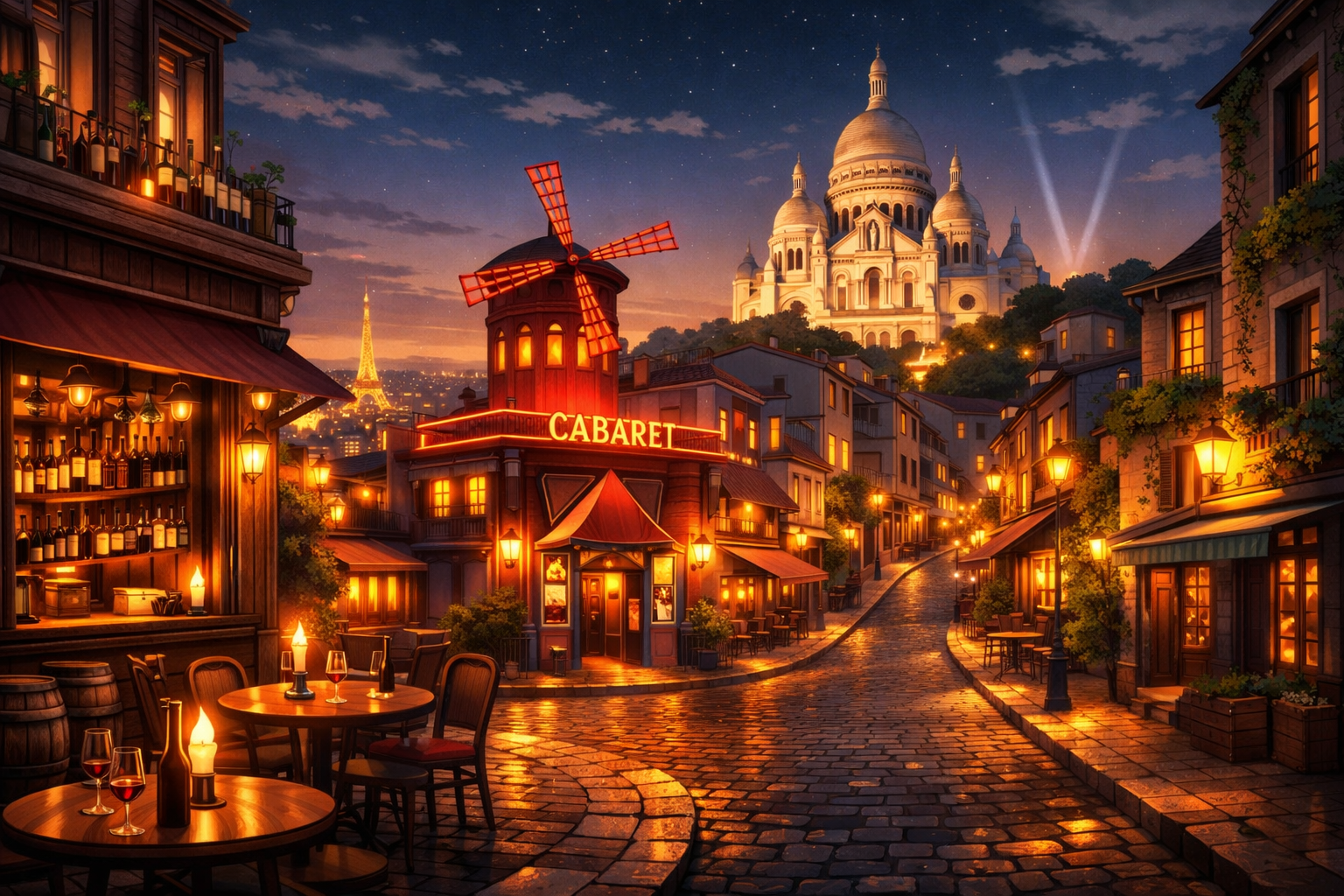
Paris sparkles after dark, from the wine bars and cabarets of Montmartre and Pigalle to chic clubs near the Seine and the Champs-Élysées. Expect a night of timeless glamour, lively streets, and that unmistakable Parisian buzz.

🧭 DAY-BY-DAY ROUTE

Ready-made country and city routes with daily plans, sights, transport and accommodation. Buy PDF guides for independent travel.

🧭 DAY-BY-DAY ROUTE


Day 1 — Paris: Montmartre, the white basilica, and the artistic hill

  • 🚕 After your arrival, plan for a relaxed pace: the trip from the airport to the Montmartre/Pigalle area usually takes about 45–75 minutes depending on the airport, traffic, and transfer method. After check-in, it’s best to allow at least 1–1.5 hours for a shower, rest, and a light snack so the first day doesn’t turn into a marathon.

  • 🚶 Montmartre is not just a tourist hill, but a whole separate world inside Paris: a labyrinth of stairways, old facades, tiny squares, vineyard slopes, studios, and panoramas where the city reveals itself both as a postcard and as a living stage. Here you can feel the Paris of artists, poets, bohemia, and nocturnal stories: in the past, Renoir, Picasso, Modigliani, and Toulouse-Lautrec walked these streets, and today the district still preserves that same blend of romance and light boldness. Start your walk closer to Abbesses or Lamarck-Caulaincourt station so you can climb gradually, without rushing. On the way, peek into quiet streets with houses in cream and gray-blue tones, past old staircases, lanterns, and little cafés that are especially beautiful toward evening.

  • ⛪ The Sacré-Cœur Basilica at the top of the hill is the district’s main visual chord. Its snow-white silhouette seems to glow even in cloudy weather, and the terraces in front of the church offer one of the most powerful city views in Paris: rooftops, boulevards, towers, domes, and the city’s long perspective all the way to the horizon. It’s best to come here close to golden hour, when the daytime noise has already softened and the panorama becomes especially cinematic. After the viewpoint, head down to Place du Tertre — the former heart of village Montmartre, where the spirit of street painting, portrait artists, and lively terraces still survives today.

  • 🍷 It makes sense to end the first evening with a wine bar in South Pigalle or a more intimate stop in Montmartre. The format is ideal after the journey: no heavy program, just the chance to slowly try a glass of Burgundy, Loire, or champagne and simply ease into the city’s rhythm. Allow 2–2.5 hours for dinner and the bar, then return to the hotel on foot or by a short taxi ride. If you want a very gentle start, without clubs or a late night, this is the best scenario.


Day 2 — Paris: Montmartre museums, a wine theme, and a cabaret evening

  • ☕ Start the morning without an early wake-up: after a busy first day, it helps to keep a slow breakfast and head out around 10:00. Today’s route is compact, with short transfers and a good balance between culture and entertainment.

  • 🏛️ Musée de Montmartre is one of the best places to understand why this district became a legend. The museum is located in a historic house on rue Cortot, literally just a few steps from the hill’s most famous views, and tells not only the story of artists, but also of Montmartre itself as a free, slightly audacious, artistic territory. The Renoir gardens are especially lovely: this is a rare Parisian feeling of silence, greenery, and slowing down, when the noisy tourist quarter seems to remain behind a wall, while in front of you there is a peaceful garden, terrace, and a view over the old district.

  • 🎭 During the day, you can walk to Au Lapin Agile — the legendary Montmartre cabaret that has preserved the atmosphere of old artistic Paris. Even if you are not planning a full evening visit here, the very presence of this place in the route matters greatly: it is a living memory of the time when cabarets were not just shows, but centers of poetry, songs, satire, and bohemian freedom. Here Montmartre feels not decorative, but historically real.

  • 🍷 For early evening, it’s a good idea to choose a wine bar with a gastronomic focus — for example, in the 9th or 2nd arrondissement. Many addresses from Pigalle are about 15–25 minutes away by metro with one transfer, or 20–30 minutes by taxi in moderate traffic. Set aside 1.5–2 hours for an aperitif and a small-plates dinner: this works well before cabaret because it doesn’t overload the evening.

  • 💃 The day’s main highlight is a classic cabaret. For the most complete impression, choose Moulin Rouge at the foot of Montmartre: the district, the history, the red windmill, the theatrical sparkle, and the feeling of that very Belle Époque Paris come together here especially naturally. If you want a more glamorous, sensual, and contemporary production, you can choose Crazy Horse. Allow about 3–4 hours for the show itself including the trip and entry. After it ends, the easiest way back is by taxi, especially if you are staying in Pigalle, Opéra, or near Montmartre.

Day 3 — Paris: the Left Bank, museum Paris, and a jazz-and-wine evening

  • 🚇 Today is a day for the larger Paris beyond the hill. From Montmartre and Pigalle, it is usually convenient to get to the Musée d'Orsay area by metro in about 25–35 minutes with one transfer, or by taxi in 20–35 minutes depending on traffic.

  • 🖼️ Musée d'Orsay is one of the most beautiful museum experiences in Paris because the museum itself is already part of the impression: a former railway station with a huge nave, clocks, metal, light, and the feeling of the early 20th century is perfectly suited to meeting the Impressionists and Post-Impressionists. Here it is especially easy to sense the bridge between “artistic” Montmartre and great European art: after the hill’s street bohemia, you find yourself among Monet, Degas, Renoir, Van Gogh, and Toulouse-Lautrec, and that means the route begins to come together not only as entertainment, but also as the story of an era.

  • 🌉 After the museum, take a long walk along the Seine embankments toward Saint-Germain-des-Prés or the Latin Quarter. This is a good day for beautiful, unhurried Paris: bridges, bookstalls, facades along the water, reflections in the river, and the transition from museum concentration to a relaxed urban rhythm. Leave at least 2.5–3 hours for lunch and the walk, without trying to fit in too many stops.

  • 🍷 In the evening, it makes sense to choose a wine bar with a different character — not Montmartre-style, but more gastronomic, urban, and mature in mood. A good format is a bar with a strong wine list and small dishes, where you can spend 1.5–2 hours without rushing. This kind of evening works especially well after the museum: art and riverbanks by day, then conversation, wine, soft light, and Parisian midnight elegance by night.

  • 🎷 If you still have energy, a beautiful continuation is live music or a dancing jazz club, for example in the Saint-Michel area. This is not a heavy club scenario, but rather an atmospheric nocturnal ending: music, the vaults of old Paris, intimate closeness, and the feeling that the city lives not only through its facades but also through its underground pulse. For the late part of the evening, 1.5–2 hours is enough.

Day 4 — Paris: romantic districts, Champs-Élysées, and a club night

  • 🌿 After two busy evenings, it’s worth having a gentler morning. The Nouvelle Athènes area and the Musée de la Vie romantique are a great fit — elegant, intimate, and very Parisian in tone. This museum does not overwhelm with scale, but beautifully conveys the atmosphere of the 19th century: salons, literary associations, a garden, a mansion, calm. If you want a refined pause between cabaret and a club night, this is almost an ideal stop.

  • 🚶 Then you can move on to more ceremonial Paris: Opéra, the grands boulevards, shop windows, arcades, then a transfer to the Champs-Élysées. It is convenient to travel between these zones by metro in 15–25 minutes or by taxi in 15–30 minutes. Today it is better not to overload the day with museums, but to focus on the city’s beautiful flow: a little architecture, a little shopping, a long walk, and an early dinner.

  • ✨ An evening on the Champs-Élysées and in the 8th arrondissement is already a different Paris: not bohemian and not village-like, but glossy, theatrical, and expensive in feel. A scenario with dinner, a glass of champagne or wine, and then a shift into a later format works especially well here. If you want another stage experience instead of a club, you can consider the district’s theatrical-cabaret offerings, but to fulfill the route’s essential entertainment component, it is better to keep tonight for the club scene.

  • 🪩 For a club evening, focus on venues in Pigalle, the Grands Boulevards area, or near Blanche. La Machine du Moulin Rouge is one of the most recognizable options within the logic of this route: symbolically it continues the Montmartre and cabaret theme, but translates it into the language of modern nightlife. Allow 30–45 minutes to get back to the hotel after the club, including taxi waiting time. After midnight, public transport is possible, but for a comfortable end to the night, a taxi is usually better.

Day 5 — Paris: a park, final Montmartre, and a farewell evening

  • 🌳 It’s best to plan the last day with some breathing room. After a club night, don’t schedule an early start: a late breakfast, an unhurried departure around 11:00, and then a green pause — for example, Parc des Buttes-Chaumont. This is one of Paris’s most expressive parks: dramatic, hilly, with bridges, rocks, water, winding paths, and panoramic viewpoints. It contrasts beautifully with the dense urban fabric of the center and gives the body a rest from stairs, bars, and late evenings.

  • 🏙️ During the day, return to Montmartre for a final walk without haste and without an “obligatory program.” Now the district will read differently: not as the postcard of the first day, but as a familiar space whose rhythm, changes in elevation, courtyards, wine stories, and nocturnal stories you already understand. You can walk along rue Lepic, turn into quiet side streets, catch the last views over the city, buy something small as a keepsake, and simply let the route close beautifully where it began.

  • 🍷 Dedicate the farewell evening to one more wine bar — preferably in the format of a beautiful, mature, calm finale. If the previous days included noise, shows, and clubs, then now a place with a strong by-the-glass list, good cheeses, pâtés, small hot dishes, and an unhurried conversational mood is more appropriate. Set aside 2–3 hours for the final dinner.

  • 🚕 If your flight is early the next day, be sure to prepare the logistics in advance that evening: online taxi booking, terminal check, departure time, and packing. For departure to CDG, it is usually wise to allow 60–90 minutes from the center, to Orly about 40–60 minutes, but early morning and rush-hour actual times may differ. It is best to end the last evening in Paris without overload so the trip keeps a taste of lightness rather than fatigue.

Flight tickets

eSIM for travel

Buy PDF guide

Buy PDF guide — 10.71 USD

PDF — 10.71 USD