
Buy PDF guide

Buy PDF guide — 29.99 USD

PDF — 29.99 USD

PARIS

PARIS

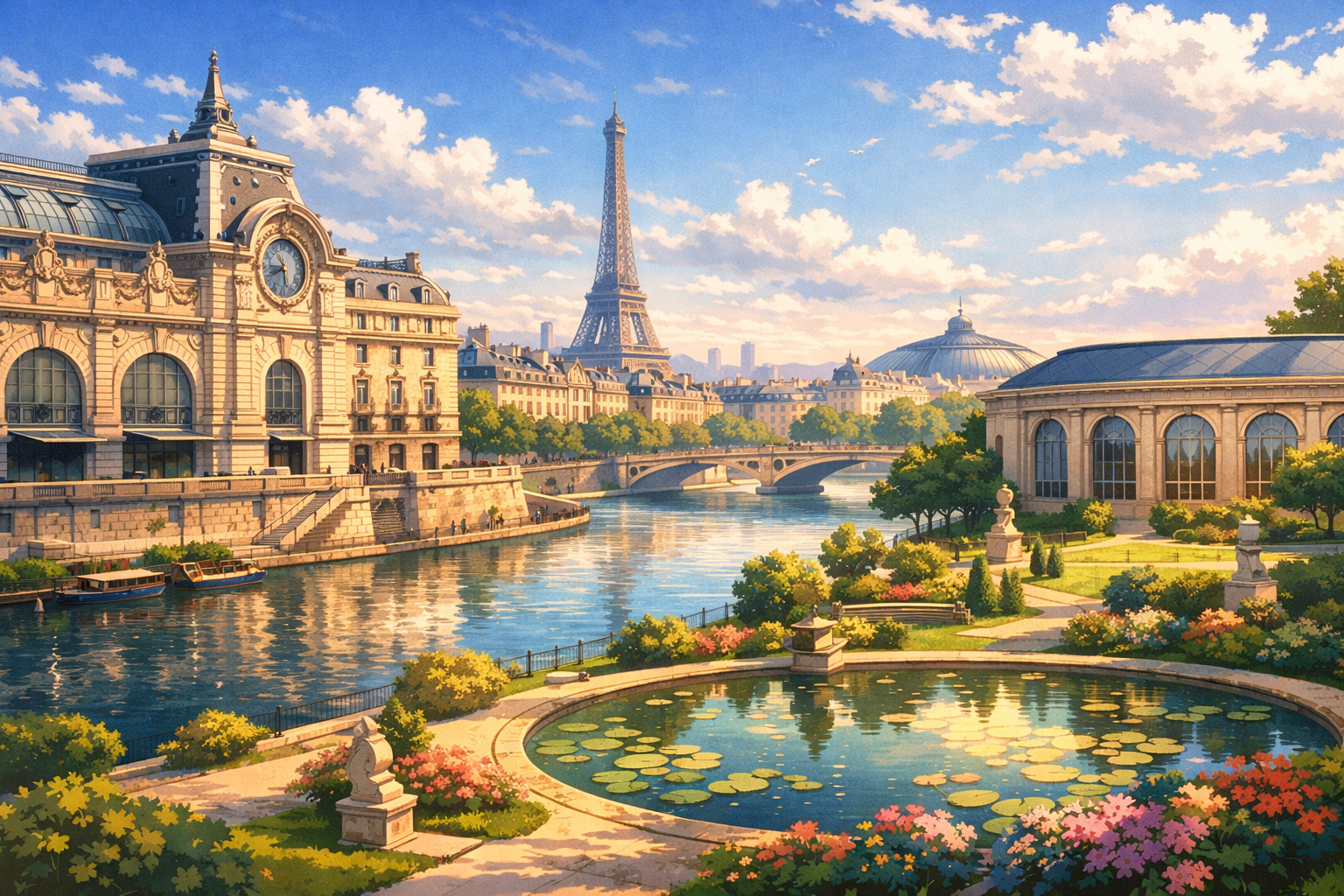
Start in Saint-Germain-des-Prés, where café chatter spills onto cobblestones, then wander through the Tuileries to Concorde and the Louvre’s gleaming pyramid. Lose yourself in the Marais’ courtyards before climbing to Montmartre for golden-hour views over the city.

🧭 DAY-BY-DAY ITINERARY

Ready-made country and city routes with daily plans, sights, transport and accommodation. Buy PDF guides for independent travel.

🧭 DAY-BY-DAY ITINERARY


Day 1 — Meeting the Seine: the Léopold Sédar Senghor Bridge and the Tuileries Garden

  • 🚶 A gentle entry into the city and the route’s theme. Walk from the left bank of the Seine to the right via the pedestrian Passerelle Léopold‑Sédar‑Senghor: the light wooden decking and the bridge’s arc beautifully “stitch” together the Orsay Museum and the Tuileries. On the right bank, turn into the Jardin des Tuileries: avenues, sculptures, the mirror-smooth pools—an ideal way to tune into a slow art rhythm. Pause on a bench with a view of the Obelisk and the facades of Rue de Rivoli: Paris reads best when it allows itself not to rush.


Day 2 — Musée d’Orsay: the rhythm of Impressionism in a former train station

  • 🎟️ Allow 3–4 hours and come in the morning: queues and entry checks take time. Orsay holds collections from the mid-19th to the early 20th century in the space of a former train station with a giant clock window. Head up to the upper galleries: that’s where Monet, Degas, Renoir, Van Gogh, and Gauguin live—light, pastel, and unexpected angles. Pacing tips: 1) don’t try to “see it all”; choose 2–3 themes (Impressionists, Pointillists, sculpture). 2) Give yourself 20–30 minutes at the terrace café—the view of the Seine helps you “gather” your impressions. After the museum, take a short riverside walk toward the National Assembly and into the quiet courtyards of Saint‑Germain.

Day 3 — Musée de l’Orangerie: Monet’s “Water Lilies” and the Walter–Guillaume Collection

  • 🎨 A shift to intimate contemplation. The Orangerie in the Tuileries Garden is two oval rooms with Claude Monet’s panoramic “Nymphéas,” painted as a meditative cycle about light and time. Sit on a bench and look at the water’s surface with an artist’s eye: you’ll notice how the brushstroke’s rhythm changes. On the lower level is the Jeanne Walter and Paul Guillaume collection: Soutine, Modigliani, Matisse, Picasso, Derain—a concise but highly concentrated story of early Modernism. Afterward, a leisurely loop through the Tuileries and a cup of coffee at Place de la Concorde.

Day 4 — The Rodin Museum and sculpture garden

  • 🗿 At Hôtel Biron, elegant architecture argues with bronze and stone. “The Thinker,” “The Kiss,” and “The Gates of Hell” read best outdoors in the open-air garden—the play of shadow and foliage adds volume and quiet. Inside are Rodin’s dialogues with Camille Claudel. Day plan: 1.5–2 hours for the museum + garden, then the boulevards around Les Invalides, where the city sounds calmer. Walk back to the Seine: this stretch is the best “breathing space” between major museums.

Day 5 — The Louvre “without rushing” and the Tuileries in the afternoon

  • 🏛️ It’s easy to get lost in the Louvre—so choose a single “spine” in advance: for example, Italian painting (Giotto → Leonardo) or antiquity (Winged Victory of Samothrace → Venus de Milo). Save energy for a self-directed wandering window at the end—that’s how personal discoveries are made. The finale is in the Tuileries sun: let the museum’s scale settle into a walk, light, and the park’s green rhythm.

Day 6 — Saint-Germain-des-Prés: bookshops, galleries, cafés

  • 📚 Saint‑Germain is a layer of literary memory and intimate galleries. Start at the Abbey of Saint‑Germain‑des‑Prés, walk along the boulevard to small contemporary-art rooms, and pop into bookshops on narrow streets. Grab a bite at a corner café (better without rushing and without the set menu). This day is about “small scale” between museum titans.

Day 7 — The Marais: private art spaces and crafts

  • 🧭 In the Marais, art easily sits alongside craft and fashion: under arcades and in inner courtyards are photographers’ rooms, small galleries, designer workshops. Walk from Place des Vosges to the Picasso Museum (if you want to expand the Modernism thread)—and back to the Seine. The point of the day is to see how Paris works with history and the present at the human scale of a neighborhood.

Day 8 — Montmartre: the hill, studios, lines of city light

  • ⛰️ Don’t go up directly: weave through the streets to Sacré‑Cœur, stop by the Musée de Montmartre and the Renoir Gardens—this is where the Impressionists’ view of everyday life was born. Place du Tertre—take it in a short arc and without obligations: what matters more is the morning or pre-evening light on the rooftops. Descend to the boulevards and the metro: it’s a full day—give your legs a rest.

Day 9 — Musée du Quai Branly — Jacques Chirac and a walk along the Seine

  • 🌿 Jean Nouvel’s architecture and collections from the cultures of Africa, Oceania, Asia, and the Americas offer a different take on the European-art “canon.” It’s a good counterpoint to Orsay and the Orangerie. Afterward, head out to the Eiffel Tower and walk east along the water: Pont Alexandre III, the views of Les Invalides—a rare day when city and museum sound as one line.

Day 10 — Versailles: a day of light, axes, and mirrors

  • 🚆 Leave in the morning: take the RER C to Versailles‑Château‑Rive‑Gauche station (allow extra time for the trip and boarding). In the palace, don’t chase everything: choose the Hall of Mirrors and one wing, plus part of the park with its avenues. It’s important to leave half an hour of quiet by the water at the end—only then does Versailles’ scale turn into an experience rather than a checklist.

Day 11 — A day “outside the center”: Canal Saint-Martin and street art

  • 🚲 Canal Saint‑Martin is a different Parisian breath: little bridges, reflections, local coffee shops, graffiti, and paste-ups. Grab a light takeaway lunch and settle on the embankment. If you want to add a museum, drop into the city’s art museum (depending on your mood) or return to the Seine for sunset.

Day 12 — Parc des Buttes-Chaumont and photography at the Jeu de Paume

  • 🌳 Morning — in the uneven terrain of Parc des Buttes-Chaumont: bridges, grottoes, panoramas. Afternoon — back to the Tuileries and the Jeu de Paume (photography): compact exhibitions, a good visual “reset” after painting. An unhurried dinner somewhere between Concorde and Madeleine.

Day 13 — Repeat your favorite: a “second lap” through Orsay/Orangerie or the neighborhoods

  • 🔁 Paris opens up through repetition. Go back to the museum that “wouldn’t let you go” — often the second visit is deeper. Or build a personal mix: an hour in a gallery, an hour by the water, an hour in a bookshop. The goal is to finally “tame” the city to fit you.

Day 14 — A finale on the water and a “lap of honor” around the center

  • ⛵ Morning — along the Seine: from Orsay to the Tuileries and back via the Senghor Bridge. Afternoon — a favorite square/street; at dusk — a view of Pont Alexandre III or from the embankment by the Louvre. Dinner without rushing. Paris is best said goodbye to not with another “must-see” item, but with your own route, where everything is already familiar and close in its own way.

Flight tickets

eSIM for travel

Buy PDF guide

Buy PDF guide — 29.99 USD

PDF — 29.99 USD