Buy PDF guide

Buy PDF guide — 29.99 USD

PDF — 29.99 USD

PADUA

PADUA

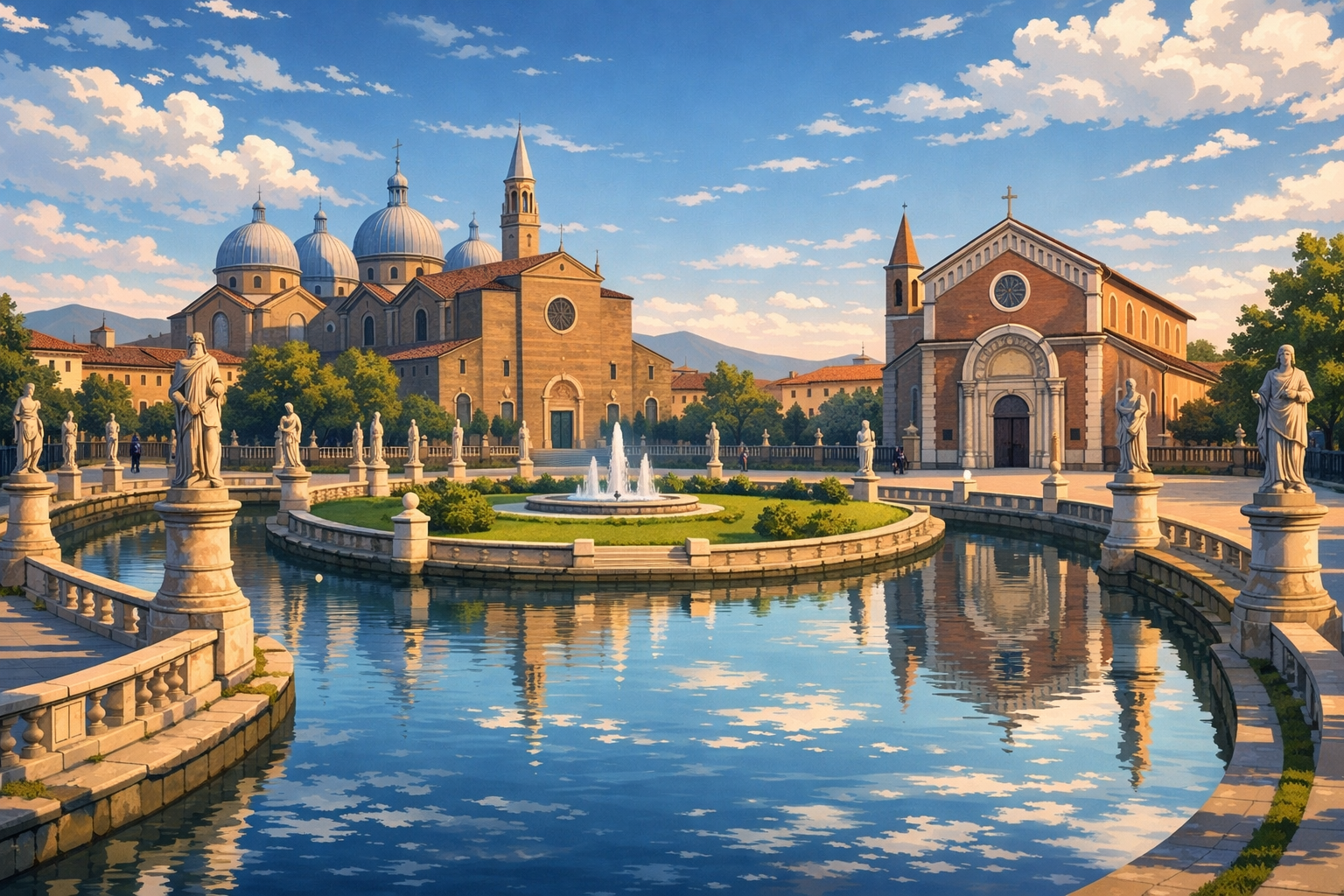
Padua blends grandeur and serenity: stroll the vast Prato della Valle and gaze at Giotto’s luminous frescoes in the Scrovegni Chapel. Follow the footsteps of scholars at the University’s Palazzo Bo and the world’s oldest Botanical Garden, then end in hushed awe at the Basilica of Saint Anthony.

🧭 DAY-BY-DAY ROUTE

Ready-made country and city routes with daily plans, sights, transport and accommodation. Buy PDF guides for independent travel.

🧭 DAY-BY-DAY ROUTE


Day 1 — Northern center: Scrovegni Chapel and Eremitani Museums

  • 🚶 Start with the Scrovegni Chapel (Cappella degli Scrovegni): 15 minutes of silence under Giotto’s starry sky — a concentration of color and emotion where the birth of perspective is literally “audible” in the walls. Pick up tickets at the Musei Civici agli Eremitani ticket office (Piazza Eremitani 8); while you’re there, drop into the archaeological and art collections and the courtyards of the former monastery. Step out into the Giardini dell’Arena: greenery, fragments of the Roman arena, and a view of the chapel’s façade create a contrast between the ancient and the modern city.


Day 2 — The grand ellipse: Prato della Valle and the Basilica of Saint Justina

  • 🚶 Prato della Valle is one of Europe’s largest squares: the green Isola Memmia, an oval canal, and two rings of 78 statues. In the morning, walk the entire perimeter, spotting Padua’s “heroes” (Galileo, Petrarch, Memmo). On the southern side is the Basilica of Saint Justina, with the tomb of Saint Prosdocimus and powerful domes visible from afar. In the evening, return to Prato for sunset — warm stone, water, and the statues’ reflections make the place truly cinematic.

Day 3 — “Il Santo,” the Botanical Garden, and the knowledge quarter

  • 🚶 From Prato it’s a 10-minute walk to the Basilica of Saint Anthony (for Paduans, simply “Il Santo”): inside are chapels with 14th-century frescoes and Donatello’s bronzes. Next is the Orto Botanico di Padova (1545): the world’s oldest university botanical garden in its original location; the historic section with the “Goethe palm” and the modern glass pavilions bring rare collections together into an “atlas of living nature.” End the day in the shady courtyards along Via del Santo and Via San Francesco.

Day 4 — The Pallavicino of knowledge: Palazzo Bo, Caffè Pedrocchi, and the markets

  • 🚶 Palazzo Bo is the university’s historic seat (1222): take a tour of the oldest anatomical theater (1595), the Aula Magna, and the ancient courtyard. Then head to the legendary Caffè Pedrocchi (“the café without doors”) — try the signature mint coffee. After that, the trio of market squares: Piazza delle Erbe, Piazza della Frutta, and Piazza dei Signori, with the enormous hall of Palazzo della Ragione above: astrological frescoes, the “Tree of Justice,” and panoramas from the arcades.

Day 5 — Science and medicine: MUSME and La Specola

  • 🚶 A day for the curious. MUSME — the Museum of the History of Medicine in the former San Francesco Grande hospital is an interactive look at the body, anatomy, and Padua’s and Europe’s discoveries. Toward evening, head to the La Specola observatory tower on the canal: an astronomy museum in a fortress tower — a rare “portal” into the era before Galileo’s telescopes. End the day with a leisurely stroll along the water to Ponte Molino.

Day 6 — Venice “for a day”

  • 🚆 From Padua to Venezia S. Lucia it’s 30–45 minutes by train. The formula is ideal: a morning train, a loop from Santa Lucia to Rialto and San Marco, then less crowded Dorsoduro/San Polo, sunset at the Zattere — and an evening return to Padua. Padua’s advantage: you come back to a calm city where you can have dinner on Piazza dei Signori in the evening without the crush.

Day 7 — Villas and Vicenza

  • 🚆 In the morning, take the train to Vicenza (≈ 15–35 min). Palladian geometry is readable everywhere here — from the Basilica Palladiana on Piazza dei Signori to the Teatro Olimpico. On the way back, you can get off at Grisignano di Zocco or Padova and travel along the Brenta Canal to Villa Pisani (if there’s a river tour or a bus) to collect a sample of the “Venetian countryside empire.”

Day 8 — Euganean Spas: Abano and Montegrotto

  • 🚆 10–15 minutes by train to Terme Euganee–Abano–Montegrotto station — and you’re in Europe’s largest thermal basin. By day: thermal parks and gardens; by evening: a Colli Euganei wine tasting. It’s a “breath” in the middle of the route: warmth, water, and light walks through villas and avenues.

Day 9 — Museums of applied arts and numismatics

  • 🚶 Return to the Eremitani “triangle” — Palazzo Zuckermann with the Museum of Applied Arts and the Bottacin Collection: glass, porcelain, jewelry, and numismatic rooms. Add the Chiesa degli Eremitani — restored fragments of Mantegna in the Ovetari Chapel. In the evening: an aperitivo on Piazza dei Signori.

Day 10 — Medieval walls and canals

  • 🚶 A walk in the footsteps of the Carraresi fortifications: from La Specola to Bastione dell’Arena, along moats and bridges. Padua is a city of water: look for vistas on the bends of the Naviglio Interno, listen to how the city “breathes” between squares and embankments.

Day 11 — Modern Padua and the neighborhoods to the northeast

  • 🚶 Renewed spaces near Padova Fiere, art and street interventions, local coffee shops and bakeries. This is a day of “everyday Italy”: breakfast cornetto + cappuccino, a lunchtime menu del giorno, and an evening with gelato by little islands of greenery.

Day 12 — Verona or Bassano del Grappa (choice)

  • 🚆 Option A: Verona (≈ 45–70 min by train) — the Arena, Piazza delle Erbe, the Adige river embankments. Option B: Bassano del Grappa (≈ 1–1.2 h): the wooden Palladio Bridge, the grappa museum, and an unconventional mountain skyline. In the evening — back to Padua.

Day 13 — Small museums and “optical wonders”

  • 🚶 At Prato della Valle, go up to the Museo del Precinema — Collezione Minici Zotti in Palazzo Angeli: magic lanterns, optical devices, visual tricks from the pre-cinema era. Then — bookshops and a vintage market (if the dates line up), coffee along the avenue overlooking the statues, and an unhurried loop around the lawn.

Day 14 — Finale: favorite views, sunset, and dinner

  • 🚶 Put together “your” Padua: a quick stop in the courtyards of Palazzo Bo, one last look at the frescoes of Palazzo della Ragione, or a return to Giotto (if you booked a second time slot in advance). Sunset — at Prato or by the canal near the Specola; dinner — at Piazza dei Signori. A calm finale without rushing.

Flight tickets

eSIM for travel

Buy PDF guide

Buy PDF guide — 29.99 USD

PDF — 29.99 USD