Buy PDF guide

Buy PDF guide — 25.71 USD

PDF — 25.71 USD

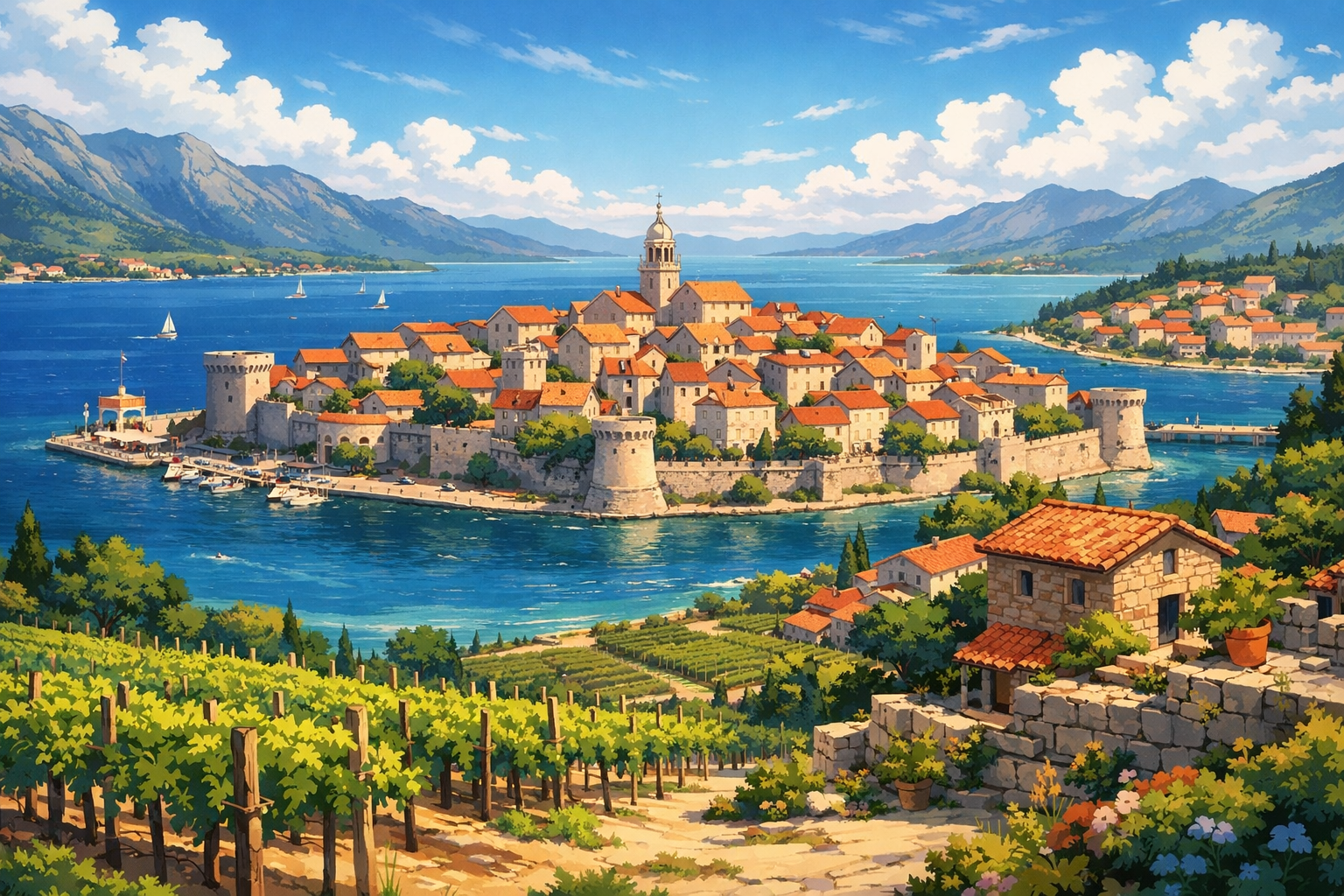
KORČULA — A MEDIEVAL TOWN AND WINE VILLAGES

KORČULA — A MEDIEVAL TOWN AND WINE VILLAGES

Build your perfect journey with curated itineraries that weave icons and hidden gems into smooth, day-by-day routes. From city sprints to scenic road trips, find the pace and path that fit you.

🧭 DAY-BY-DAY ITINERARY

Ready-made country and city routes with daily plans, sights, transport and accommodation. Buy PDF guides for independent travel.

🧭 DAY-BY-DAY ITINERARY


Day 1 — Arrival in Dubrovnik → transfer to Orebić → ferry to the island of Korčula

  • ✈️ Arrive at Dubrovnik Airport (DBV). Outside, the official Platanus shuttle runs to the Gruž bus station (timed to flights). Then take a private transfer/intercity Arriva bus along the scenic Adriatic coastal road and across the Pelješac Bridge to Orebić (≈2–2.5 hours overland depending on traffic). ⛴️ Island crossing: from Orebić, the regular Jadrolinija ferry (Orebić ⇄ Dominče/Korčula line, ≈15–20 min). Check into a hotel in Korčula Town and take an evening stroll along the waterfront: the feeling of a “stone ship” of the old town cutting through the Adriatic light.


Day 2 — Korčula Old Town: the town plan, gates, and walls

  • 🚶 Morning entry through the Land Gate (Veliki Revelin): the city’s former defensive logic is easy to read. Walk the main axial street to the central square, Trg sv. Marka — a rare example of Gothic-and-Renaissance harmony on the Dalmatian coast. Notice the rhythm of narrow “rib” streets, oriented to catch the summer breeze and dampen winter winds; it’s medieval “climatic urbanism,” preserved almost without distortion. Around the perimeter are watchtowers, loggias, and the arsenal: this port town lived at the intersection of trade, shipbuilding, and monastic communities.

Day 3 — St. Mark’s Cathedral and the Town Museum: “stone, light, and relics”

  • 🏛️ St. Mark’s Cathedral is the pinnacle of Dalmatian Gothic-Renaissance: portals with figures of Adam and Eve, a compact basilica composition, and carved stone shimmering in the midday light. Next door is the Abbey Treasury in the former bishop’s palace: silver monstrances, antique textiles, and documents explaining Korčula’s role in ecclesiastical and maritime history. Then head to the Town Museum in the Gabriellis palazzo: from Roman finds and the city statute of 1214 to maritime artifacts — the perfect “second chapter” after the cathedral.

Day 4 — Lumbarda: ancient roots and the indigenous Grk

  • 🚌 A short ride by Arriva bus (≈15–20 min) or taxi to Lumbarda — a winegrowers’ village on sandy soils. Here, among dry-stone walls and seaside vineyards, the rare white variety Grk is born. Tasting at family wineries (e.g., Bire): try Grk and rosé with a lightly salty Mediterranean finish. On the way to the beaches of Pržina and Bili Žal, stop by chapels and stone farmers’ houses: their miniature plasticity is the island’s “small architecture,” no less expressive than palaces.

Day 5 — The wine villages of Čara and Smokvica: Pošip and ethnographic stories

  • 🚗 Along the island’s central axis to the fields of Čara and Smokvica (taxi/driver hire): this is the birthplace of Pošip — sunny, mineral, and food-friendly. Drop into Krajančić’s cellars (Zavalatica) and the Toreta winery in Smokvica with its intimate ethnographic display. In the villages, notice the ceremonial staircases and stone railings of houses from the late 19th to early 20th centuries: a “palatial language” scaled to rural everyday life.

Day 6 — Blato and an everyday-life “house museum” + bay time

  • 🚶 Blato is one of Korčula’s largest villages, stretched along a shady linden avenue. The Barilo ethno-house preserves utensils, textiles, and 19th-century everyday objects — a useful key for reading local stone houses and craft-based layouts. Afterward, a leisurely lunch of seasonal dishes and a swim on the south coast (e.g., Žitna/Prizba): “exploration through rest.”

Day 7 — Vela Luka and Vela Spila: prehistory atop a hill

  • 🚌 Vela Luka (≈50–60 min by Arriva bus): above the town is Vela Spila Cave, one of the Adriatic’s most important Neolithic sites. Hike up the trail or take a taxi: inside are excavations and a powerful natural portal frame where archaeology and landscape merge into a single “hall of time.” In the center is a cultural center with archaeological and ethnographic collections (check opening hours: exhibits are being updated in the building). In the evening, sunset on the promenade and return to Korčula.

Day 8 — Badija Island: a Franciscan monastery and pine alleys

  • ⛵ Local boat-taxi or kayak to Badija Island (10–15 min from Korčula): a late-medieval Franciscan monastery, stone galleries, cells, and the strict geometry of the courtyard. Walk the loop trail along the water, swim in clear lagoons, watch the light on the monastery’s white stone — a great day to see the “island of monks and seafarers” without the bustle.

Day 9 — Žrnovo and the protected natural landscape of Kočje

  • 🥾 The trek from Žrnovo to Kočje is a “stone garden” with mossy grottos, a microclimate, and shady karst openings. It’s an encoded textbook on how landscape shapes settlement: terraces, dry-stone walls, and stone steps are the island’s natural “architectural details.” Afterward — village taverns and an olive oil tasting.

Day 10 — Korčula’s micro-museums and brotherhoods

  • 🚶 Return to the old town’s “intimate” architecture: the churches of St. Michael and All Saints, and the brotherhood halls with icons and processional banners. Look closely at the wooden ceilings and vaults, the marble details of small altars — here you can see the hand of local stonemasons and carvers. In the evening — Moreška (a traditional sword dance; seasonal) as a living urban stage.

Day 11 — Southern bays: Pupnatska Luka and a coastal viewpoint tour

  • 🚗 Trip to the south coast (taxi/transfer): the amphitheater bay of Pupnatska Luka with rocky walls and azure water is one of the best places to “read” the island’s geology. By day — swimming and relaxation; toward evening — viewpoints on the switchbacks up to Pupnat with panoramas of the archipelago. Finale — dinner with Pošip and seafood.

Day 12 — Return (catamaran/ferry) and wrap-up

  • ⛴️/🚍 Return: catamaran to Dubrovnik or Split (seasonal) or a short ferry to Orebić and transfer to Dubrovnik Airport. Close the trip’s “timeline”: prehistory (Vela Spila) → medieval town (Korčula) → monastic islands (Badija) → wine villages (Grk/Pošip).

Flight tickets

eSIM for travel

Buy PDF guide

Buy PDF guide — 25.71 USD

PDF — 25.71 USD