
Buy PDF guide

Buy PDF guide — 25.71 USD

PDF — 25.71 USD

ALBANY • HUDSON

ALBANY • HUDSON

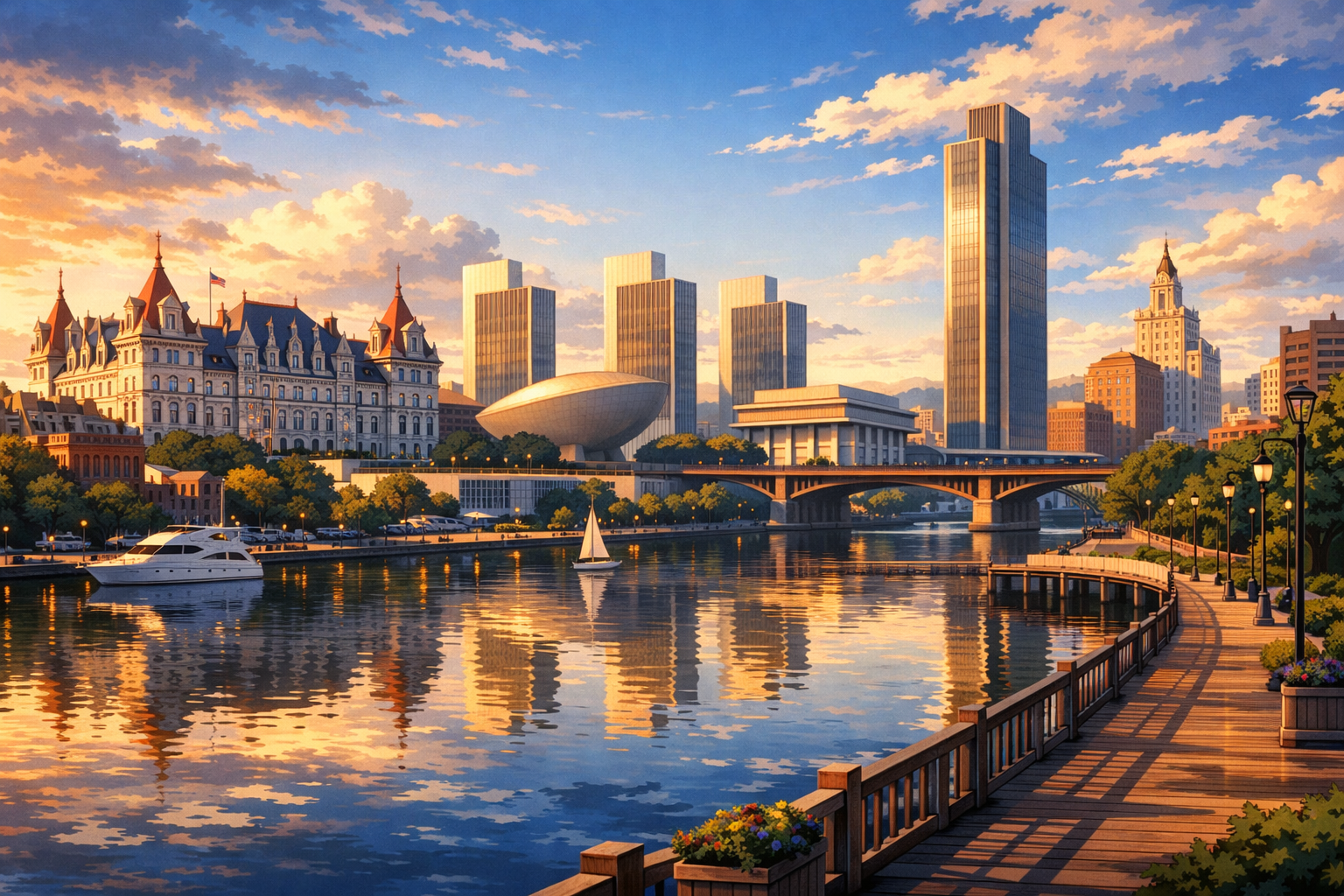
Follow the Hudson on a loop from Albany’s grand Capitol and riverfront to Troy’s brick-and-iron heritage and the rushing confluence at Peebles Island. Drift south to Olana and the Thomas Cole House, then arc north through Saratoga Springs and the Stillwater battlefield before returning to Albany, where history meets the water.

🧭 DAY-BY-DAY ITINERARY

Ready-made country and city routes with daily plans, sights, transport and accommodation. Buy PDF guides for independent travel.

🧭 DAY-BY-DAY ITINERARY


Day 1 — Arrival in Albany + evening reconnaissance of Capitol Hill

  • ✈️/🚆 Fly into Albany International Airport (ALB) or arrive by train at Albany–Rensselaer station (about 15–25 minutes by taxi/rideshare to downtown). Check in and take a short walk along State Street: feel the steep climb up to the Capitol and the “stone theater” of the plaza in front of it.

  • 📸 In the evening — soft light on the façades of the New York State Capitol: a grand late-19th-century stone mass combining Neo-Renaissance and Romanesque character, arcades, rustication, carving — a “textbook” of power and representation in stone.


Day 2 — New York State Capitol + the underground Concourse connector

  • 🚶 Tour the Capitol interior: ceremonial staircases, mosaics, stained glass, and carved stone. Try to join a morning tour — fewer people, and the carving details and spatial drama of the halls read better.

  • 🏛️ Go down to the Concourse level of Empire State Plaza: a 20th-century “underground city” linking the Capitol, Corning Tower, and the cultural center. Look closely at the concrete geometry, light wells, and axial vistas — the language of late modernism designed as a unified government ensemble.

Day 3 — Empire State Plaza, Corning Tower, and the New York State Museum

  • 🌁 Views from Corning Tower (observation deck) over the city, the river, and the rolling valley. From above, the Plaza plan’s logic is clear: mirrored pools, the tower’s “chair-back” parallel, and the oval volume of The Egg.

  • 🏺 New York State Museum (222 Madison Ave) in the Cultural Education Center building: archaeology, natural history collections, and exhibits on state history. A key “context point” so you can later read Albany’s houses as fragments of a larger story.

Day 4 — Hudson River waterfront: Corning Preserve, the Hudson River Way pedestrian bridge, and a cruise

  • 🚶 Walk down to the water via Hudson River Way from downtown to Corning Preserve/Jennings Landing: the arched spans of the pedestrian bridge “stitch” the city to the river, and stairway angles open up industrial panoramas of the port and highway viaducts. Along the waterfront: running and bike paths.

  • 🛥️ Evening river cruise with Dutch Apple Cruises (departure near the intersection of Broadway and Quay St): the best way to read the city’s “river façade,” bridges, and silhouettes in sunset light. Plan 1.5–2 hours for boarding/cruise/return.

Day 5 — USS SLATER DE-766 and 20th-century “naval archaeology” + Albany Institute of History & Art

  • ⚓ Museum ship USS SLATER on Quay St: narrow gangways, engine room, gun decks — a rare preserved destroyer escort that makes the logic of naval architecture and crew life “tangible.”

  • 🖼️ After lunch — Albany Institute of History & Art (125 Washington Ave): Dutch and Federal Hudson Valley heritage, Hudson River School painting, house models, maps. A great “rebuild” of the visual vocabulary before visiting 18th–19th-century homes.

Day 6 — Albany homes and estates: Schuyler Mansion and Historic Cherry Hill

  • 🏠 Schuyler Mansion (up the hill from downtown): a brick volume with strict Colonial-era proportions, suites of formal rooms, and stories of General Philip Schuyler’s family — the Revolution era comes alive in the interiors.

  • 🌳 Historic Cherry Hill (523 1/2 S Pearl St): a 1787 estate with a rare complex of “family memory” — letters, household items, photos. Outside: a great view of the house in the landscape; inside: subtle “archaeology of everyday life.”

Day 7 — Churches and downtown accents: First Church in Albany, Cathedral of the Immaculate Conception, St. Peter’s

  • ⛪ A route through sacred architecture: First Church in Albany (Reformed) on N Pearl St — a trace of the city’s Dutch roots; the neo-Gothic St. Peter’s Episcopal on State St; the monumental brick Cathedral of the Immaculate Conception (125 Eagle St). Look at plans, spires, masonry, and stained-glass light scenarios.

  • ☕ Finale — Lark Street or Pearl St: historic streetscapes and cafés help “assemble” impressions of the downtown materials and scale.

Day 8 — Troy: a 19th-century brick cluster and the Hart Cluett Museum

  • 🚆/🚗 Travel to Troy (≈20–30 min by car from Albany; by public transit CDTA 15/22/85 depending on your start point). Walk the Central Troy Historic District: carpet-like brickwork, cast-iron façades, cobbled streets, and a sequence of squares.

  • 🏛️ Hart Cluett Museum (57 Second St) and the Hart‑Cluett House tour: the marble “Marble House,” Gilded Age interiors, and local stories of industrialist families — an excellent “memory storage” of Troy.

Day 9 — Cohoes and the Mohawk confluence: Peebles Island State Park and Matton Shipyard

  • 🌊 Peebles Island (Cohoes, ≈25 min from Albany): looping trails above the confluence of the Hudson and Mohawk, views of mill buildings, dams, and islands. A natural “balcony” for reading the industrial-era landscape.

  • 🛠️ Historic Matton Shipyard (on Van Schaick Island): a set of workshops and slipways from the early 20th century — “architecture of labor” on the water; today a site under restoration and interpretation.

Day 10 — Hudson and Catskill: Frederic E. Church’s Olana and the Thomas Cole House

  • 🏛️ Olana State Historic Site (Hudson, ≈55–65 min by car from Albany; Amtrak to Hudson ≈25–40 min + taxi): painter Frederic Church’s home-studio — exotic façades, river panorama, and a “theater of the view” as part of the architecture.

  • 🖌️ Thomas Cole National Historic Site (Catskill, across the Hudson): the home and studio of the founder of the Hudson River School. Compare the artist’s view of the landscape with the real topography — a rare chance to “see like an artist.”

Day 11 — Saratoga Springs/Stillwater: the battlefield and resort classics

  • 🪖 Saratoga National Historical Park (Stillwater, ≈45–60 min by car from Albany): a loop through the key points of the 1777 battles. Terrain, defense lines, positions — an “open textbook” of military topography.

  • 🏛️ Congress Park and Canfield Casino (Saratoga): Neo-Renaissance motifs and late-19th-century resort planning. A dusk stroll is ideal for reading volumes and axes.

Day 12 — Final day in Albany: revisit favorite viewpoints and fly out

  • ☕ Morning — revisit the key spots (Capitol, Plaza, waterfront) in different light. At noon — a museum/gallery of your choice or quick shopping downtown.

  • 🚖 Transfer to ALB (≈20–30 min to the airport, traffic permitting). If leaving by train, allow 15–20 min to get to Albany–Rensselaer plus extra time for boarding.

Flight tickets

eSIM for travel

Buy PDF guide

Buy PDF guide — 25.71 USD

PDF — 25.71 USD