
Buy PDF guide

Buy PDF guide — 29.99 USD

PDF — 29.99 USD

New Zealand

New Zealand

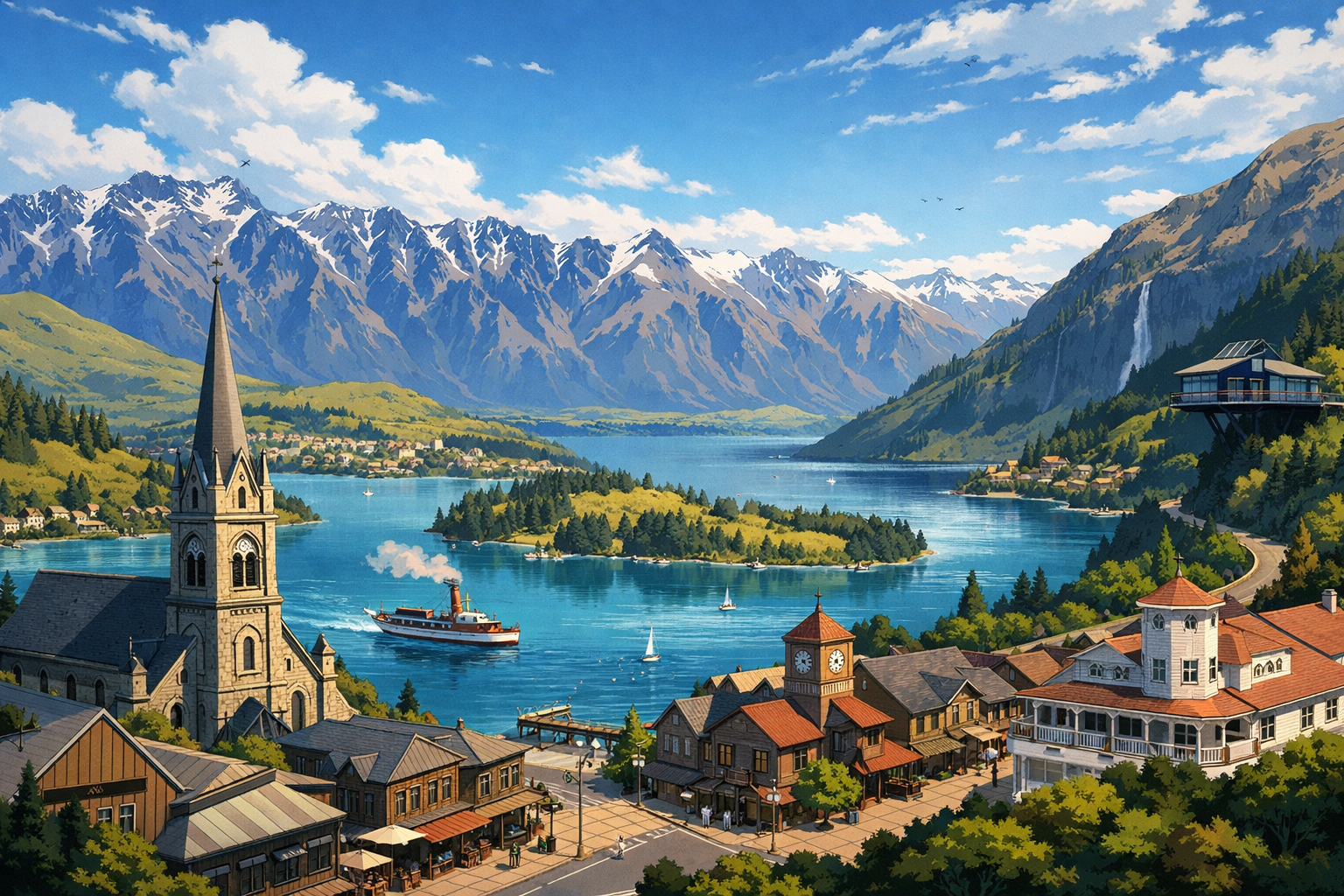
From Auckland’s harbours to Rotorua’s steaming valleys and Taupo’s vast blue lake, New Zealand feels wild, fresh, and endlessly cinematic. Finish in Wellington’s creative buzz and Queenstown’s alpine drama for a journey packed with nature, culture, and adventure.

🧭 DAY-BY-DAY ITINERARY

Ready-made country and city routes with daily plans, sights, transport and accommodation. Buy PDF guides for independent travel.

🧭 DAY-BY-DAY ITINERARY


Day 1 — Auckland: Viaduct Harbour waterfront, Sky Tower, and the city center

  • 🚶 Auckland is New Zealand’s largest city and one of the most beautiful gateways into the country, where urban life meets the sea at almost every step. The best first day here is not about chasing checklists, but about gently settling into the city’s rhythm through Viaduct Harbour, the central waterfront, and a climb up the Sky Tower. This part of the city captures Auckland’s identity especially well: it is not a heavy megacity, but a bright, maritime, wind-swept city with yacht masts, glass façades, restaurants on the water, and the constant sense that the horizon is always nearby. The Sky Tower dominates the center and serves as the perfect landmark: from above, you can see harbors, volcanic cones, the business district, and suburban neighborhoods scattered along the bays. Down below, though, the city feels completely different—lively, relaxed, and very walkable. After a long flight, this route works well because it does not require rushing: you can stroll calmly along the water, have a coffee, sit by the marina, and in the evening catch the sunset around Federal Street or by the harbor, when the lights of the tower and the port piers create that first true wow effect of New Zealand.


Day 2 — Auckland: Auckland Art Gallery, Albert Park, and the area around Queen Street

  • 🚶 The second day in Auckland is perfect for the city’s more cultural and intimate side. Auckland Art Gallery Toi o Tāmaki is the country’s main art institution, where it is especially enjoyable not only to view the collections, but also to experience the architecture of the building itself: the historic wing and the bright contemporary extension are joined into a very elegant space full of wood, air, and soft light. After the waterfront and panoramic views of the first day, this place helps you feel the country differently—through art, colonial history, Māori motifs, and the contemporary visual culture of Aotearoa. Very close by is Albert Park, a hilly urban park with shady paths, flower beds, and beautiful views of university buildings and the city center. The area around Queen Street, High Street, and Vulcan Lane is ideal for an unhurried walk, picking up small travel essentials, and adjusting to the time zone. This is one of those days when the route is intentionally not overloaded: after the museum, you can have an early dinner, return to the hotel without complicated logistics, and save your energy for the more intense journey deeper into the North Island.

Day 3 — Auckland: Waiheke Island as a seaside breather

  • 🚢 Transfer: Auckland → Waiheke Island by ferry from Downtown Auckland Ferry Terminal: usually about 35–45 minutes one way, with a return in the evening via the same route.

  • 🚶 Waiheke Island is the perfect way to see just how diverse New Zealand can be in the very first days of a trip. Just a short ride across the bay—and the noise of the city center gives way to vineyards, coves, green hills, and an almost Mediterranean mood. The island is famous for its beaches, art studios, local wineries, and overall feeling of a slow, beautiful life. Even if you do not plan a complicated route across the whole island, the ferry ride itself is already a pleasure: on the way, views open up over the Hauraki Gulf, the outline of the city, and the island hills. Once there, it is best to choose one or two spots without overloading the day: for example, a walk around Oneroa, some viewpoints, the beach, and a long lunch. This is not a day for heroics, but for letting the trip breathe: let your body recover and your mind fully switch into travel mode. Returning to Auckland in the evening makes sense to end with an early night, because the road-trip part of the tour begins next.

Day 4 — Transfer Auckland → Matamata → Rotorua: Hobbiton as cinema and landscape

  • 🚗 Transfer: Auckland → Hobbiton Movie Set in Matamata usually takes about 2 hr 15 min–2 hr 30 min by car; after the visit, the drive Hobbiton → Rotorua is another roughly 1 hr–1 hr 15 min. It is best to plan the day without extra stops, apart from a coffee break and lunch.

  • 🚶 Hobbiton Movie Set is one of those places that works even for people who are not fans of The Lord of the Rings or The Hobbit. In reality, it is not just a film set, but a surprisingly complete world built into the soft green landscapes of the Waikato region. The hills here look as if they were truly invented for a fairy tale: rounded pastures, sheep, neat paths, ponds, and the famous hobbit doors that seem to grow right out of the grass. The main effect of Hobbiton is in its scale and details: at first it feels like simply beautiful scenery, but as you walk, the place starts to feel like a real settlement with its own character, everyday life, and logic. A daytime tour fits well into a transfer day because it provides an emotional highlight in the middle of the road. After it, the drive to Rotorua already feels like entering another New Zealand—not cinematic, but geothermal, Māori, and more primordial.

Day 5 — Rotorua: Te Puia and living geothermal activity

  • 🚶 Rotorua is a city impossible to confuse with any other place in the country: here the earth itself breathes, steams, bubbles, and smells of sulfur, reminding you that beneath the beautiful lakes and forests lies powerful volcanic energy. The best introduction to this side of the region is Te Puia, where geothermal landscapes, Māori culture, and craft traditions come together. The place feels at once like a natural park and a cultural center: here you can see steaming fields, hot springs, mud pools, and the famous Pōhutu Geyser, and nearby—wood carving, weaving, and the history of the Te Arawa people. The strongest impression of Te Puia is the sense of a living earth: not decorative, not museum-like, but real, noisy, and hot. Steam, mineral smells, wet paths, pale deposits, and unexpected bursts of water make the walk highly physical and memorable. After Auckland and the rural hills of Matamata, Rotorua feels almost alien—and that is exactly what makes it so captivating.

Day 6 — Rotorua: Whakarewarewa Village and the Redwoods

  • 🚗 Day logistics: between Whakarewarewa and the Redwoods it is usually 10–15 minutes by car or taxi; at a relaxed pace, it is convenient to have a long lunch break and leave time to rest at the hotel before an evening walk.

  • 🚶 Te Whakarewarewa is a rare place where geothermal activity and everyday life have existed side by side for centuries. This is not a stylized village or just a show for tourists, but a living community with deep history, where the traditions of the Te Arawa people are told by people for whom this is their own family memory. Here you especially feel that New Zealand’s culture is not abstract, but literally lived: stories about the land, springs, cooking, baths, and the region’s history become part of the walk itself. In the second half of the day, it is both beautifully contrasting and very fitting to head to Redwoods, Whakarewarewa Forest. If in the morning Rotorua shows its hot, steaming, volcanic essence, here its forested, damp, calm, and almost meditative side opens up. Tall Californian redwoods, soft light between the trunks, the smell of pine, and long straight paths create a feeling of total reset. This is a great day for balance: a little culture, a little nature, and no overload of endless kilometers.

Day 7 — Rotorua → Taupo: Huka Falls and an evening by the lake

  • 🚗 Transfer: Rotorua → Taupo usually takes about 1 hr–1 hr 15 min by car. From central Taupo to Huka Falls, it is about 10 minutes by car. The road part of the day is short, so it is easy to include some rest.

  • 🚶 The drive to Taupo is one of the most comfortable in the entire route: no excessive fatigue, beautiful roads, and the chance to arrive in a new town before lunch. The day’s main natural highlight is Huka Falls, a powerful section of the Waikato River where an enormous volume of water suddenly compresses into a narrow canyon and surges forward with incredible force. Photos rarely convey the real energy of this place: what impresses here is not the height, but the pressure, speed, and almost neon color of the water. It is one of those spots where you do not need to spend very long, yet the emotional impact is strong. After that, it is best not to overload the day and to leave a long evening for Taupo itself—a walk along the lake, dinner with a view of the water, and an early rest. Lake Taupō is enormous and visually feels closer to the sea than to a typical lake: if the weather is kind, the distant horizon and the light on the water create a very calm, spacious mood.

Day 8 — Taupo: Craters of the Moon and a measured pause in the route

  • 🚶 Craters of the Moon is an excellent spot for a day when you consciously need not to rush. It is a geothermal area near Taupo where wooden boardwalks and trails take you among steaming craters, fumaroles, mineralized ground, and a light constant hissing rising from below. Unlike the larger-scale complexes of Rotorua, this place feels more intimate and almost minimalist: fewer cultural layers, more of the sense that you are simply looking at the surface of a planet still being formed. A day like this matters for the overall rhythm of a 14-day trip: not every journey should be built on the principle of “maximum impressions in minimum time.” Here it is better to do a half-day walk, have lunch without hurry, perhaps stop by the lake or a viewpoint, and leave the second half of the day for recovery before the long drive south. Taupo is one of the best places on the route to exhale.

Day 9 — Transfer Taupo → Wellington: a long road with an early start

  • 🚗 Transfer: Taupo → Wellington usually takes about 5 hr 15 min–6 hr by car without long stops. For a comfortable day, it is worth leaving early, making at least two breaks, and not planning a complicated sightseeing program for the evening.

  • 🚶 This day is entirely governed by the logic of the road, and that is exactly why it is better not to disguise it as a “full sightseeing day.” The route from Taupo to Wellington crosses much of the lower North Island and shows well how varied New Zealand’s landscapes are: rolling pastures, rural valleys, changing light, scattered towns, and an increasingly distinct sense of approaching the capital. Wellington feels different from Auckland: it is more compact, hillier, windier, and at first glance seems more European in scale. After a long drive, the best strategy is not to try to “collect more impressions,” but to limit yourself to an evening walk along the waterfront, a light dinner, and an early return to the hotel. This gentle pace matters: the capital will open up much better the next day if you meet it rested.

Day 10 — Wellington: Te Papa and the waterfront

  • 🚶 Te Papa Tongarewa is one of the best museums of the whole trip and a place that helps bring together many themes of New Zealand: natural history, Māori culture, the colonial past, art, memory of earthquakes, and modern national identity. This is not a museum for rushing through; its strength lies in speaking both intellectually and emotionally at the same time. Here you can move from giant natural-history displays to deep cultural stories, from national memory to contemporary art, and all of it feels not like a set of unrelated halls, but like a coherent story about the country. After the museum, it is ideal to continue the day with a walk along Wellington’s waterfront. The promenade here is very lively: cafés, sculptures, wind from the harbor, runners, street life, and the feeling of a capital-city pace without tension. The day ends up rich in content but physically comfortable—exactly what you need after the previous transfer.

Day 11 — Wellington: Wētā Workshop and Zealandia

  • 🚗 Day logistics: central Wellington → Wētā Workshop in Miramar takes about 20 minutes by car; then to Zealandia from the central part of the city is usually about 10–15 minutes. If using public transport, allow more time for transfers and waiting.

  • 🚶 This day shows two very different but equally important sides of Wellington. First—Wētā Workshop, the legendary space where cinematic worlds become tangible through props, special effects, models, costumes, and production stories. Even if you are not a devoted fan of film franchises, the tour works as an immersion into craft and imagination: suddenly you understand how much engineering, drawing, sculpting, metal, paint, and handwork stand behind a few minutes of screen magic. Then—a sharp but beautiful contrast in Zealandia, the urban eco-project that has become a symbol of New Zealand’s care for wildlife. This is a completely different kind of magic: silence, water, forest, birds, rare endemics, and the feeling that right next to the city a fragment of almost pre-human New Zealand has been restored. In one day, fictional creatures and real rare birds stand side by side—a combination that feels very Wellington and very successful.

Day 12 — Wellington → Queenstown: flight and a gentle adjustment to the South Island

  • ✈️ Transfer: the Wellington → Queenstown flight usually takes about 1 hr 25 min–1 hr 40 min in the air, but with the trip to the airport, check-in, baggage drop, and collecting a car/transfer, it is sensible to allow half a day. On domestic flights, online check-in usually opens 24 hours in advance, and baggage drop closes 30 minutes before departure.

  • 🚶 Queenstown is best understood not as a city, but as a stage onto which the journey steps in its final act. Even the landing approach often makes a powerful impression: the mountains rise close, the lake appears almost suddenly, and it becomes clear that the South Island will feel different—larger, more dramatic, more alpine. On the day of arrival, it is best not to build a dense schedule. The optimal choice is to get to the hotel calmly, walk along the Lake Wakatipu waterfront, have a coffee or wine with a view of the water, and simply allow yourself to look. Queenstown has a highly cinematic beauty: the light changes literally every half hour, the peaks clear and then disappear into cloud, and the lake itself reflects it all like a giant mirror. This day is needed precisely for adaptation and enjoyment without a race.

Day 13 — Queenstown: Skyline Gondola and panoramas of Lake Wakatipu

  • 🚶 Skyline Gondola is one of the simplest and at the same time most rewarding spots in Queenstown. The ride up is short in itself, but dramatic: the town quickly remains below, the line of the water opens out, and the mountains begin to feel not like a backdrop, but like the main characters. At the top, the classic Queenstown panorama opens up—the one people come here for: Lake Wakatipu, long dark-blue inlets, an amphitheater of mountains, and the toy-like town at their foot. In clear weather, you just want to stand there in silence because the space feels too vast for ordinary urban experience. It is easy to build the day around this point without fuss: go up outside peak time, leave time for the views, then descend and walk through the center, the pier, Queenstown Gardens, or along the lake. In the evening it is especially beautiful, when the light turns golden and the mountain slopes start changing shades every minute.

Day 14 — Queenstown: Glenorchy road, farewell to the route, and big views

  • 🚗 Day logistics: the road Queenstown → Glenorchy usually takes about 45–50 minutes one way. The round trip with stops at viewpoints and a walk easily becomes a full but not exhausting day.

  • 🚶 The road from Queenstown to Glenorchy is one of the most beautiful finales for a New Zealand journey. It is not just a transfer between two points, but a full scenic-drive experience where almost every bend reveals a new composition of water, forest, cliffs, and snowy peaks. Lake Wakatipu stretches alongside, light glides over the mountains, and the roadside itself suggests where you will want to stop and simply look. The final day here is best made not eventful, but contemplative. After the busy northern part of the route, the museums, geothermal sites, and transfers, it is exactly these vast, simple landscapes that create the feeling of completion. Glenorchy and its surroundings are known for an almost epic beauty: valleys, rivers, pastures, and mountain walls look as if the country decided at the last moment to show all its most powerful scenery at once. Returning to Queenstown in the evening feels gentle and a little sad—as a good route should end.

Flight tickets

eSIM for travel

Buy PDF guide

Buy PDF guide — 29.99 USD

PDF — 29.99 USD