
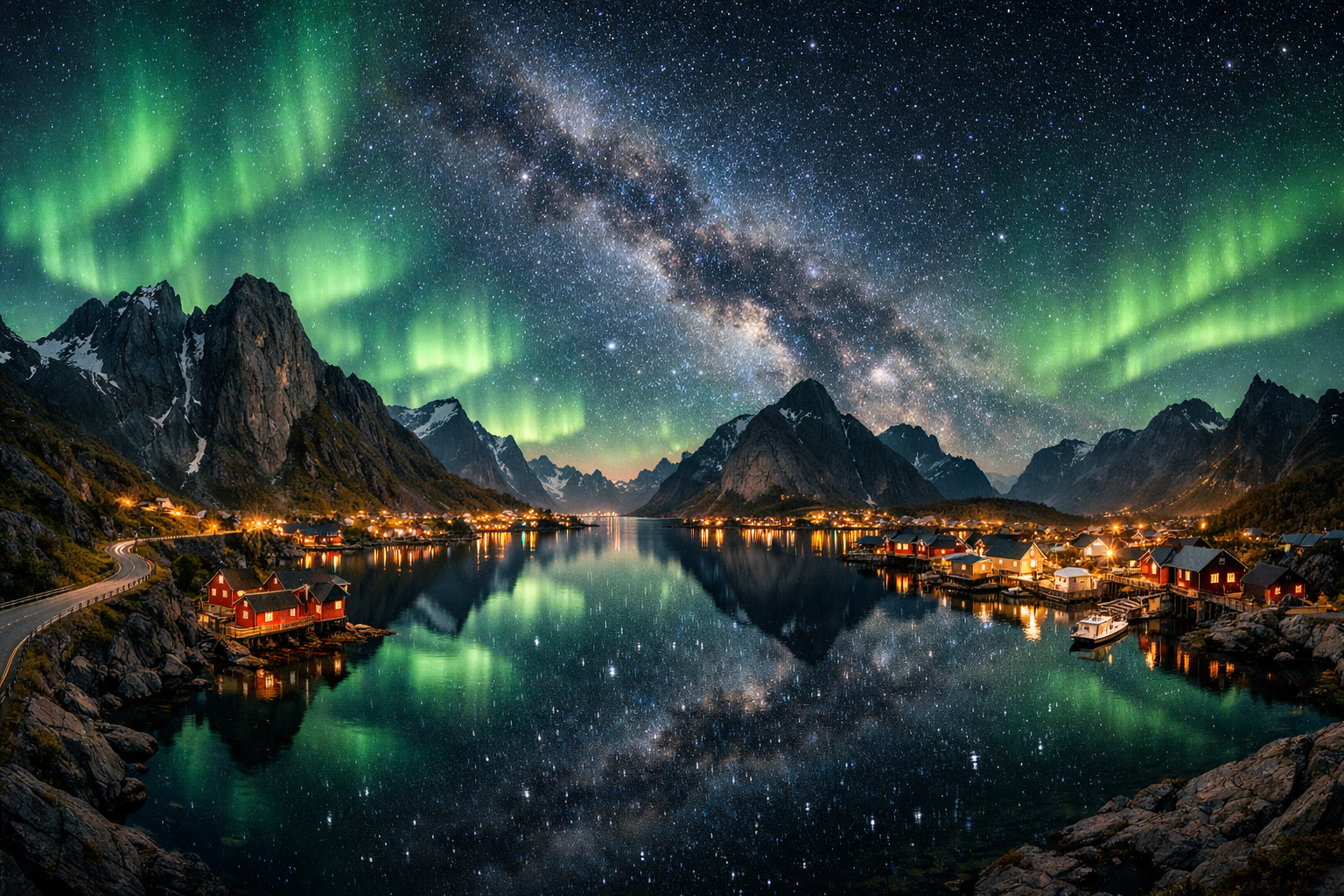
Day 1 — Evenes → Svolvær: entering the Lofotens and the first sky hunt
🚆 Arrival via Harstad/Narvik Airport Evenes. The most realistic start for such a 7-day route is to fly into Evenes and transfer to Svolvær. The Flybussen Lofoten airport bus runs to Svolvær, with a travel time of about 3 hours; with a rental car, the drive usually takes around 2.5–3.5 hours depending on the weather, stops, and the condition of the E10 road. After the flight, don’t plan any demanding activities: the Lofotens reveal themselves best to those who save their energy for the evening window of clear skies.
🌌 Svolvær is a good first base because it is a lively port town with infrastructure, yet already offers quick access to darker spots. After check-in, dedicate the rest of the day to gentle acclimatization: a short walk along the waterfront, an early dinner, then preparation for a night outing. For an astronomy-focused route, the best season here is roughly from late September to March, when the nights are dark enough for the northern lights and the Milky Way above the horizon; the weeks around the new moon are especially convenient, when moonlight interferes less with sky contrast. During the midnight sun and white nights in summer, the starry sky itself loses meaning as a travel goal.
🚗 For the first night session, the surroundings of Svinøya, outer coastal stretches near Kabelvåg, or darker roadside pockets toward Austnesfjorden are suitable, where there is less direct city light and water-filled coves for reflections. The goal of this evening is not to “catch guaranteed aurora,” but to assess the cloud cover, wind, air transparency, and your own readiness for night outings. The northern lights are possible here, but never guaranteed: you need a fortunate combination of clouds, geomagnetic activity, and the local horizon. Even with weak activity, the Lofotens often outperform more continental spots thanks to their dramatic relief and reflections in the water.
⚠️ Night safety is especially important on the first day: after the flight, do not head onto mountain trails, do not park on the narrow shoulders of the E10, and bring a headlamp with a red-light mode, a warm clothing layer, a thermos, a charged phone, and reflective elements. In the Lofotens, the weather changes quickly, and the ocean wind at night feels noticeably colder than the actual temperature. If the sky is overcast, treat this evening as reconnaissance: sometimes the cloud cover only breaks after midnight.