
Buy PDF guide

Buy PDF guide — 8.57 USD

PDF — 8.57 USD

LOWER SAXONY - North Sea Cuxhaven and Wadden Sea

LOWER SAXONY - North Sea Cuxhaven and Wadden Sea

Lower Saxony’s North Sea coast blends fresh sea air, broad sandy beaches, and the untamed beauty of the Wadden Sea. From Cuxhaven to Duhnen and Sahlenburg, it’s a place for long shoreline walks, tidal landscapes, and classic seaside charm.

🧭 DAY-BY-DAY ROUTE

Ready-made country and city routes with daily plans, sights, transport and accommodation. Buy PDF guides for independent travel.

🧭 DAY-BY-DAY ROUTE


Day 1 — Cuxhaven: Alte Liebe, the port, and the historic center

  • 🚆 Transfer: Hamburg → Cuxhaven by regional train RE5 — about 1 hr 40 min to 1 hr 50 min without complicated transfers. This is the most convenient and realistic way to get to the sea: you leave a big city and gradually find yourself in a completely different Germany — flat, windy, slightly salty, with a wide sky and a sense of northern freedom.

  • 🚶 Start your route at the Alte Liebe promenade — the famous viewing platform by the harbor, where it is especially beautiful to watch giant ships sailing along the Elbe toward the North Sea and back. In Cuxhaven, the sea feels not like a resort postcard but like a living element and a working artery: here you hear the wind, rigging creaks, the air smells of salt and wet wood, and the horizon is constantly moving because of the ships. This place works especially well as a first introduction to the region because it immediately shows the character of the coast: harsh, open, real.

  • 🚶 Then take a slow walk toward the old harbor and the center. Along the way, it is nice to linger by the piers, look at the maritime infrastructure, boats, excursion vessels, and the life of the port. After the walk, it is worth planning a lunch and rest break of at least 1–1.5 hours: the northern coast quickly tires you out with the wind, even if the route seems short. In the second half of the day, it is good to move on to Schloss Ritzebüttel — the historical core of the city. This castle, surrounded by greenery, sharply changes the mood of the walk: after the open windy shore, you enter an intimate space of the old administrative and cultural center, where you can feel the layered history of a city connected for centuries both to the sea and to Hamburg.

  • 🚶 In the evening, you can finish the day with a calm walk through the center and an early dinner without overloading yourself with impressions. It is better not to make the first day too packed here: after the transfer and the sea air, your body asks you to slow down. And that is exactly the right rhythm for Cuxhaven — not rushing from point to point, but gradually entering the northern space, where the main attractions are often created not by walls, but by wind, light, water, and a very long horizon line.


Day 2 — Döse and Duhnen: Kugelbake, beach promenade, and sea rhythm

  • 🚌 Getting around the city: from the center of Cuxhaven toward the districts of Döse and Duhnen, it is usually convenient to take a local bus, allowing about 15–25 minutes depending on your starting point and the season. If the weather is good and you want a long walk, part of the route can be done on foot along the coast.

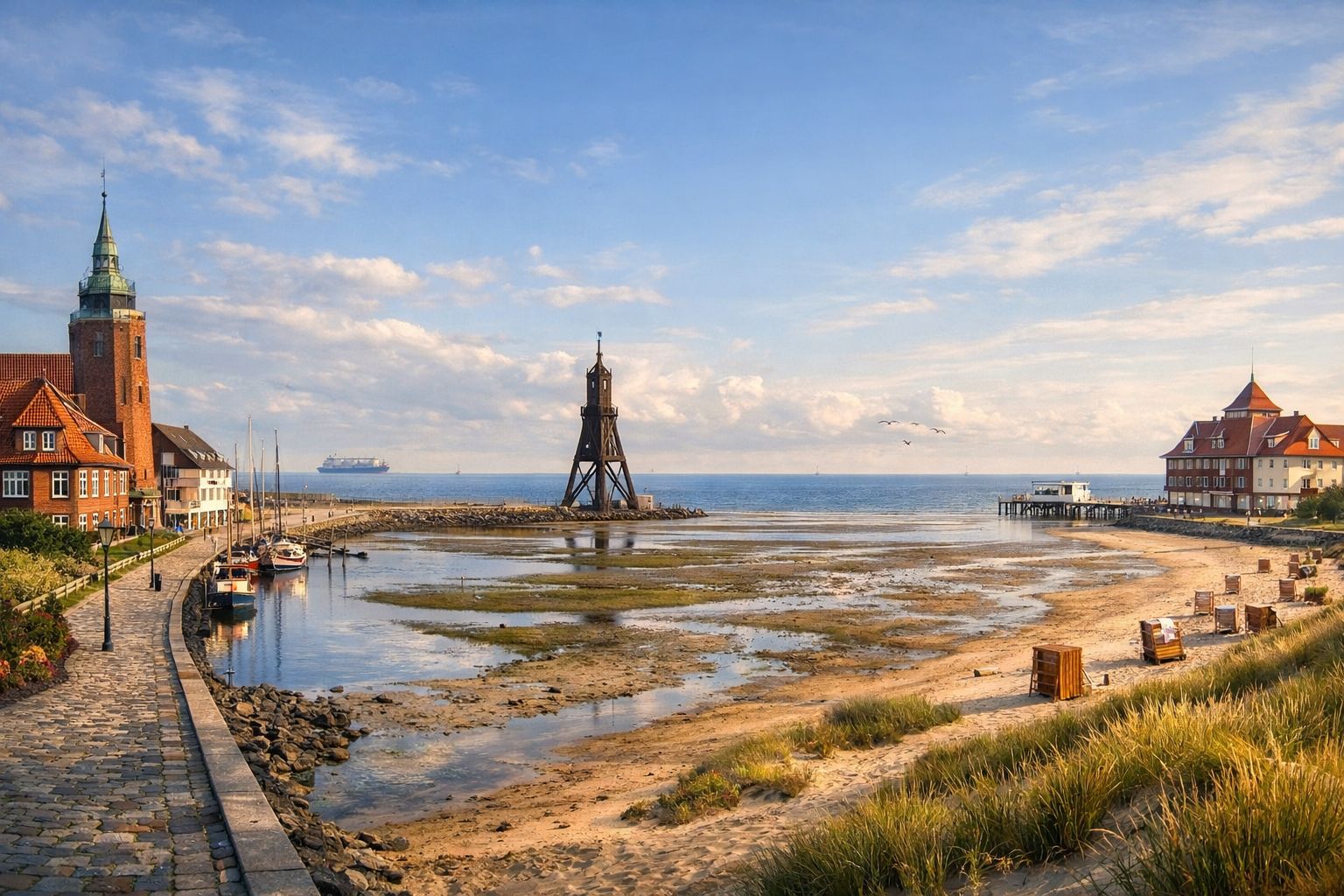
  • 🚶 Dedicate the morning to Kugelbake — the main symbol of Cuxhaven and one of the most recognizable sea marks on the German North Sea. This tall wooden navigation tower stands where the Elbe finally opens into the North Sea, and here the geography of the region is felt especially strongly: you are literally standing at the edge of Lower Saxony, on the threshold of a huge body of water. Kugelbake impresses not with luxury or architectural scale, but with its ultimate northern simplicity. In the wind, among dunes, grasses, and stone fortifications, it seems like a marker of the boundary between river, sea, and time.

  • 🚶 After that, it makes sense to continue the route through the resort part of the coast in Döse and farther toward Duhnen. Here the atmosphere becomes gentler: more walking paths, beach terraces, cafés, family recreation areas, and panoramas where the main feature is the endless bright expanse of low tide. On a clear day, you want to walk very slowly here because the landscape keeps changing: wet sand reflects the sky like a mirror, thin water channels cut through the tidal flats, and the silhouettes of people and riders in the distance look almost unreal.

  • 💤 In the daytime, be sure to plan a full rest for 2–3 hours: either return to the hotel or take a long break in Duhnen by the promenade. A relaxed format works very well for this area — a walk, coffee, sea air, and then a little more walking. In the evening, Duhnen is especially good for a calm end to the day: there is no feeling of a metropolis, but there is a rare sense of an old northern European resort where the main entertainment remains space, light, and unhurried observation of the sea.

Day 3 — Sahlenburg and the Wadden Sea: Besucherzentrum + walk by the Wadden Sea

  • 🚌 Transfer: Duhnen/central Cuxhaven → Sahlenburg district and Wattenmeer-Besucherzentrum — usually about 15–25 minutes by bus, with a little extra time for waiting. It is best to start the morning earlier, especially if you are planning a walk on the tidal flats tied to low tide.

  • 🏛️ First, visit Wattenmeer-Besucherzentrum Cuxhaven — this is a very important stop on the route, because without it the Wadden Sea is easy to underestimate and mistake for just a “flat beach.” In fact, before you is one of Europe’s most unusual natural systems: a world of tides, bird migration, salt marshes, channels, mud, sand, and the constant movement of the boundary between land and water. The exhibition helps you see the depth of this landscape, explains the rhythm of the sea, the life of the seabed, the features of the coast, and why this region is included on the list of World Natural Heritage sites. After the center, the walk along the shore itself is perceived in a completely different way — with understanding and much more intensely.

  • 🚶 The main part of the day is the shore of Sahlenburg and contemplation of the Wadden Sea. At low tide, a gigantic space opens before you that is hard to compare with an ordinary sea coast. Here the sea seems to retreat, leaving behind a shining plain, thin streams, dense wet sand, and a very special silence. This is not emptiness, but a living stage where everything happens slowly: the light changes, clouds move, the wind strengthens, birds appear, and the whole area seems to breathe in the rhythm of the Moon. If you choose an organized walk on the tidal flats, it is best to go with a licensed local guide and not try to go far on your own: the terrain is deceptively simple, but the tide returns quickly and the surface may be uneven.

  • 💤 After the active part, take a long restorative break. The Wadden Sea tires you out more than it seems: lots of wind, open sun, humidity, and long distances across a flat space. In the second half of the day, you can simply stay by the shore, walk through the dunes and coastal paths, or arrange a quiet evening in Sahlenburg. This is one of the most atmospheric days of the route because it gives you not an “attraction,” but a rare natural experience — to feel the sea where it has temporarily disappeared.

Day 4 — Cuxhaven: maritime museums, Ringelnatz, and a calm finale by the sea

  • 🚶 The last day is best devoted to the cultural side of the city without long transfers. Start with the Windstärke 10 museum — one of the best places to understand the true character of Cuxhaven. This is not an abstract “museum about the sea,” but a museum on authentic port grounds, telling about shipwrecks, fishing, harsh work on the water, and the city’s maritime memory. After walks along the coast, such exhibitions are felt especially vividly: you already feel the wind and the scale of the water, so the stories of ships, fisheries, and northern resilience gain volume.

  • 🏛️ Then it is good to continue to Joachim-Ringelnatz-Museum. This museum adds an unexpectedly human and literary dimension to the journey. After the wide sea views, you find yourself in a more intimate space focused on the poet, artist, sailor, and the cultural memory of Cuxhaven. This contrast works perfectly: the North is not reduced only to nature and the port; it also has a subtle, ironic, intellectual side.

  • 🚶 If you still have energy and the mood, you can go back to the sea again or return to a favorite spot from the first days — for example, the promenade at Alte Liebe or the beach line of Duhnen. This is a good way to beautifully close the route: over four days, the coast stops being just a geographical point and becomes a space with its own rhythm. It is better to leave the final hours free, without a dense schedule, so there is time for coffee, a last look at the ships, unhurried packing, and the journey back.

  • 🚆 Return transfer: Cuxhaven → Hamburg on RE5 — again about 1 hr 40 min to 1 hr 50 min. If your flight is on the same day, it is wise to allow a large margin: regional train, then a transfer to Hamburg city transport to the airport, plus time for the airport itself. The most comfortable option is either not to leave at the last minute or to keep the final night in Cuxhaven and depart in the morning.

Flight tickets

eSIM for travel

Buy PDF guide

Buy PDF guide — 8.57 USD

PDF — 8.57 USD