
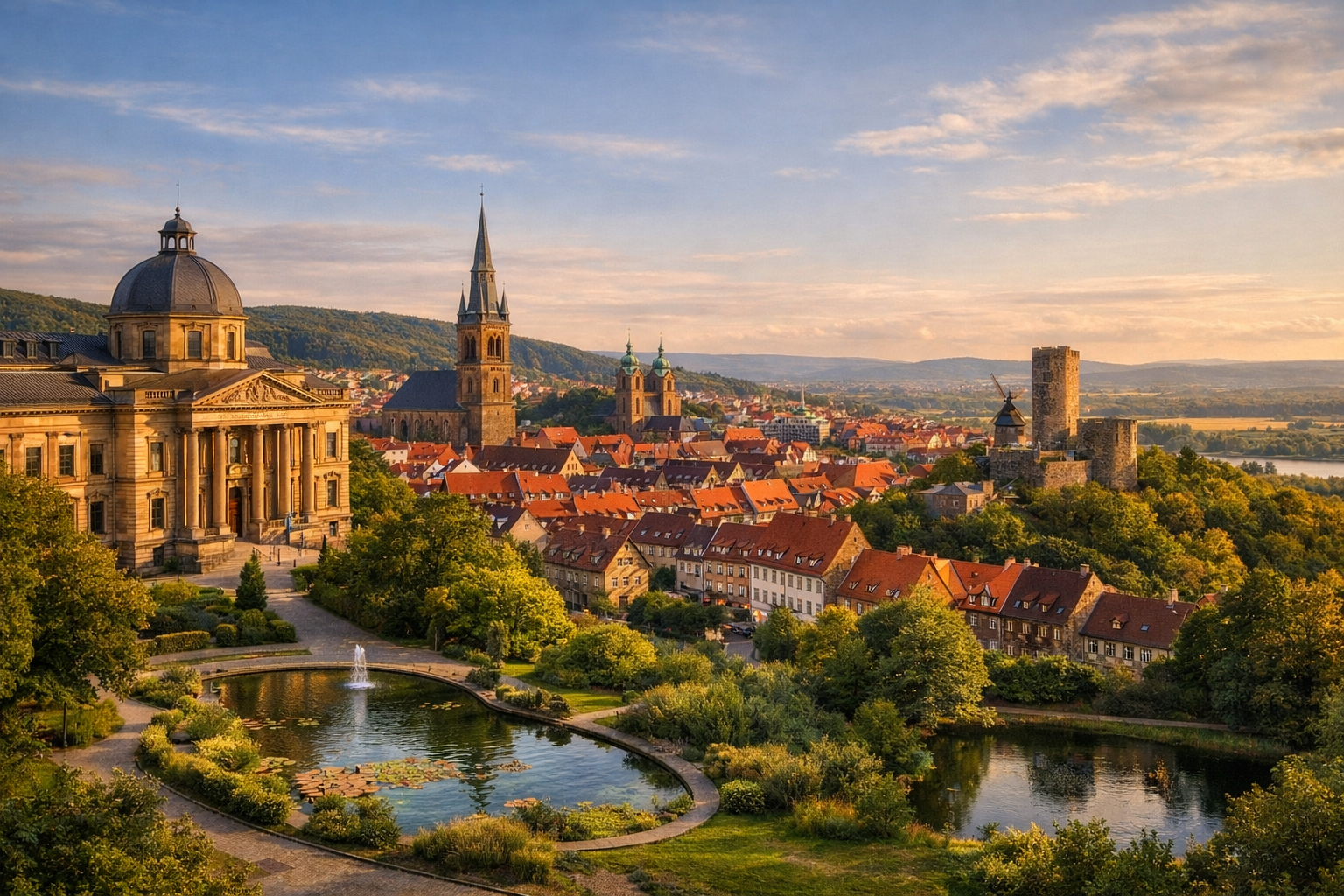
Day 1 — Göttingen: old town, university, and an evening on the rooftop
🚆 It is most convenient to plan your arrival in Göttingen via Hanover: from Hannover Airport, first take the S-Bahn S5 to Hannover Hauptbahnhof, then change to a train to Göttingen. Altogether, the journey usually takes about 1 hr 50 min to 2 hr 15 min depending on the connection, and trains toward Göttingen run frequently, so this route is realistic even for a short two-day trip. From the station to central hotels, Forum Wissen, and the old town, it is usually a 5–15 minute walk or a short city bus ride.
🚶 Start getting to know Göttingen through its historic core — a compact old town that feels made for a thoughtful, unhurried stroll. It does not feel like an “open-air museum” in a sterile sense; on the contrary, the medieval facades, cobbled streets, cafés, students on bicycles, bookshops, and bell towers come together in a living, breathing urban landscape. The central point is Market Square with the Gänseliesel fountain and the Old Town Hall at Markt 9. Göttingen is often called the city of knowledge and kisses, and the bronze girl with geese has long become its most recognizable symbol: newly minted university doctors traditionally come to her. This place sets the tone for the whole trip perfectly: a little history, a little academic legend, and a very recognizable, almost intimate German beauty.
🚶 After the square, walk to Paulinerkirche and the historic university library. Paulinerkirche is not just a beautiful old church volume, but a space closely linked with the early history of the university, whose ceremonial opening took place here. Inside and around this quarter, you feel especially strongly that Göttingen is not just a city with a university, but a city that grew around scholarship. This is a place where you do not want to rush through with a camera, but rather pause, notice the details, recall the names of scholars who worked within these walls, and catch that rare atmosphere in which intellectual history is not separated from everyday life.
🚶 For lunch and a relaxed daytime stop, Forum Wissen at Berliner Straße 28 near the station and the central bus hub is ideal. This is a modern university museum created as a space for dialogue about how knowledge is born. The exhibitions are built around the rich academic collections of the University of Göttingen: scientific objects, instruments, botanical and natural history materials are presented not as dusty relics, but as parts of a larger story of observation, experiment, and discovery. For a short trip, this is almost an ideal location: it gives context to the entire city and helps you see Göttingen not only as a cozy old center, but also as the intellectual capital of southern Lower Saxony.
🚶 In the second half of the day, head to Alter Botanischer Garten der Universität Göttingen, the historic botanical garden at Untere Karspüle 1. This is one of the city’s oldest university green spaces, and it conveys especially well the gentle contrast between academic discipline and almost romantic quiet. It is pleasant to give yourself 1–1.5 hours here without a strict plan: sit on a bench, walk among rare plants, exhale after the journey, and feel the rhythm in which Europe’s old university towns live. For a two-day itinerary, this is an important stop not just for the sake of “checking it off,” but for rest — the garden really works as a green pause between museums and architecture.
🚶 In the evening, it makes sense to return to the center, have dinner without long transfers, and finish the day at one of the hotels with a pleasant public area. If you stay at FREIgeist Göttingen Innenstadt, a good ending is to go up to the rooftop terrace: from above, the city opens up in a completely different way. Roofs, spires, soft light, the calm scale of the streets, and the feeling that you are not in a metropolis, but in a very intelligent, very human city. After a full first day, this format works especially well: minimal logistics, maximum rest.